
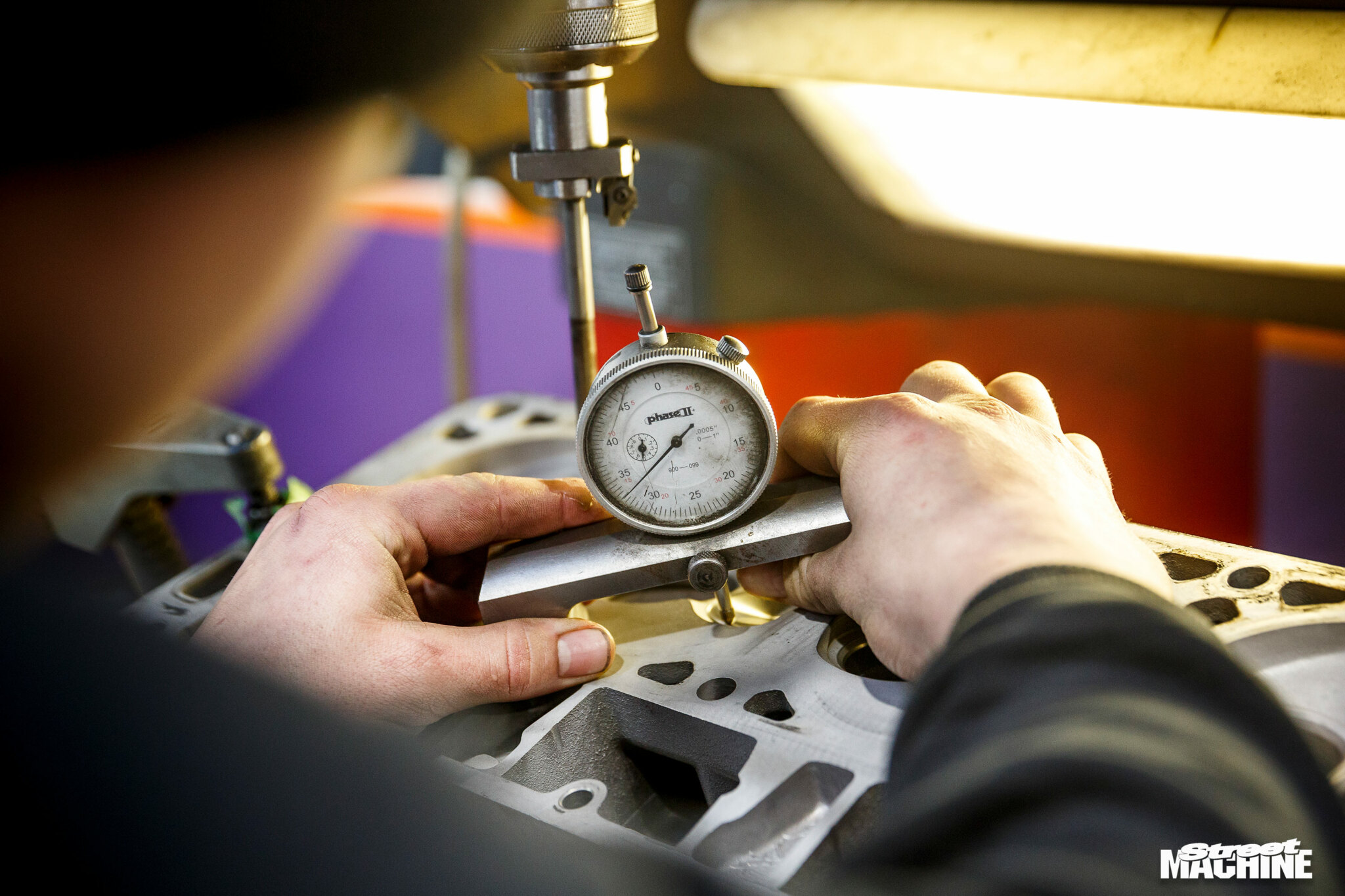
Blueprinting a stock engine: what the hell does that mean? Put simply, it’s all about returning an engine back to the original design specifications, before the factory machinists got to stuff up the pieces. I have seen short blocks where the pistons at top dead centre are still 6mm below the top deck instead of just 1mm, so you lose all that compression, and it’s purely due to rushed machining. Or crankshafts that throw 60thou too short or too long, as the operator was too tired to set his machine properly. Lots of stuff like that, mostly with the older engines, before CNC machines were invented.
So, how do we begin to correct all of this? Start by stripping the complete engine and cleaning the components. First job is to separate the conrods from the ringless pistons, as we will need to length-match both to get them all as even as possible. Using micrometers or a digital vernier caliper, measure each conrod from the top of the bearing shell hole to the bottom of the piston pin hole, and write down the results. Then, measure each piston from the top of the pin hole to the top of the crown and record those. The aim is to pair each conrod with the right length of piston so that all the conrod-and-piston assemblies are exactly the same length, or as near to that as we can get.
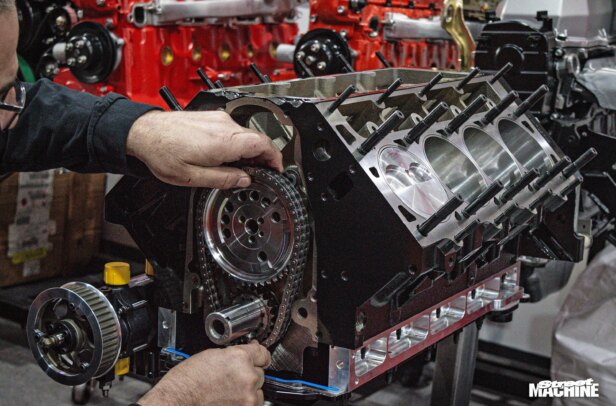
With the crankshaft checked for throw length (and machined to correct this if needed), refit the crank and the conrod/piston assemblies into the block. Then check each piston at TDC to find out how much material needs to be removed from the top deck of the block, remembering that we will need 60thou between the piston crowns and the deck to allow for piston expansion. That will get you back to the original design specification.

Next is the cylinder head. With that disassembled, have a look at the valve seats. These will most likely be way too wide and at the smallest diameter possible. These seats will almost always need to be recut at 45, 30 and 70 degrees to move the seats out to the largest diameter, with the inlet seats set to .060in and the exhausts at .120in. The purpose of this is to gain the largest valve-open area possible, which can be as much as a 25 per cent increase.
New valve springs are a good look here, too. If you have access to a valve spring load tester, check each new spring at the assembled height specification, and add shims to get them all even. You would reckon these would all be the same, being brand new, but that ain’t the case.
Next, check combustion chamber capacity. If the manufacturer’s compression ratio spec is 8:1, convert that to millilitres with a little arithmetic. Find the swept volume of one cylinder by dividing the manufacturer’s stated engine capacity by the number of cylinders, and add 6ml for the volume of each head gasket hole. Divide that according to the stated 8:1 compression ratio, and this will give you the volume in millilitres that the combustion chamber should hold.

Then, with the head upside down and dead flat and the valves installed in one combustion chamber, fill the chamber with water using a burette or graduated syringe to the manufacturer-stated chamber volume. That fluid level will almost always be well below the head face, so the amount to machine off to reach the original specs can be found by placing a straight-edge ruler across the chamber and measuring down from the underside of that with feeler gauges to just touch the fluid.
There is other stuff you can get paranoid about, like correcting the angle of the rocker arms or degreeing in your camshaft. But if your engine has covered a fair few kilometres, the camshaft lobes will most likely need regrinding to a respectable profile. That’s a job for a specialist, and it’s up you as to whether you stay with a stock profile or go with a mild sports grind. Whatever you choose, once the engine is all back together, it will finally perform as the designer intended!

Comments