
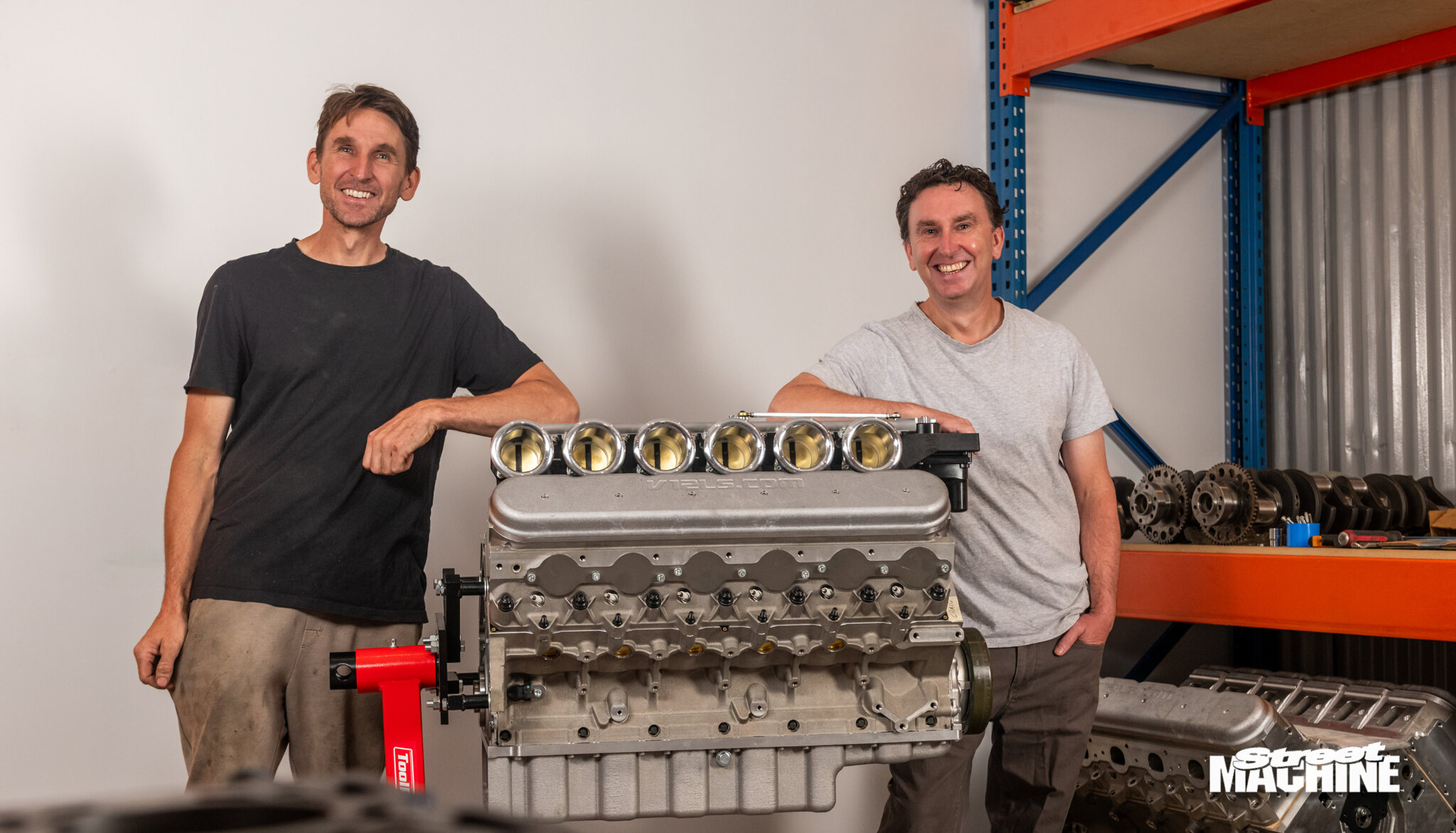
Sure, we know some of you are sick of hearing about LS engines, but this might be one time when even the most ardent hater of the late-model GM small-block needs to put the angry letter-writing pen down and check out something truly incredible. Namely, this all-Aussie, 900hp, naturally aspirated V12, based off LS architecture.
First published in the April 2026 issue of Street Machine

Shane and Matt Corish of Race Cast Engineering (RCE) in Wangaratta, Victoria have been busy with their V12 LS project since we last chatted to them about it a few years back. Their first engine broke cover around 10 years ago – a much simpler 700hp unit based around a pair of production 5.7-litre LS1s welded together – but the Corish brothers promised they were working on a spicier offering, and this all-new evolution is it.
“The first production V12 LS engine was sold to Craig Ruth of Cheetah Evolution in the USA [see more below],” Matt Corish begins. “It was pumping out over 700hp with an LS3 bore and stroke, a mild cam and sheet metal-intake, and it was ready to ship when Craig decided to opt for a big upgrade.”

While the prototype block was made from a pair of alloy Gen III LS1 blocks and cathedral-port cylinder heads, the RCE boys are now casting their own iron and alloy V12 blocks and heads off Gen IV-era architecture. Dandy Engines then handles the machining of the blocks, including line-honing and having the crank tunnels checked for true.
“We make our own patterns and use a combination of traditional and 3D-printed sand for them,” says Matt. “We cast the blocks at a few different foundries, but this engine, V12LS001, was cast at TP Castings in Dandenong.”

Displacing 607ci (or 9.94 litres), this hi-po variant of the V12 LS uses a standard LS3 4.065in bore, but with a longer 3.9in stroke compared to the Gen IV-standard 3.622in. This increases capacity while retaining an off-the-shelf 6.125in rod.
“Most of our engines use a standard-sized, LS-fitment rod and piston,” Matt explains. “You have to choose a piston to suit the valve angle, and as this engine uses an LS7-style head with a 12° valve angle, we went with forged JE pistons. Thankfully, this is all available off-the-shelf.”

The crank is a custom RCE 4340 billet unit, wearing K1 H-beam rods and JE forged slugs to squeeze 10.8:1 comp for cracking throttle response. If this engine didn’t have four extra cylinders, it would run to a fairly conventional 404ci (6.6-litre) capacity.
Some might question the use of the locally cast LS7-pattern heads, as there are fewer intake and exhaust options for this hi-po layout compared to the more popular LS3 rectangle-port style, but this choice was based purely on the amount of air the high-revving, 600-cube mill can swallow.

“We really didn’t want too many head castings in our inventory,” says Matt. “When we started this program, the LS7 head was the best-flowing LS head in the GM range, and we could have Yella Terra machine the exhaust valves to suit our smaller 4.065in-bore alloy blocks [the 427ci LS7’s bore is 4.125in]. Yella Terra ran the heads through their CNC program, while Matt Mundie in Wangaratta finished them off with some mild port work and dual PAC valve springs.”
The engine was assembled by Brett Niddrie of BNR Engines, with the cam upgraded to a 247°/257°/110° hydraulic-roller stick from Clive Cams to complement the high-compression, deep-breathing package.

“It’s got a different beat to the idle, and even with a little cam, it sounds like it’s got a really hot cam in it, because of that odd firing pattern,” says Matt. “We were cruising a different V12 LS in our Camaro at Summernats, and people wanted to know what was in it, because it sounded pretty nasty.”
As Matt intimated, that unique sound is assisted by having to run an odd-fire crank layout. Due to the 720° ignition cycle, traditional V12s used narrower valley angles closer to 60° (720/12 = 60) to maintain an even firing order, which isn’t possible with the V12 LS, which retains the LS’s 90° vee.

The 30/90 firing arrangement doesn’t hurt the engine’s smoothness, though. “These are balanced better than a V8,” says Matt. “An inline six is balanced on all three orders of balance, whereas a V8 is not. That means you can add another inline six at any bank angle and they will stay balanced. So, our V12 will also remain balanced.”
Dave Forrester from Wired By Dave made a loom to connect the V12 to the Haltech Elite 2500 ECU, ICE Ignition smart coils, and Bosch LS injectors from QuickBitz. Matt and Shane then took the 10-litre behemoth out to see what it’d do.

Danko Knezevic at Adicted Performance handled the dyno sessions, with the long-tube headers from GP Performance finally running out of headroom around 900hp, according to Shane. After a break-in session, Danko worked his magic to achieve 900.2hp at 6600rpm and 800.9lb-ft at 4700rpm.
This engine has now been sent Stateside, where Craig Ruth is installing it into a bespoke aluminium supercar of his own design. Given the amazing howl from Race Cast’s entry-level 700hp packages, we can’t wait to see videos of this 900hp big-banger proudly flying the Aussie flag in a one-off speed machine.
IN DETAIL:

While Matt and Shane’s initial V12 LS prototype used the 5.7L LS1 block and head architecture, their production mills are based off the Gen IV platform instead, including LS3-style blocks and these enormous LS7-style ‘square-port’ heads. Photo: Jesse Marlow.

While they were getting cast blocks and heads made, the RCE crew also had Hasco Foundry in Ballarat make many of the engine’s ancillaries from cast alloy, rather than machining them from billets. Along with the cool slimline rocker covers, the baffled 10L cast sump looks like an OEM part.

Running LS7-pattern heads has many high-performance benefits due to them being set up by GM for high-rpm, naturally aspirated performance. One of these is the factory 1.8-ratio rocker, which offers higher lift than any other production LS engine. The RCE engine uses Yella Terra rockers in that spec.

The Yella Terra CNC port program has been used inside the RCE-cast heads, with a little finishing work by Matt Mundie. The intake valves remain 55mm LS7 big-bangers, while the exhaust ports wear 39mm units due to this engine’s smaller 4.065in bore compared to an LS7’s 4.125in bore.

Lengthening an engine by a quarter isn’t just a matter of stretching everything out. Matt and Shane redesigned the LS crank and cam to suit, and get them made locally in Victoria. Photo: Jesse Marlow.

Iron sleeves are fitted to the blocks after the castings are poured, and machining then begins, with this engine using a 6.2L LS3-sized 4.065in bore. Retaining the LS architecture opens up a world of torque converter, clutch and transmission options. Photo: Jesse Marlow.

“Whenever we’re building one of these engines, we laugh that if it was a V8 we’d be done by now,” Matt says. “The extra four cylinders just take so much more time to do, and more parts to put into them. It’s basically one-and-a-half times the balancing, machining, parts assembly, and measuring, and it’s a bit of a mental thing to get past.”

Adding four cylinders to an engine’s firing order has dramatic effects on the balance, and the sound. “This is a 90° odd-fire V12 with a 30°/90° split, so it sounds quite different to other narrow-angle V12s from, say, Ferrari or Lamborghini,” says Matt. “Some people say it sounds like a hot six from the speedway.”

“Harrop has done two Hurricane intakes for us now, with the first made from two V8 manifolds sliced down the middle, but that was fairly involved, I think,” laughs Matt. “They’ve tooled up with us to create these engines, and that makes it a much simpler task. The first sheet-metal intake manifold and single throttlebody was at its limit around 750hp.”


The alloy V12 long motor weighs in at just 191kg (or 265kg for the iron long), which is a scant 11 kilos heavier than the LS1 equivalent (179kg) but 24kg lighter than an iron 6.0L LS long motor (215kg), and a whopping 120 kegs less than an iron big-block Chev (311kg). “We may drop the iron-block V12 in the future, as everyone who has bought one did so purely because they couldn’t wait for an alloy block to be ready,” Matt says.
ACCIDENTAL HERO
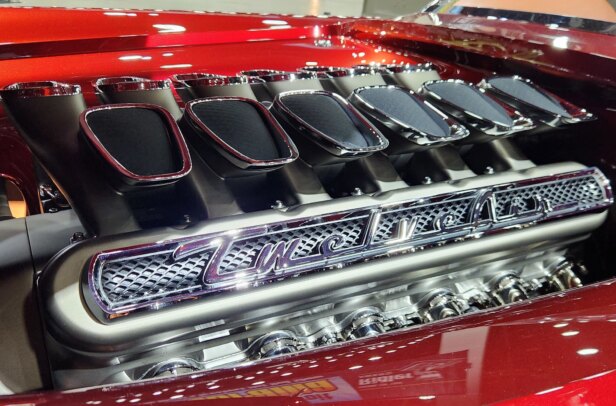
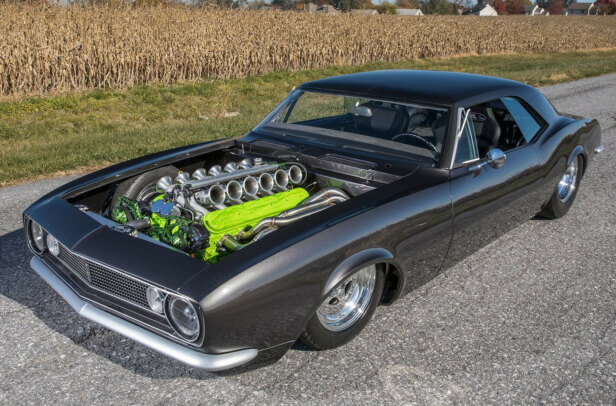
Craig Ruth of Cheetah Evolution in the USA used the first production version of the Corish brothers’ V12 LS for his wild Cheetah build, which was shown at SEMA 2018 (pictured below).

Bill Thomas built the original, Chevy-powered Cheetah race car in the early 60s, primarily as a styling exercise to show General Motors management the kind of advanced projects and concepts that Thomas’s business could produce. Having already built some super-advanced GM-linked race cars, Thomas used his relationship with Chevrolet’s Vince Piggins to get his hands on some spicy 327ci small-block V8s, four-speed transmissions, and independent rear ends from the then-new Corvette. Spindles and brakes were sourced from other Chevy performance models, but the key to the Cheetah was the super-advanced (for the time) TIG-welded tube chassis.
The engine sat right in the middle of the frame, with the headers running over the top of the driver’s legs and the output of the transmission connected directly, via universal joint, to the front of the diff centre. While the first body was made in aluminium, subsequent bodies were made in fibreglass, as it was quicker, cheaper, and easier to produce.

Even though the chassis didn’t have anywhere near enough rigidity to handle motorsport, the decision was made to start circuit racing the Cheetah, and the 450hp, 775kg featherweight certainly made for a wild time on the track. Although the Cheetahs were reportedly much faster than their Shelby Cobra rivals, owners had to add extra frame bracing so the cars wouldn’t fold up mid-race, and the heat in the cabins caused more than one case of heatstroke.
Unfortunately, 1963 was a bad year to be tied up with GM, as the company’s racing ban put a halt to all kinds of awesome projects across many of its divisions. It is believed 23 Cheetah chassis were completed, but since 1965, plenty of replicas and continuations have been built.
Comments