
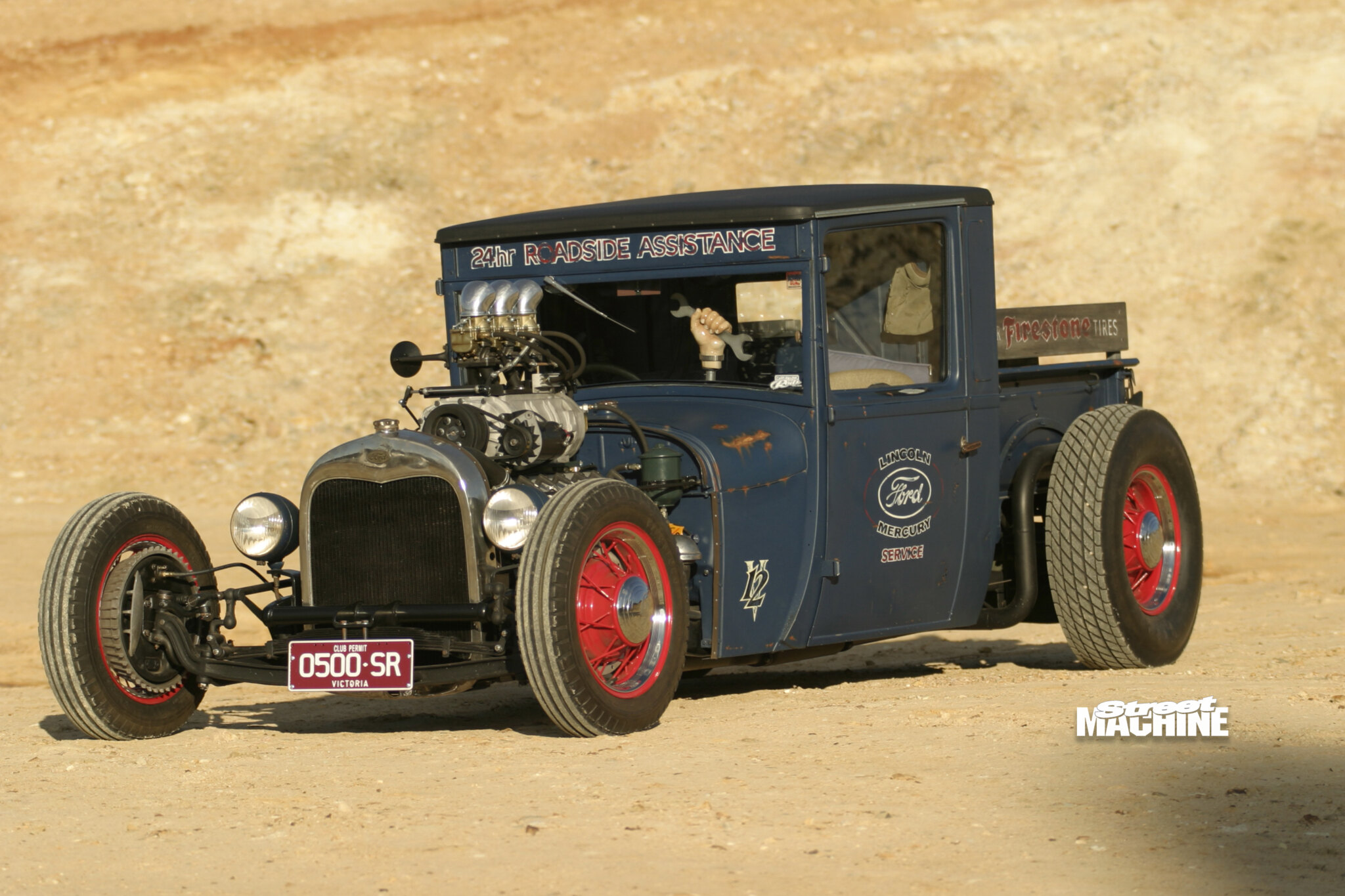
First published in Street Machine’s Hot Rod magazine #1, 2004
Well you’ve heard the story of the hot-rod race that fatal day, When the Ford and the Mercury went out to play.
This is the inside story I’m here to say, I was the kid that was a-drivin’ that Model A. It’s got a Lincoln motor and it’s really souped up.
And that Model A body makes it look like a pup.
It’s got twelve cylinders, and uses them all, With an overdrive that just won’t stall.
Twelve cylinders? That’s what Charlie Ryan said in his original version of Hot Rod Lincoln, penned in the early ’50s. His song never cracked the record charts, but Commander Cody and the Lost Planet Airmen were more successful with a version years later that was pretty much identical to the original but for the inexplicable change to eight cylinders.
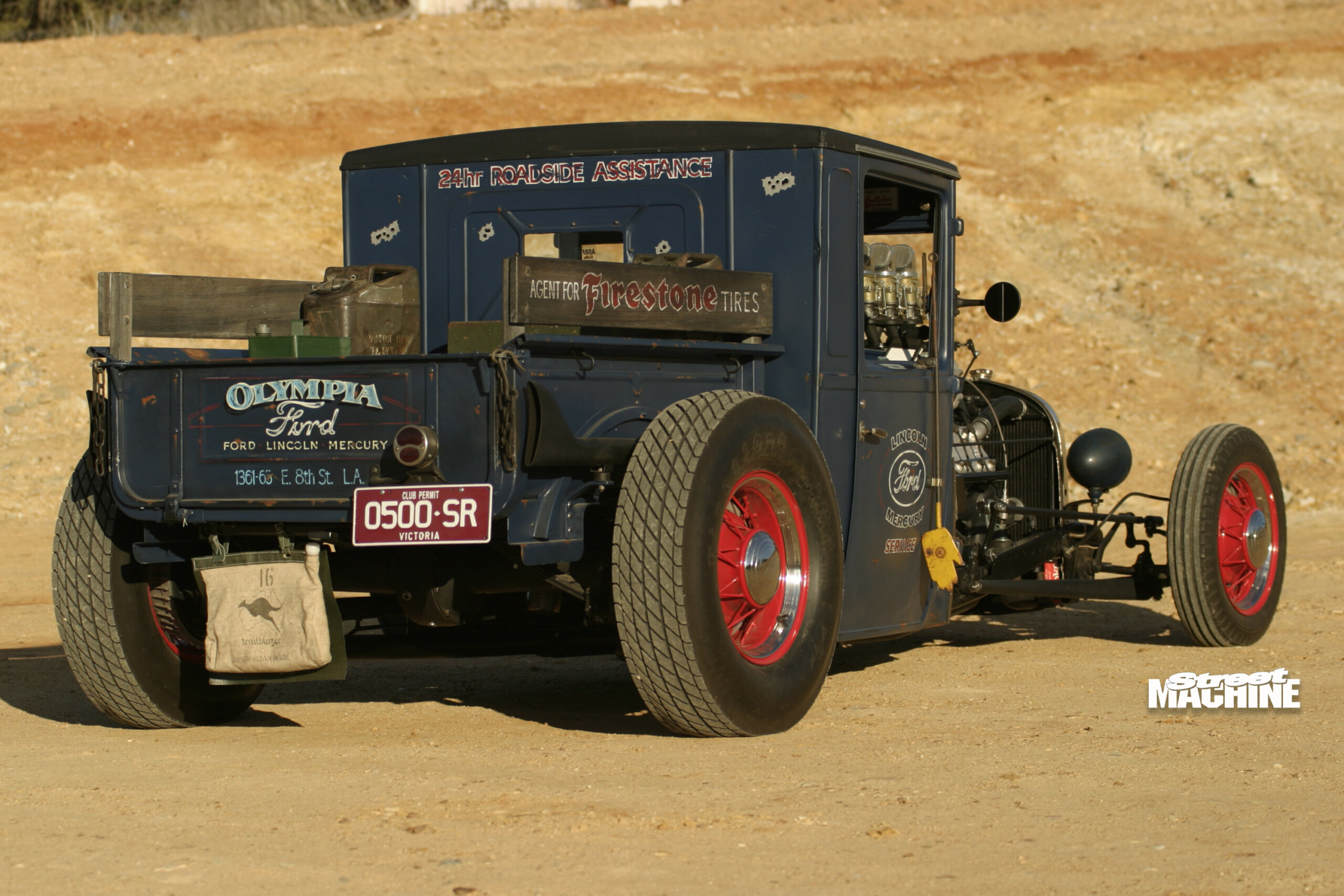
Rod Hadfield, never a bloke to do things by halves, wasn’t fooled, and built this little pup with the full complement of cylinders.
Rod was listening to Ryan’s tune on the wireless (as Rod calls it), and thought to himself, “Shit, who’s ever done the Hot Rod Lincoln?” There had been a few rods called Hot Rod Lincoln, but all had overhead-valve engines. Rod’s creative juices started flowing.

Amazingly, this project came together in only seven months, thanks in part to the talents of everyone at Hadfield’s Castlemaine Rod Shop and also to the fact that Rod happened to have a lot of the “junk” that went into this rod lying around. After the massive effort that went in to his amazing Merlin-powered ’55 Chev, Rod wanted something quick and easy. Only Rod could consider a V12 Lincoln rod to be quick and easy.

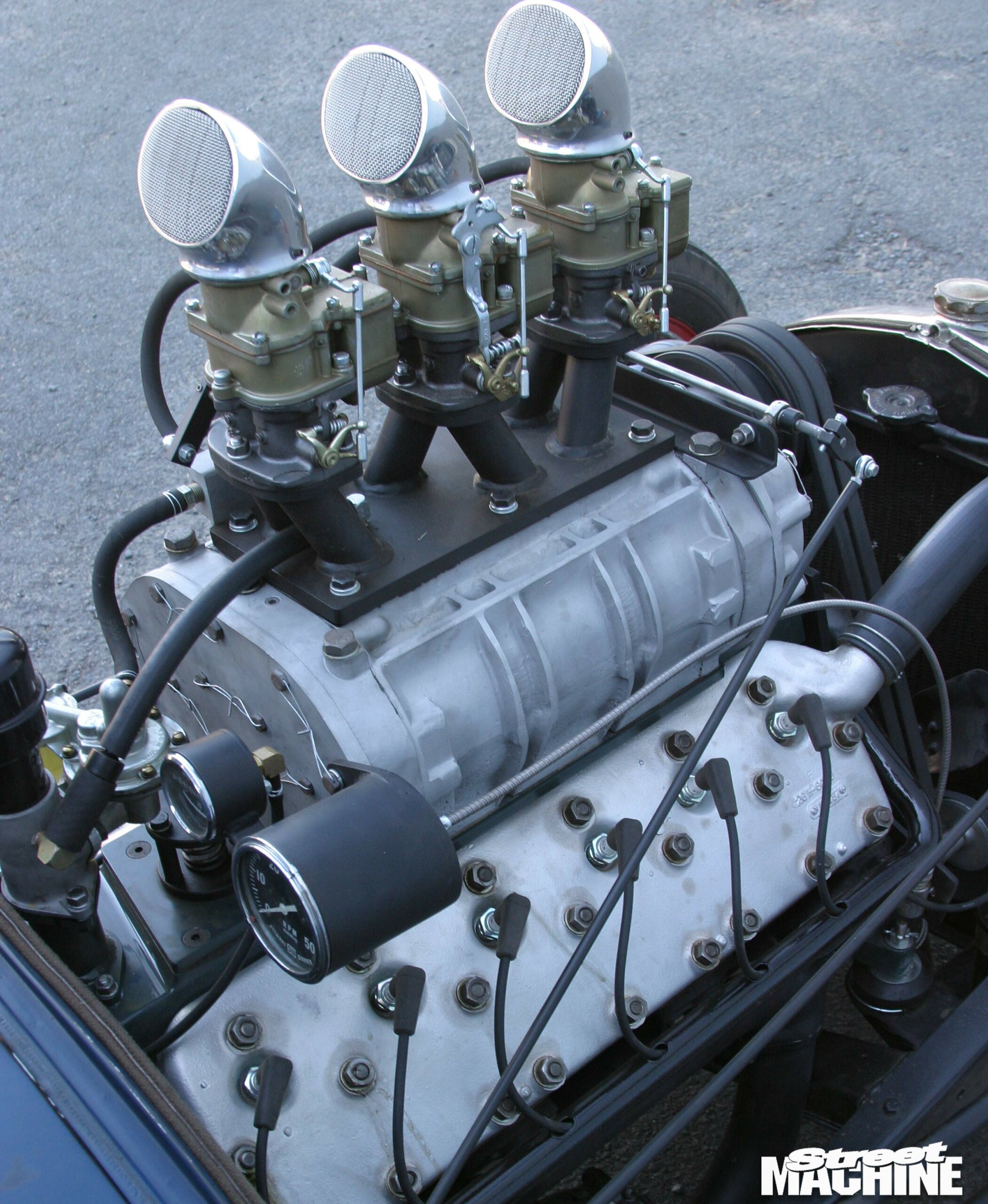
And only Rod would happen to have a 1946 flathead V12 Lincoln engine lying around. He knew it would come in handy some day. When that day arrived and Rod took a closer look, he discovered it was very, very sad.
“It was the biggest problem, biggest heartache, and the most capital has gone into the engine,” he says. Getting it up and running was no mean feat, requiring substantial research and a lot of help from r… r… r… restorers. The saga reads like a cross between a Boy’s Own adventure and an episode of CSI.
Rod knows a lot of stuff about cars and engines, but nothing about flathead Lincoln V12s. It seemed no one else knew anything, either. Fortunately, Rod did know of a runner just down the road from his place.
Unfortunately, the owner had died and the car had gone to a new home. Fortunately, the widow put Rod in touch with the new owner, who told Rod that Pearce’s Engine Reconditioning had rejuvenated the engine. And Pearce’s said they’d be happy to do another.

All the parts needed are available from the USA, but they’re not cheap, especially when you need to buy them by the dozen!
Bolt-on kits for a blower are not so easy to get – and not just for any blower, but a suitably beaten-up 6-53 GM unit that Rod sourced from Bob Fisher. The blower manifold was machined from billet aluminium and painted to match the engine. A Gilmer drive just wouldn’t have looked right, so an old-school twin V-belt pulley set-up was fabricated. The intake was also scratch built to mount the trio of Stromberg 97 carbs. Water pumps were fabricated with modern bearings and seals.
The ignition was another major hurdle. Of course, the engine ran a 6V electrical system, but to make it even more confusing, the coils only ran off 4.5V. If it wasn’t for the wealth of knowledge of Willy Farnell from Ignition Developments, this engine may never have been given the spark of life. The original distributors (one for each bank) were modified to run on 12V coils, all without modifying the distributor caps. Essentially, the engine is two six-cylinders that share a common crankshaft and, according to Lincoln Car Register president Graham Allum, who also gave great advice, it can run with one head removed. He’s speaking from experience!
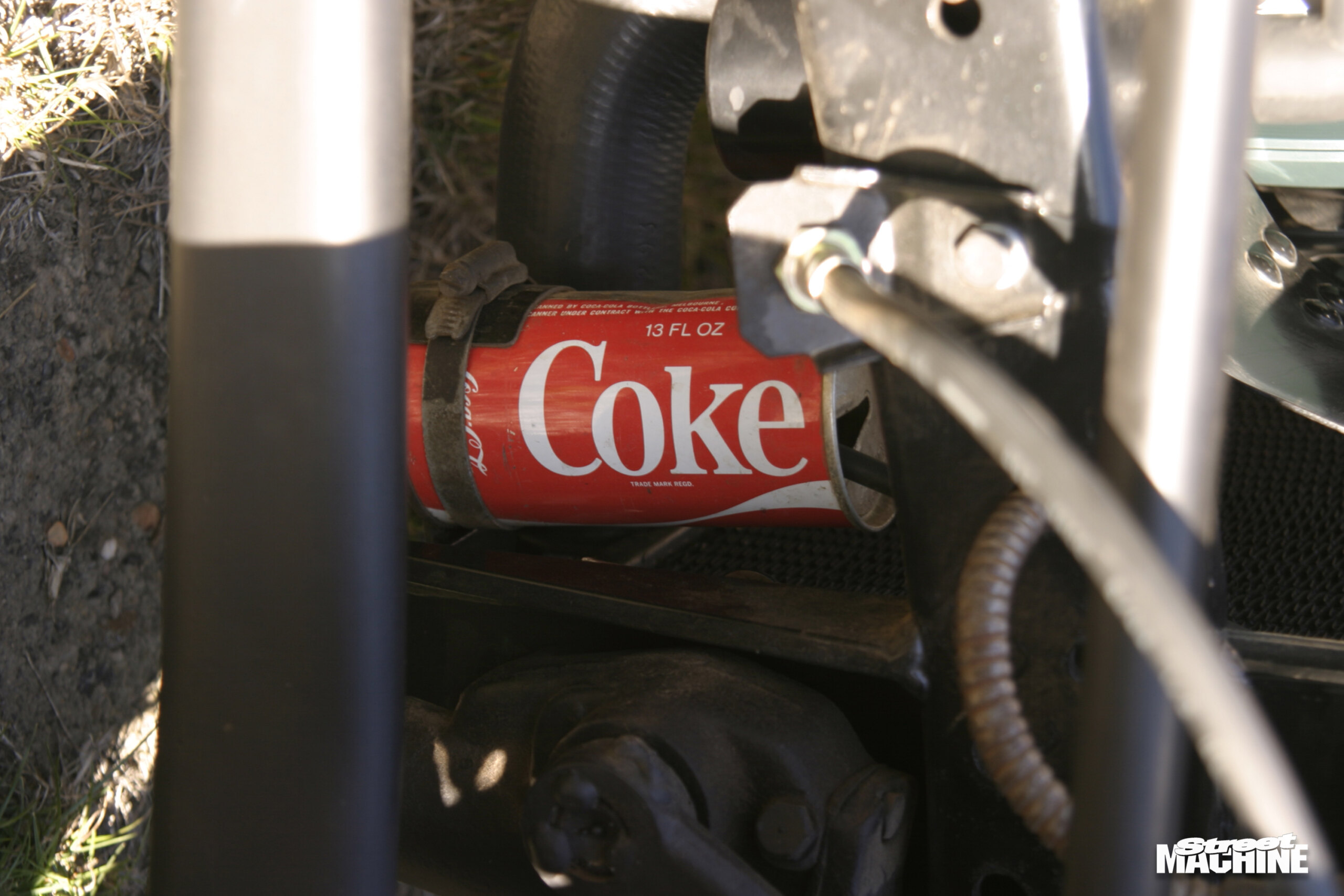
Rod wanted to keep his creation all Ford but couldn’t find a suitable gearbox. He decided the best option was a four-speed Saginaw with a low first gear, as there’s nothing worse than trying to drive in traffic with a high first gear ripping out the clutch. But Rod kept breaking gearboxes, and finally found out that Lincoln engines and gearboxes were machined together, so although the Saginaw was square with the block, it wasn’t square with the crank. Took them all week in the CRS workshop to figure it out after pulling it all apart and measuring everything.

Charlie Ryan did build the car he sings about, and it had a coupe body. The more Rod thought about it, though, the more he reckoned a pick-up would better suit his version. After looking at half a dozen bodies, he came across this one, which was so good that Rod reckons blokes would’ve cried if they’d seen them cutting out the mint floor in preparation for the channelling job. All the dents and a small amount of rust were left as is, with the only major change being the creation of a new steel roof.
Rod can’t talk highly enough of the job the boys at Waddington’s Smash Repairs did in replicating the original canvas-covered roof. As Rod says, “I don’t mind the discomforts of a rat rod and I don’t mind water coming up from underneath, but I f***ing hate it coming down on top of you.”

The tray was shortened nine inches to get the proportions right, then the sides were swapped left to right so the fender swage lines matched the wheels better. The grille shell had been in the foyer of Rod’s shop for years, and is wrapped around a radiator from Aussie Desert Coolers.
The shop also already had one of the two Model A chassis used, and the other was at good mate Norm Hardinge’s place. The chassis were joined just ahead of the firewall and pie cut and radiused to give the front rails a nice upward rake and get the front down real low. The remains of one chassis was used to box the other, making it look almost as if the factory did it that way. The rear was kicked up 13 inches, which not only lowers the car but also creates room to store essentials and hide the battery.

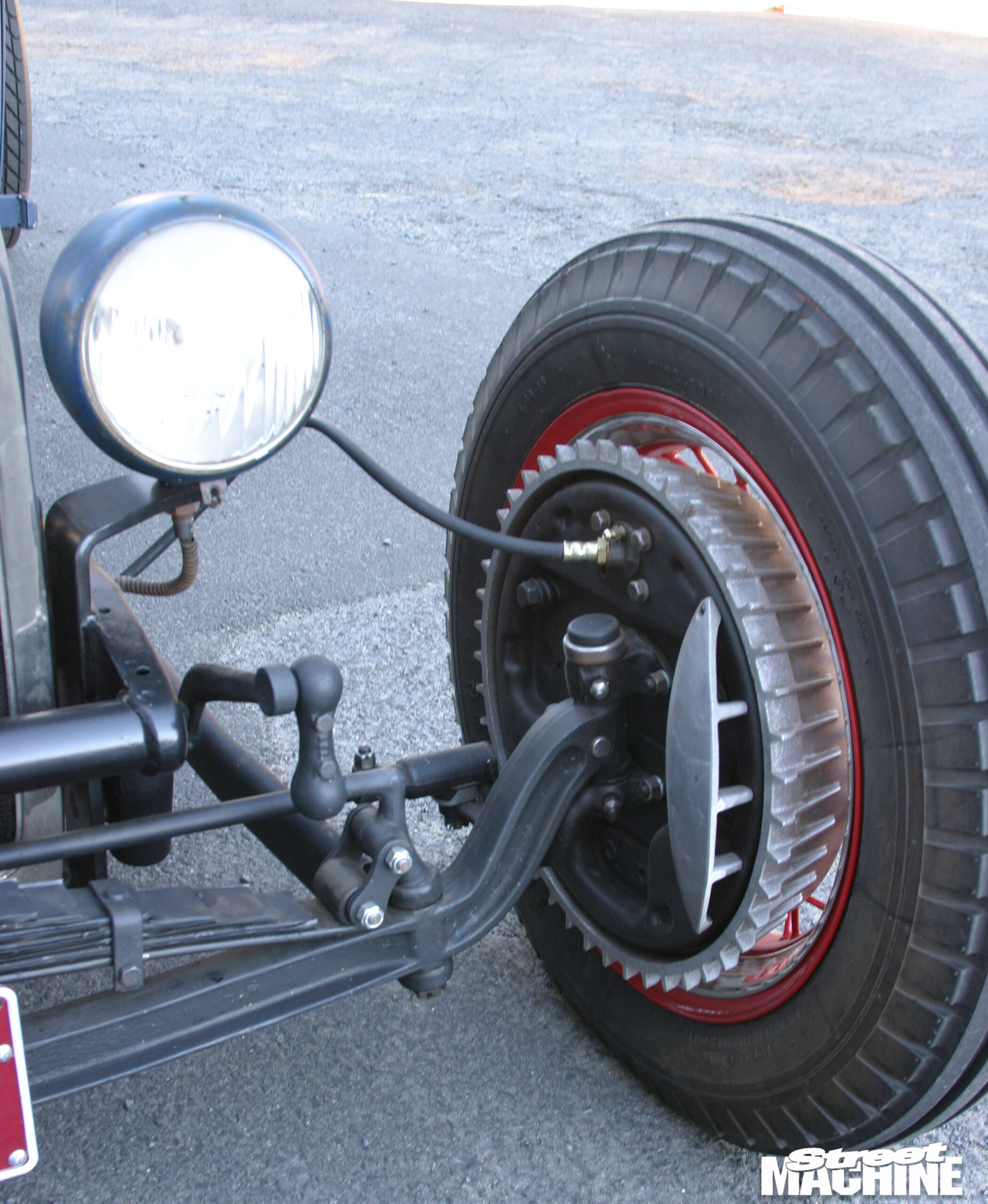
The running gear for this unique little truckster is pretty standard hot rod fare with a few oddball bits thrown in for good measure. The front end is from a ’34 Ford that has a two-inch drop. It’s mounted suicide style with split wishbones that utilise Ford truck tie-rod ends to avoid bind. Rod used mechanical dampers all round, and the front ones mount to a hand-crafted bracket that also supports the headlights, grille and radiator, while adding strength to the chassis.
The steering box is from a Kombi and is interesting in that when you turn right, it turns left. Rod couldn’t believe how perfectly it worked out, even lining up with the original hole in the firewall.

The rear end is out of a ’48 Ford pick-up, which has the advantage of running an open driveline instead of the usual torque-tube set-up. It runs a transverse spring and radius rods that are strengthened with steel rod.
Rod wanted something completely stupid for the gear shifter, so he sacrificed an old spanner and had a mould taken of his left hand clenched in a fist. The mould was applied while Rod was at the shop, on the phone. All was going well until they removed the mould – along with every hair underneath it! Rod yelled like he’d just been shot, while still on the phone to a customer. Not sure if that customer ever called back.

There are so many clever little tricks and interesting little pieces on this car that you really have to spend hours taking it all in. Rod has really gone to a lot of trouble to keep everything true to a theme and an era. Things like the ’50s-style finned brake covers and scoops. The exhaust ends are hand-made fishtails, and Rod loves the effect they add.
In the cab, Austin Healey seats are covered in specially stencilled hessian sackcloth. There are antique hooks to hold spare belts and an engraved antique clip to hold speeding and parking fines. Another neat trick is the use of American-style jerry cans as a reserve fuel tank. The pick-up still uses the original cowl-mounted fuel tank and the reserve is switched on via an antique tap.
Paint it bad
Believe it or not, the paint is one of the outstanding aspects of Rod’s Hot Rod Lincoln. It looks for all the world like Rod has grabbed an old, unrestored service truck and plonked it on a crazy hot rod chassis. Nope, far from it.
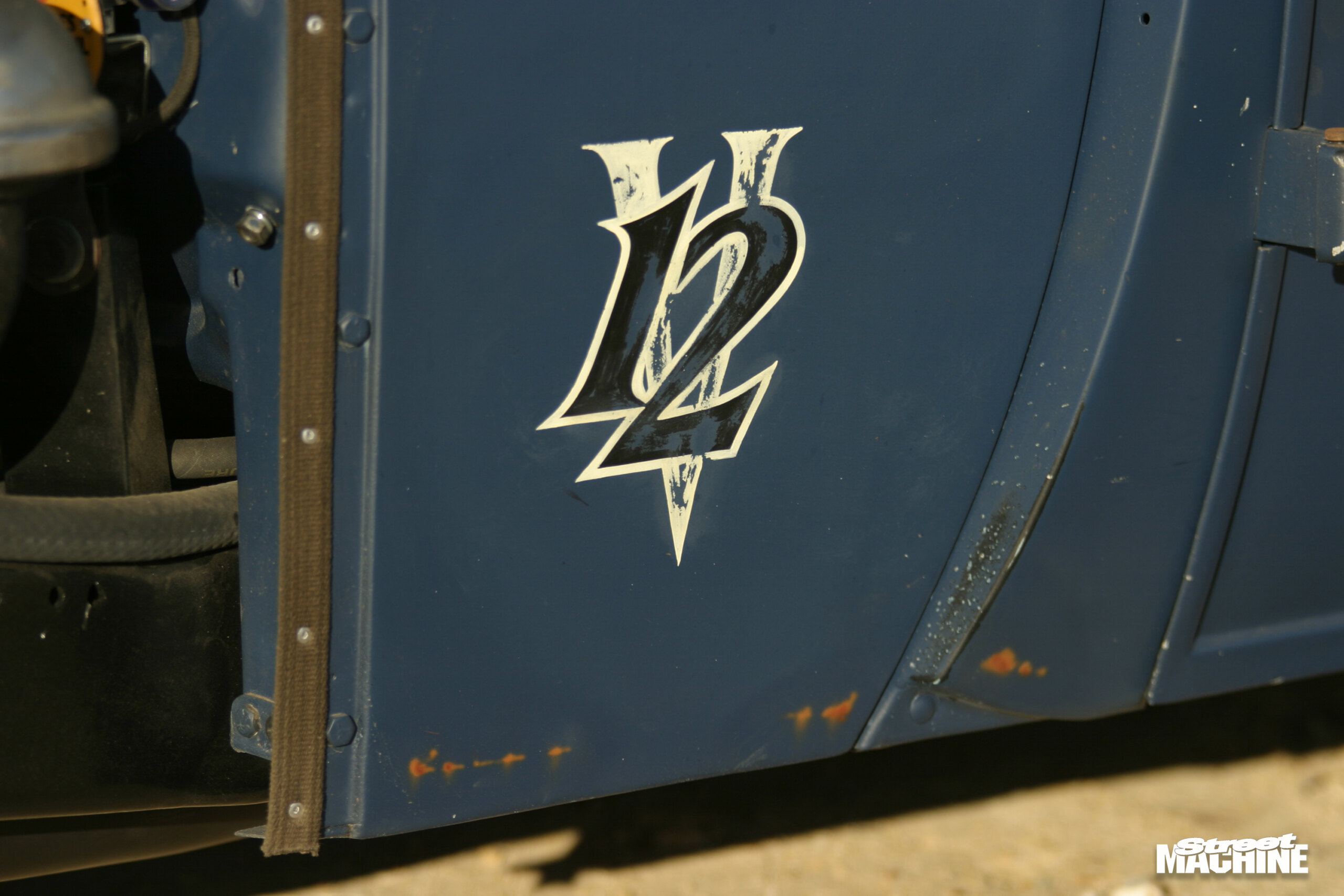
Rod spied a painting by Philip Berry while at John’s Rod & Custom Picnic. He thought it was the best painting of a car scene he’d ever seen. Rod asked Phil if he would be able to “paint rust and stuff and generally make a car look like crap”. Phil said yes, so Rod sent him an old boot lid with some samples of the lettering he wanted. The boot lid is now on display at Rod’s shop and the artist’s skill is on display on just about every part of the pick-up.
The faux patina extends to all parts of the body and even some of the accessories. Rod had the chassis powder-coated black, and all the other black parts Jet-Hot coated, the dull finish ideally suited to the rod. That fine shade of Fordson Blue was sourced from the headlights, which came off a Fordson tractor. Rod’s probably right when he says there wouldn’t be any other hot rods painted that colour.

The only way to finish a story on a Hadfield car is to look at what’s next on the agenda. There’s always something on the go. Rod’s still got the Meteor tank engine he was originally planning to put into the ’55 Chev, and figures it will look right at home between the chassis rails of a 1920s-style beach racer.
Rod Hadfield
Model A pick-up
| Colour: | Fordson Blue |
| USING THEM ALL | |
| Engine: | 1946 Lincoln V12 |
| Blower: | GM 6-53 |
| Carbs: | Triple Stromberg 97s |
| Gearbox: | Saginaw four-speed |
| SAFETY TUBES | |
| Chassis: | Model A |
| Front end: | ’34 Ford, dropped two inches |
| Rear end: | ’48 Ford |
| Steering: | Model T wheel, Kombi box |
| TYRES FAIR | |
| Dampers: | Mechanical, MG (f), Willys (r) |
| Brakes: | ’48 Ford |
| Wheels: | ’35 Ford, 4.5×16-inch (f), 5.5×16-inch (r) |
| Tyres: | Firestone ribbed (f), Firestone Dirt Trackers (r) |
| LOOKS LIKE A PUP | |
| Body: | Ford pick-up |
| Shifter: | The Hand of Rod |
| Seats: | Austin Healey under hessian |
| Instruments: | Original plus external tacho and Air Blower gauge |
GUY BESIDE ME
As well as everyone mentioned in the story, Rod has a big rap for Con Mantzaros of the ASRF’s street rod rego scheme for his assistance in getting Hot Rod Lincoln registered quickly and easily.
.
Comments