
Believe it or not, 1997 was almost 30 years ago, and that’s how long we’ve been enjoying General Motors’ compact, lightweight pushrod V8 engine platform, the LS. It was GM’s first big, clean-sheet redesign of their small-block architecture since the 50s, and we still marvel at how easily the Gen III and Gen IV LS- based mills can be fettled to suit any project or budget.
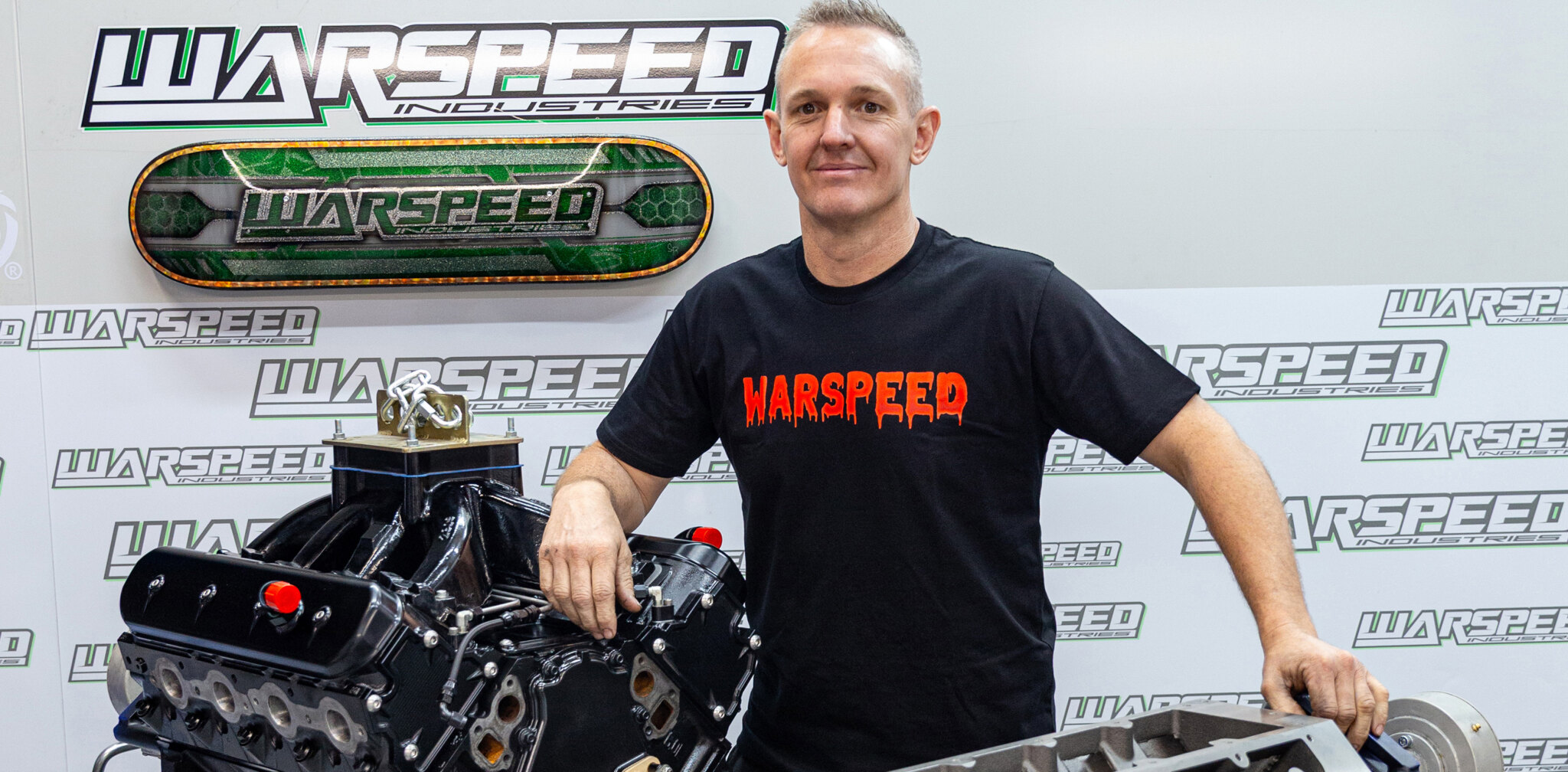
Troy Worsley of Warspeed Industries is one of Australia’s leading LS engine builders, renowned for pumping out everything from cam-only LS3s for the Superute race category to blown alcohol burnout combos and full-house 427ci screamers used in desert-racing trophy trucks. We asked Troy to give us his recommendations for making good power from an aspirated, street-based, pump-fuel LS, from entry-level through to max-effort combos.

1. This iron-block 6.0L runs an LSA steel crank; 13.5:1 CP pistons; Callies Compstar rods; a modified Canton pan that’s been extended for capacity; ported factory 241 cathedral-port heads with upgraded Ferrea valves and springs; an Edelbrock single-plane intake; and a Holley carb. Making 530rwhp, the mill sees weekly use on the street and in burnouts in a VH Commodore.

2. This Dart 434ci combo will run E85, so it has custom 13.8:1 Diamond pistons, Frankenstein cylinder heads from the USA and a big 268°/276°@0.50in solid-roller cam, on a 112° LSA and 780thou lift. “It’s got some decent camshaft in it, that’s for sure,” Troy laughs.

3. Troy says the factory LS7 lifters are the go-to for all hydraulic-roller combos until you start getting properly spicy. “Once you’re beyond 700hp, you really need an aftermarket race lifter like a Johnson or Lunati,” he says.

4. “These Dart LS Next blocks don’t have the deep skirt housing the crank tunnel like on a factory LS block,” says Troy. “These blocks are missing an oil gallery in that skirt, so if you run a wet sump, you have to pump oil out the front of the block and feed it in the back. Where you pump it out is where the alternator is in most right- hand drive applications, so the dry sump overcomes that problem.”

5. “The goal for this 434ci combo is to make between 850hp and 950hp, and it’ll be a pretty wild thing with its billet twin-throttlebody manifold,” Troy says. “The customer has the quickest VF GTS in Australia, known as FUBARA, so he pushes everything he owns.”
ENTRY LEVEL
450-550HP
For reliable late-model power in your weekend cruiser, it’s hard to go past the turn-key simplicity of a cammed LS. They’re cheap, readily available, fiercely reliable, and able to make 400-500hp in near-factory guise.

“A 6.0-litre block is the best to get, as you’ve got capacity there and good heads, and you don’t have the problems of sleeves splitting like in a 6.2-litre block,” Troy advises. “If you’re starting from scratch with a build, a 6.0-litre is the best factory block in my opinion.”
While the basic LS rotating assembly is nickel-tough, any engine that is more than a decade old is going to need a major service. “I swap the whole front and rear cover as a unit with genuine GM parts, because it’s more cost-effective,” Troy says. “They’re aluminium, so they bend over time, and the complete cover with the seal already fitted is only slightly more expensive than the seal on its own.”

Changing the cam out for something that doesn’t have the lift and duration of a broomstick is also key to a getting a powerful, hot-sounding LS. However, Troy cautions against going hog-wild with the specs. “The cam will need to be kept between 210° and 238° at 0.50in to retain the stock pistons,” he says. “I use LS7 lifters and their buckets (or Caddy lifters that superseded the LS7s) in all my combos except the real big-banger stuff. They just work so well and are a great, cost-effective solution.”
Combine those suggestions with a new, quality single-row timing chain set, along with fresh head bolts, gaskets and upgraded valve springs, and you’ll have a package that will make as much power as GM’s baddest production big-block from the muscle car era but still be turn-key reliable and have brilliant daily driver road manners.


“To get 500hp from these engines is simple,” Troy says. “Look at a factory Chevrolet Performance CT525 crate engine; it’s pretty much a standard 6.2 with a camshaft upgrade, and it makes 525hp as a controlled spec-racing engine. With 6.0 litres, you’re gonna have more camshaft, but if you do a cam and head package, you’re making over 500hp at the crank every day of the week, still with a standard intake manifold that’s easy to fit under the bonnet of almost any street car.”

(Above) “When you’re buying a second-hand engine, it’s cheaper to buy an iron block compared to an alloy block,” Troy says. “Iron blocks are a bit heavier over the nose of the car, and in a naturally aspirated combo, the strength isn’t really needed. There is also a byproduct that it’s a little bit harder to keep them cool, because iron retains heat.”
MELLING SELECT OIL PUMP
The problem with making more power is that it also means higher revs, which can spell trouble for the standard LS oil pump, as Troy explains. “A standard LS pump will get to about 6500rpm and cavitate,” he says. “We run standard-volume Melling Select oil pumps in most of our engines, and we increase the volume of oil in the engine so that we’re always going to have oil around the bearings. High-volume oil pumps have wider gears, and they will move the cavitation problem up the rev range, but you’re then moving more oil to the top of the engine. We don’t want oil up top; we need it around the bearings, not the pushrods.

“Generally, you find people start running higher-volume oil pans, but then they start emptying their sumps quicker. A factory high-volume pump from an LSA has a 33 per cent higher volume than a factory naturally aspirated pump, and if you run it flat-out, it’ll take 30 seconds to empty the pan, because oil is pressure-fed out of the pump but drains back with gravity.”
MID-RANGE
600-700HP
While it’s easy to make 600hp with a bolt-on blower, Troy says plenty of people still love a tough aspirated engine in their street car, and an aspo LS can make that sort of power pretty easily.

“Strokers work in street cars over 500hp,” Troy advises. “The more power there is down low, you’re going to gain torque; a 346ci LS1 becomes 383ci; a 6.0L [366ci] becomes 403ci; and a 6.2L [378ci] LS3 goes up to 416ci. You’re already buying rods and pistons, so add $2000 more for LS3 goes up a stroker rotating assembly and you’ll gain a heap of cubes and torque.”
Having built so many engines for all manner of applications over the years, Troy knows the precise engine specs he’d suggest to a customer looking for a 600hp aspirated deal for the street. “For a 600hp, 6.0L-based 403ci stroker, I’d run a Callies crank and rods, and JE pistons,” he says. “I’d keep compression between 11.5:1 and 12.5:1, but that comes down to camshaft selection. In a 400-cube stroker with 12:1 comp, I’d pick a cam around 246°/254°/112°, as it will have a nice, broad power range. Traditionally, a Holden or Chev would be around 108°-110° LSA, but they fall over by 6300rpm, whereas an LS carries more rpm and more power, so you need the broader spread of the cam lobes.”


Troy reckons there’s no need for a race-spec cam or exotic head casting for a 600-horse aspo package, thanks to the LS platform’s solid base engineering.
“On this mid-tier combo, you could run a factory rectangle-port cylinder head with a port program through it, and then upgrade the valve springs,” he says. “We’d want to know if it’s going to be used at events like Powercruise or in burnouts, as we’d then typically change the valves to Ferrea stainless items. It adds a little bit of weight, but it also adds security, as factory hollow-stem valves can break the head off.


“I’d also stick with the LS7 lifters in anything up to 700hp, and we use the same Cloyes single-row C5R timing chain on almost all the engines here. These were engineered for the Le Mans Corvette endurance racing engines.”
Mr Warspeed says the factory rockers are good bits of gear, so they’d be retained, albeit with a trunnion upgrade to remove the weak needle roller bearings. “They’ve got a 1.7 rocker ratio on rectangle-port heads; we actually won Horsepower Heroes at Summernats 37 at 2109rwhp with factory GM rockers [in Lee Povey’s twin-turbo, Dart LS-powered VL Calais]. The factory intake manifold is also fine at this power level. You can put a 102mm throttlebody on it, but you’ve still only got a 90mm opening in the intake.”

1. “Every engine we build gets a four-port steam kit,” says Troy. “Bleeding air out of all four corners eliminates the chance of having air pockets in your cooling system that can get stuck in the heads. It can really help the stability of the head gaskets, as the rear two cylinders have less chance of getting hot.”

2. “Burnout cars run higher rpm for longer periods of time than a drag car. So, your valvetrain needs to be quite good,” Troy says. “We set up most of our burnout cars as hydraulic-roller combos, because an LS revs very well, so it’s more likely to hit the limiter. A solid-roller won’t accommodate that with their spring tension, but the hydraulic-roller lifter can cushion some of that shock.”

3. Troy suggests upgrading Gen III motors with a front-mounted cam sensor and cover plate from a Gen IV engine for a more stable output, rather than relying on the cam sensor in the back of the block. He also upgraded this Gen III with a Gen IV-based timing system on the front (matching the 58-tooth reluctor wheel crank) to improve the timing control.
JE PISTONS
The more stroke you put in your mill, the lower your piston heights need to be in order to keep them within the 9.240in LS deck height. “If we go up more, we’ve got to crush all that stroke into a smaller volume, so the pistons get shrunk to make that happen,” Troy says.

“Depending on the cylinder heads we’re using, the valve location can also be different, and that might mean taking an off-the-shelf JE piston and having the valve pocket modified to suit the head, or changing the dome volume from a flat-top to a 5cc positive crown.
“It is important to chase compression ratio with the piston, not the cylinder head,” Troy continues. “On entry-level combos, most people will chase comp by skimming their factory heads down, but this weakens the head and reduces your clamping pressure, which is incredibly important on these top-end engines. The deck thickness on a factory LS head is only 350thou, whereas most aftermarket cylinder heads are 750thou thick, so if you’re skimming OEM heads, you’re going to blow head gaskets.”
MAX EFFORT
700HP+
A full-on, balls-to-the-wall LS will be an angry, complicated beast, but Troy has plenty of customers wanting to make up to 950hp without power-adders, or spin their combo to 9000rpm.
“Max-effort combos always use an aftermarket race block,” says Troy. “The blocks I use are application-dependent, because the combo might suit a cast-iron Dart better than a Dart aluminium block, or maybe an LSR block has a specific feature we need for that engine to do what the customer needs from it.”

For a 700hp+ aspo street car build, Troy would go for a Dart SHP block, Callies Magnum eight-counterweight crank, Callies Compstar rods, coated ACL bearings, and JE pistons, along with a big solid-roller cam to really push the rev window. High-end bushed tie-bar lifters are a must with the cam specs and rpm limits at play here, and Troy says he’d consider using an LS7-pattern head on a build like this.
“Depending on power levels, we’re going to be at minimum using a Callies Compstar rod, or jumping up the range, it might be a Callies Ultra Enforcer or an Oliver,” he says. “The type of combo and the way it is being used will once again dictate whether it needs alloy or steel rods, because these hi-po combos don’t have a regular service life – you’re not doing 300,000km on one set of bearings if you’re turning a 900hp engine to 8500rpm!”

Similarly, the pistons in a no-holds-barred, big-power aspirated LS build will rarely be off-the-shelf, budget-friendly items. “The pistons might be something we need custom-made, because parts need to be smaller or narrower, or we have to add or change a feature like the valve pocket or pin height,” Troy explains.
“Compression could be anywhere from 12:1 up to 16:1, depending on fuel. My off-road truck engines make between 879hp-920hp at the engine, but they have to run on drum 98 premium unleaded, so they’re 13:1 or 13.1:1,” Troy says. “If someone wants an E85 max-effort deal, then that would be around 14.5:1, and if it’s on alcohol, it could be 15.5:1-16:1, once we know what camshaft we’re going to run in the combo.

“If someone doesn’t want an aggressive cam, then we need to bring our comp back down, but if they’re going to have a go, we’ll push it further. Camshaft and compression go together like bacon and eggs, so if you put more camshaft in an engine, you need to put more compression in.
Otherwise, you’re going to bleed off cranking pressure, and then the thing will be a pig.”
Troy has changed his process for his wildest builds in order to get a better idea of the engine’s health. “We have compression-tested engines on the dyno, because you’re not going to know the actual cranking pressure until you crank it over,” he says. “Theoretically, it might have 12:1 with a 246° at 0.50in cam, but if we comp-test it and only see 195psi-200psi cranking pressure and we know we can safely run 210-215psi, then we would pull the heads off, skim them, and then go back to chase that cranking pressure and hunt the power.”


Troy doesn’t fire-ring the blocks on aspirated builds, instead preferring Cometic MLX head gaskets, as they have a thicker fire ring. “The standard gaskets are very close to flat, whereas the MLX gasket has a 4thou protrusion that clamps on the cylinder harder than what it does around the water jackets, and that’s fine for most NA deals. Unless they’ve got two big blue bottles in the boot and they’re going to spray that thing with a 500hp shot of gas – then we’ll fire-ring it.”
Opting for a quality dry sump set-up means Troy knows the engine can be used to its full potential over and over again with no risk of oil system woes. “They can whip the car as hard as they like, or flip it on its roof and leave it running, and with a dry sump, it will still have oil pressure,” he laughs.

One side effect of shifting to a big solid-roller stick is having to move away from a timing chain. “A big-power combo will run a solid-roller cam with a lot of duration, and that means it will have a lot of valve spring pressure to deal with, so swapping the timing chain out for a belt drive system becomes necessary,” Troy cautions. “Our 600hp mid-tier combo would probably have 170lb of pressure on the seat and 470lb on the nose of the spring, whereas a max-effort naturally aspirated set-up will have 280lb on the seat and 850lb on the nose. Our spring tension is doubled per spring, and multiplied by 16 for all the engine’s valves fighting each other, the load on a chain is concerning. The belt-drive adds strength and reliability, and takes some harmonics out of the engine, too.”
Troy says he’d finish off an all-out aspo street car combo with an ATI balancer, Edelbrock Super Victor manifold, and either a big carburettor – a Holley 950 or Dominator – or large-frame throttlebodies.
CALLIES MAGNUM EIGHT-COUNTERWEIGHT CRANK
For max-effort mills like this, Troy uses an eight-counterweight crank like the Callies Magnum. “Standard LS crankshafts don’t have counterweights on the centre main.
When we build these top-spec combos, they need a counterweight on either side of the main bearing to support the crankshaft along its length and stop flex in the crank; we don’t want our crank bending like a bit of spaghetti in the centre,” Troy says.

“Keeping it straight also takes harmonics out of the engine and strengthens the whole area, providing a stable base to really push the LS platform with big rpm, big comp and big power. Depending on the application, say if it’s a drag engine, you can get away with a ‘good’-quality crankshaft, but in heavy-duty use, like in the 427ci off-road truck engines we’ve done, we had to use a crankshaft designed for big boosted combos. This is due to the number of strain forces on the engine like pounding harmonics, drivetrain load, tyre size, and jumping through the air with the foot flat on the floor.”
HEAD HUNTER
LS cylinder heads come in three basic flavours: cathedral port, rectangle port, and ‘square’ port. They were fitted to different engine generations, and each type of head has its own pros and cons.
The cathedral-port heads are what most people know in LS engines, as these came on pretty much all Gen III mills, including the LS1 and LS6. They’re easy to find and cheap to buy, as power-hunters have now switched away from them for other bolt-on options.

GM stepped up to a new rectangle-port head design on the Gen IV engines, which are claimed to flow an enormous 320cfm out of the box. Found on nearly all 6.0L and 6.2L LS engines from 2005 onwards (barring some early LS2s), these heads are incredibly common and have a mind-boggling aftermarket. The base castings are almost all the same; the performance LS3 got lighter valves and improved rocker ratios, but all can be CNC-ported to flow ridiculous numbers.
The big-dog 427ci (7.0L) LS7 uses something different again, with an enormous, raised rectangle-port design referred to as ‘square-port’. The 505hp NA LS7 was built for rpm and circuit work in the C6 Z06 Corvette, so square-port head castings require different intake manifolds, different rockers with higher ratios for increased lift, and much larger valves.
PROJECT BOOMSHINE
A huge fan of high-revving, high-power-per-litre combos, Troy’s personal project is a 9000rpm, NASCAR-style LS. “It’s a bit of a weird combo, but my theory is that high-revving NA engines are popular at the moment, especially in burnout cars,” he says.
“A used NASCAR engine might seem very desirable when you’re on Marketplace at 10pm because it’s got 800hp, but to refresh that engine is extremely costly. Every team runs different-spec parts in their engines; you can’t get off-the-shelf pistons, rockers or lifters, and finding spares is super difficult, as they only sell off obsolete combos.”

With that in mind, Troy decided the basic engineering inside the LS platform could be pushed to create something to rival those legendary small-block V8s that have ruled stock car racing since the early 70s.
The basis for the project is a used 5.3L alloy truck block. “You can get them pretty cheap,” Troy says. “We’ll use a factory 4.8L crank, factory rockers with a trunnion upgrade, factory front and rear covers, and an off-the-shelf intake. When it comes time for a refresh, your average engine builder will be able to do it for $5000-$10,000.”
Troy has replaced the factory cylinder liners with aftermarket sleeves to give a larger capacity of approximately 340ci (5.6L). “A 5.3 block has a 3.78in bore, but we used Melling iron sleeves to push this one to a 4.125in bore like the 427ci LS7,” he says. “We used a siamese-bore block, because there’s no water running between cylinders so we can put a larger sleeve into it without breaking into the water.”
Troy has worked with CP to develop alloy conrods and custom pistons to suit, as he has very specific metrics in mind for the combo.
“My goal for this is to sit on 9000rpm, be on alcohol, run a custom Comp hydraulic-roller cam, and run factory rockers in ported factory LS3 head castings,” he says. We’ll bring you more as the project evolves.
DART SHP PRO BLOCK
To extract the highest possible grunt from a combo – whether NA or forced induction – Troy always starts with an aftermarket race block, with a Dart SHP Pro being his go-to block. “We could sleeve a factory block, but aftermarket blocks have the benefit of better oiling systems, extra clamping force around the cylinder heads, and a better style of main cap fastening,” he says. “In a factory LS, plus LSR and LSX aftermarket blocks, four of the six main cap bolts go straight down, whereas a Dart block splays the outer two bolts in the crank tunnel into the side of the casting. This way, it clamps the crankshaft down a lot stronger than coming straight up and down would.

“You need the solid foundation in the block, because on a big-banger NA combo like this, we’re going to be prepared to hang 9000rpm on it if we have to. Generally, the number will be 7500-8500rpm, but we may have to squeeze it a bit harder, and you can’t do that if you’re unsure about the oiling system, or even block metallurgy.”


Warspeed Industries: warspeedindustries.com.au
Precision International: precisionintl.com
Comments