
If angry V8s working hard around a race circuit pushes your buttons, forget V8 Supercars — the Muscle Car Masters is where it’s at. As far as aural spectacles go, the bellowing rumble of big-cammed, big-cube, barely muffled V8s leaves our premier sedan category for dead. The event attracted around 260 entrants spanning the history of Australian touring car racing, from 50s sports cars to the big-banger Group C machines, right up to the odd pre-blueprint V8 Supercars and every conceivable type of racer in between. Where else can you witness a screaming 1.3-litre Mini Cooper S trying to muscle its way underneath a marauding 7.0-litre (427ci) Galaxie land-yacht!

It’s friendly, laid-back and family oriented, with many of the teams welcoming spectators into the pit area for a closer look and a chinwag — everyone’s a character with a story or two to tell. Even so, it was surprising when one of the open-wheel F5000 guys responded to a punter’s question about how cramped the cockpit looked by saying: “Take your shoes off and see if you can squeeze in!”

After getting over the shock, he removed his runners and squeezed himself into the restrictive cockpit — complete with irremovable ear-to-ear grin. This type of friendliness pretty much sums up the annual Muscle Car Masters, now in its fourth year.

Sure, the emphasis in the racing classes is on fun, with many drivers consistently broadsiding through their favourite corners. But that’s not to say there’s a lack of determination. Even though they’re steering historic and often quite collectible machinery, they’re just as committed and drive just as hard as any driver in any category, as shown by the creased panels and swapped paint.
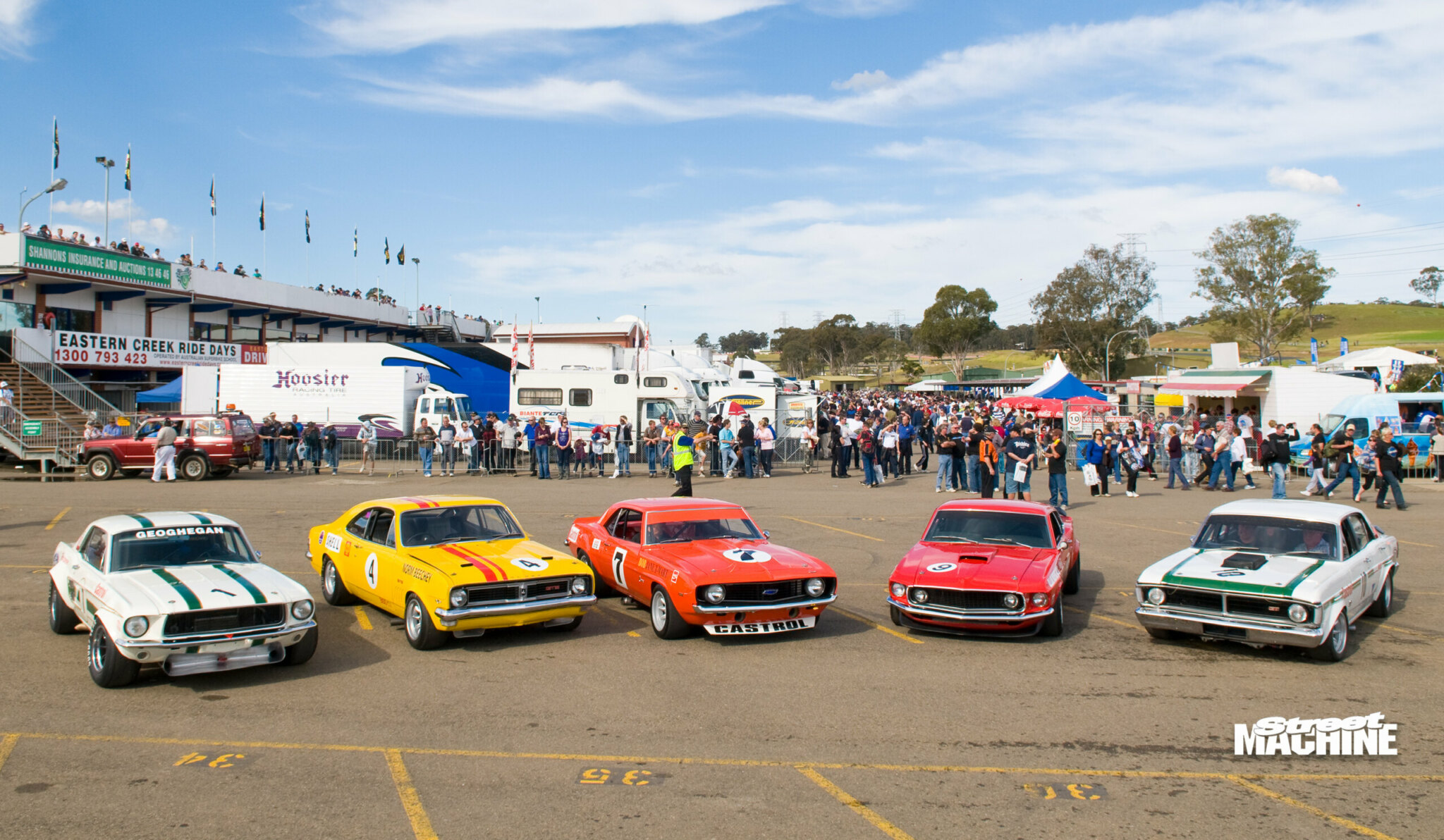
The highlight of Sunday was gathering the Famous Five
On top of the racing classes, there were the Heritage and Master Blaster laps. With these, spectators were enthralled by famous cars being driven spiritedly though not actually racing. And if action on the track wasn’t enough, there was plenty of mechanical eye-candy on static display in the form of gleaming GT Falcons, Cobras, Mustangs, Toranas and Monaros.

In between driving stints, the who’s who of Australian racing royalty — including Kevin Bartlett, Dick Johnson, Allan Moffat, Bob Jane, Alan Grice, Garry Rodgers, John Harvey, Colin Bond, John Goss, Murray Carter, Phil Brock, John Bowe and Barry and Glenn Seton — happily signed autographs.

The highlight of Sunday’s proceedings was gathering the Fantastic Five. These five legendary touring cars are considered to be the most notable machines from the height of the late 60s and early 70s Improved Production series.


Collectively these cars not only polarised Australian Touring Car racing, but won every championship between 1967 and 1972. Each car is a highly collectable piece and this was the first time the five machines had been in the same place at the same time. That gang in the pits was quite a spectacle for the throngs of spectators who’d flocked to see these historic racers. Bringing fans, young and old, together with celebrated racing icons is what Muscle Car Masters is all about.
PETE GEOGHEGAN
1967 MUSTANG COUPE

After snatching the 1966 Australian Touring Car Championship behind the wheel of a 289-powered 1966 Ford Mustang, big Pete Geoghegan decided to step up to a ’67 model (with the bigger 302 engine) for the following year. It proved to be a match made in heaven, as the dynamic duo won on debut at Queensland’s Lakeside Raceway before going on to win the ’67, ’68 and ’69 Australian Touring Car Championships (ATCC). Pete campaigned the car until jumping into the Super Falcon in 1972.
Although its specifications changed numerous times, it remained the same car — same chassis number. No other single car has ever won three consecutive Touring Car Championships.

Here it’s presented in its final and most sophisticated specification, from the 1972 season, complete with 15×10 wheels, fat tyres and flared guards. By then the mighty 302 Windsor had sprouted Lucas mechanical fuel injection and made better than 500hp — an obscene amount of power in 1972. Des Wall now owns the car and this is the only one of the five still competing — and it’s still winning races!
BOB JANE
1969 ZL-1 CAMARO

The biggest, baddest factory-built Camaro of all time is the ultra-rare ZL-1 427. Just 69 were made, for drag-racing homologation, and were the only first-gen Camaros fitted with aluminium blocks. Yep, the ZL-1 developed by GM for Can Am Sports Car racing was aluminium! The rarest and most collectable Camaros, they’re worth in excess of US$1 million!
Compared to its small block-powered rivals, Bob’s Camaro was in a league of its own. It won the 1971 ATCC title in big-block spec and again in 1972 fitted with a 350. Bob modified it again to suit 1973’s Group C regulations but the powers that be banned it, as there weren’t 25 similar cars in the country.

Chassis-wise it was probably the most standard of the ’71 and ’72 Improved Production cars. That said, it sported a NASCAR-style rollcage, fuel cell, huge L88 Corvette discs front and rear, along with a Muncie M22 modified by Peter Hollinger to withstand the 600-plus hp and massive torque of the big-block. This car is still owned by Bob and has recently undergone a cost-no-object resto by Thunder Road Restorations.
NORM BEECHEY
1969 HT GTS 350 MONARO

The first 10 Australian Touring Car Championships (ATCC) were won by imports but in 1970 Norm Beechey and his HT GTS Monaro changed all that. It became the first Holden and the first Australian-built car to take the title.

Due to the dominance of the purpose-built Trans-Am Mustangs and Camaros, CAMS relaxed the rules for the 1970 season, allowing locally built muscle cars to be similarly modified. Norm and his dedicated team (including Lou Mallia, Adrian Dalton, Ken Box and Ron Harrop) turned the humble Aussie Monaro into a beast capable of wrestling the ATCC away from its rivals. Mods included a savage weight-reduction program, moving the engine back and down, an intricate rollcage, huge Corvette brakes, 12-bolt Positraction fully floating diff, reinforced and relocated pick-up points for a fully adjustable and tuneable suspension system that incorporated upper and lower trailing arms and a Watts linkage out back. That allowed Norm to make the most of its 500hp, quad-Weber 350 Chev. The immaculate GTS is now in the Bowden Collection.
PETE GEOGHEGAN
1971 XY SUPER FALCON

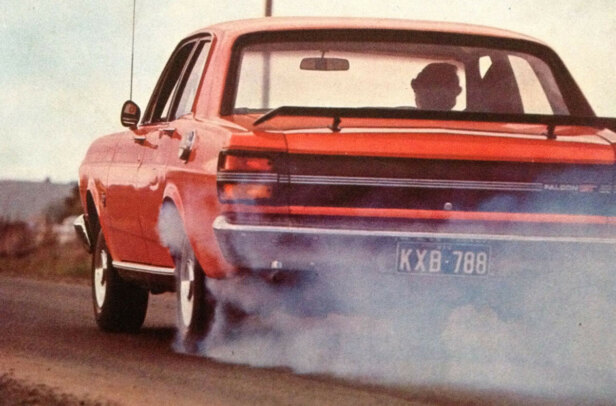
They don’t come much rarer than Pete Geoghegan’s Super Falcon. One of only two built by Ford Australia in 1970 (for Pete and Allan Moffat), Ford was confident they would both drop their US Mustangs to race the highly modified XWs.
Allan stuck with his Boss Mustang so his Super Falcon was stripped and sent to the tip! But Pete updated his XW to XY looks and developed it into the fastest, most powerful touring car in the country by the end of ’72, when CAMS changed from Improved Production regs to Group C rules for the 1973 ATCC.

Geoghegan’s Super Falcon never won the ATCC but it’s still one of the most revered cars of its era. Costing a rumoured $AU125,000, the brutal beast’s fuel injected 351 Clevo was good for 620hp and revved to a staggering 9600rpm!
The suspension set-up was radical and the car featured lightweight panels — including magnesium door hinges — and a recessed firewall so the Clevo could be moved back 3in for better weight distribution. Easily the greatest Aussie Falcon ever built and it’s a prized member of the Bowden Collection.
ALLAN MOFFAT
1969 TRANS-AM BOSS 302 MUSTANG

Raced in Coca-Cola and Brut 33 livery, Allan Moffat’s Boss 302 Mustang is arguably Australia’s most famous touring car ever. It never won the ATCC title but Allan and his Mustang dominated Aussie racetracks between 1969 and ’74. With 101 wins from 151 starts, it’s hard to understand how it didn’t take the title.
It’s also a car of international note, being one of the Fastbacks constructed by Kar Kraft for Shelby and Bud Moore Engineering to contest the 1969 American Trans-Am series. There were three for Carroll Shelby, one for Smokey Yunick, and three for Bud Moore — raced by Parnelli Jones and George Follmer. This is one of the Bud Moore cars and one of only three original machines still in existence.

These ’Stangs featured lowered and set-back engines, tapered front sheet-metal, relocated suspension pick-up points, rear traction bars and significant lightening. With superior handling and braking, it was more than a match for its bigger capacity rivals. Best of all, the cornerstone of the Bowden Collection looks absolutely bitchin’!

Comments