
First published in the December 2005 issue of Street Machine
What the hell has 65-year-old father of three Noel Tuckey got to do with Dirty Stuff? He’s the man behind the myth that is William Porker — and for those of you not paying attention, William Porker has been penning Dirty Stuff in Street Machine for the past 20 years, starting with the Oct/Nov issue in 1985. After such a fine innings, we thought it was time the man came out of the shadows and explained himself.

First up, what’s with the name?
The then editor of Street Machine, Phil Scott, came up with that. At the time I was going through some marital problems and I didn’t want the column in my own name.
And how did you come to be writing the column in the first place?
I’ve written for various magazines over the years — Wheels, Sports Car World, Two Wheels, Modern Boating as well as some Japanese and UK magazines. I suppose this is going to out me but I’ve had a number of columns and none of them have been in my own name. I had a column in Wheels for 25 years — I was George Ambrose. My brother, Bill Tuckey, was editor at the time and he came up with that name. George is my middle name and Ambrose was my dad’s middle name. I still do one other column aside from Dirty Stuff.
I’ve heard a rumour that you may be a Pom.
My parents were both English. My father emigrated in the early 20s and so did my mother’s family. They met in Sydney; I was born in Wau, New Guinea. We were chased out by the Japanese in the war. My father joined the Australian army to fight them; he was in the 1st New Guinea Infantry. He was killed in 1944.

So what sparked the interest in cars for the Tuckey boys?
I guess because we never had one! We used to walk everywhere. I did a pre-apprenticeship course but we moved to Taree, NSW, before I completed it. I got an apprenticeship with a Ford dealer, the biggest mistake I ever made — it took me a long time to learn how to fix cars. After the apprenticeship I moved to Queensland and got quite heavily involved in motor racing as a technician, as a volunteer at first. I eventually turned fully professional and met John Scott-Davies and got a fulltime job with him on his Lola T70. But I blew up three engines and that was that!
Did you ever race?
Only briefly — keeping the things together for various people has been my main involvement. One of the best came about from a conversation with Peter Robinson, then editor of Wheels. He asked if I had any story ideas, and I’d just found a 1955 Super Squalo Ferrari at the Giltrap Auto Museum at Kirra on the Gold Coast. I met with George Giltrap jr and asked if we could run it at the 1975 AGP at Surfers Paradise. He said it hadn’t run in 14 years but if we could get it going, that would be great. I spent two weeks getting it unseized and finding the special fuel for it.
I took it to Amaroo for the first Historic Day there in 1976. After that I raced it for six years until it became too valuable — it sold for $1.5million. It had a centre pedal accelerator — great for heel-toe driving — but the bloke who bought it had an American driving it and in a corner he hit the centre pedal to stop and crashed it.
Any others?
I built a Ford V8 Special and raced it. I restored another one — we bought the front and rear quarters but the rest had been gas-axed and thrown away!
What are the cars in the pics?
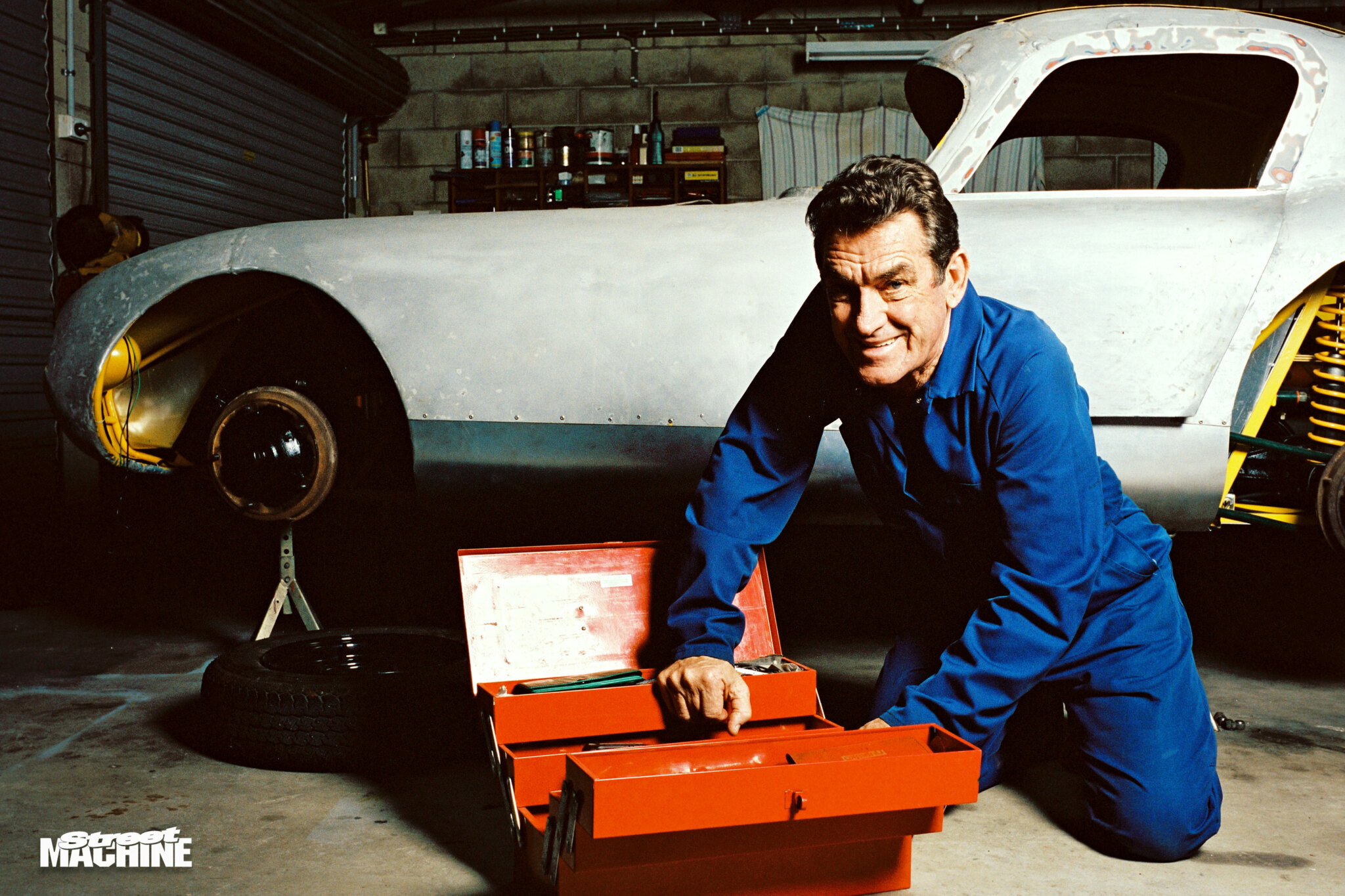
The shell in the garage is the Mustard Special. It’s an early Rochdale body on a chassis built by Andrew Mustard, an engineer with Malcolm Campbell and the Bluebird land speed record team. He came to Oz with Campbell and brought his car. I’ve had the Mustard Special for 30 years and been restoring it for 14!
The green car with black fenders is a DKW with a two-stroke vertical twin engine. At the end of WWII the Russians kept the factory going and it went on to build Trabants — basically the same car underneath a plastic body.
And the lady?
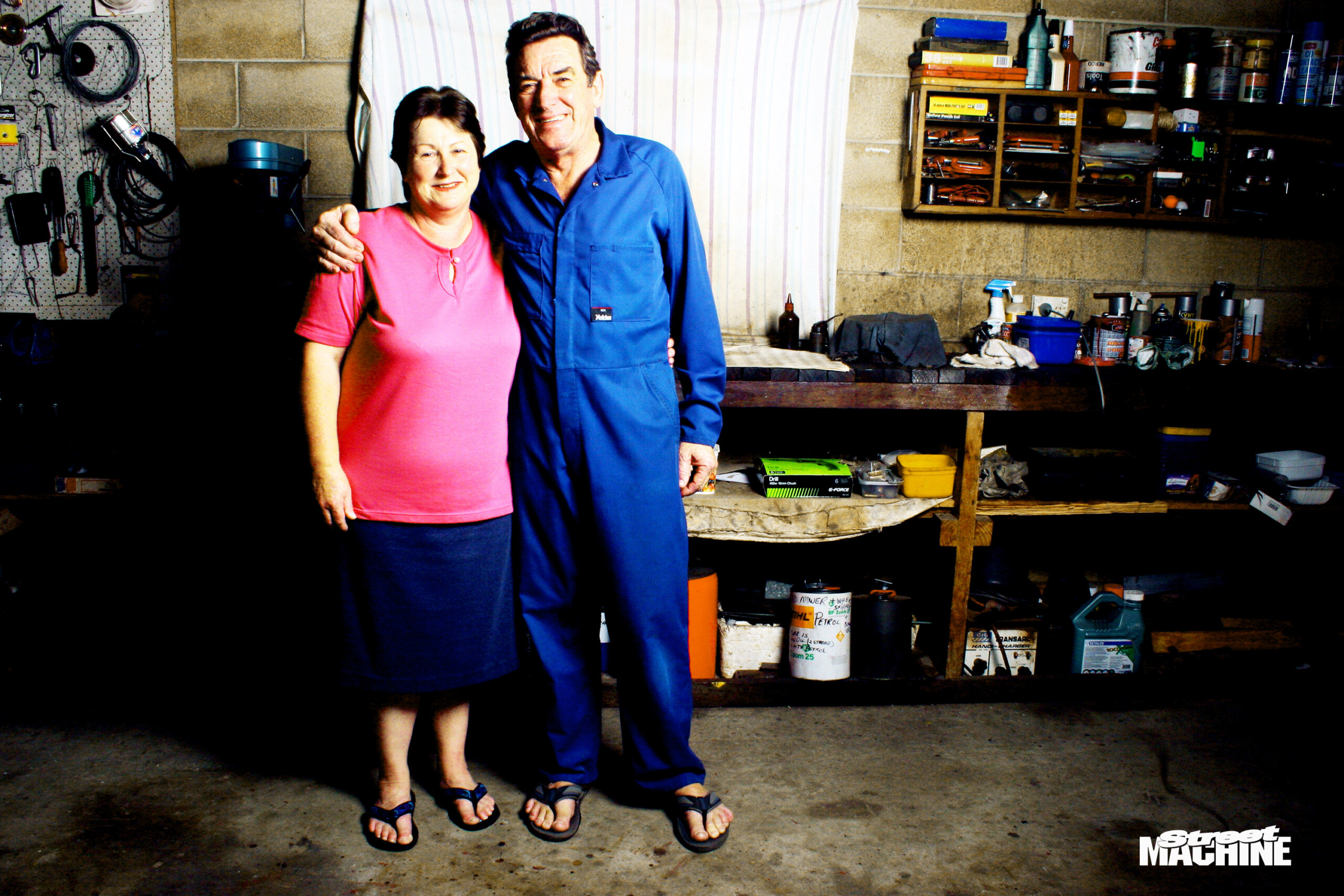
That’s my second wife, Janet. She works side-by-side with me on the Brabham we race. She knew nothing about it when we met but she’s very practical and isn’t afraid of learning. She goes with me to all the races and I think we’re a good team.
The Brabham?
That’s what the red engine is from. It’s a 1.1-litre Ford Anglia 105E engine that makes 120hp. It’s the most successful engine in the Formula Junior class and you get 1000km before a full rebuild. Graham Brown drives it — he won the championship the year before last. Janet and I have just spent two weeks working on it after the throttle stuck open and it ended up in a pond! There’s a practice day coming up so I’ve put the second engine in — I just hope that the other one didn’t swallow too much water.
Have you ever repeated a Dirty Stuff story in those 20 years?
I’ve often thought I could rehash an old column, but I’ve never had to. There’s always something new, though I am stuck in a time-warp — I would rather work with carbs than a computer. I get involved with the scene as much as I can to find stories and I’ve got my own experience of nearly 50 years. At Mallala there was a drifting demo and I thought it was awesome, so I wrote a column about it. I try to be as accurate as possible but no-one’s perfect. I made a blue once about high-tensile bolts. I won’t do that again!
Everything in the old days was rumour — so-and-so’s running this cam or modifying his heads this way, so you’d try it. Frank Matich, a top driver in the 60s and early-70s, designed his own cars and other teams were constantly trying to spy on him. So one of his mechanics brazed a tyre valve stem onto the chassis, painted an aqualung bottle blue, and connected up the bottle while a mechanic from another team was watching. The other mechanic later complained to the stewards that Matich’s team was filling their chassis with helium!
I got into the performance parts tuning scene early on, hotting up old Holdens and the like, and that’s where I get the inside line for the columns.
And what do you do when you’re not working on cars?
I don’t have a lot of downtime. The Brabham absorbs a lot of it, and I’m writing a book, an eco-adventure about the Tasmanian tiger, which I’m aiming to finish in the next month. With the Brabham, the book and the columns I tend to work seven days a week.
Comments