
First published in the June 2008 issue of Street Machine
Whether blown or aspirated, nothing looks as bad-arse as an old-school mechanical injection set-up. Sadly, you don’t see many genuine street cars running this type of injection, and for good reason. Not only is it very difficult to get a reliable and responsive tune-up for the street but the systems are designed to run on methanol — for race cars. That might be okay for a mainly strip-driven car that gets the occasional midnight cruise around the block but it’s a definite no-no on a regularly street-driven car. That, plus the popularity of EFI, makes genuine streeters running mechanical injection a rarity these days.

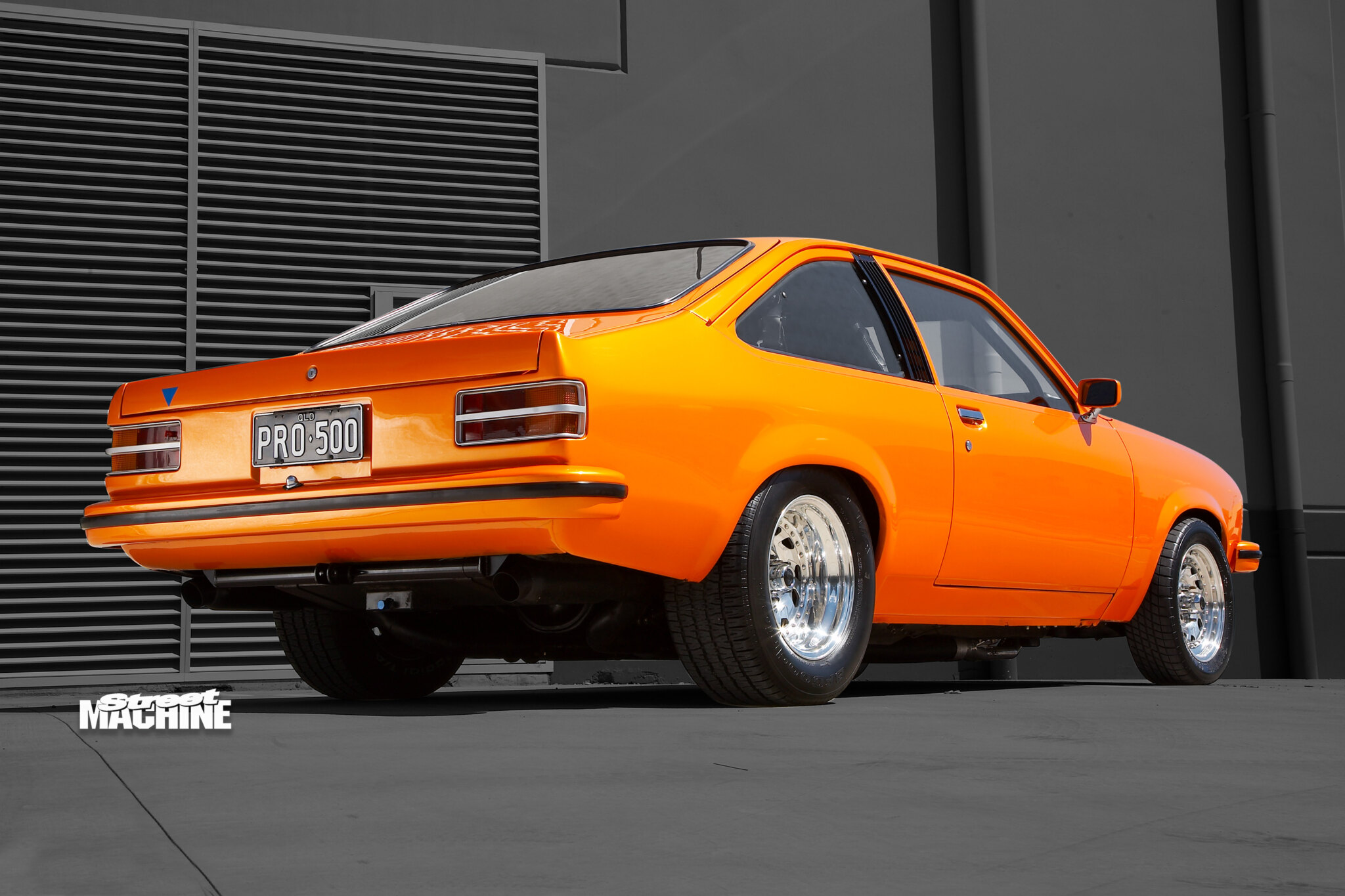
None of which could stop Queenslander Robert Pace from fitting a Kinsler Dragon Claw system to his sweet and tough LX hatch.
“I wanted to do something different and it looked like a challenge to run mechanical injection but keep the car streetable,” he says.

The Torana was already built and going hard when Rob decided to take the plunge. He bought the car in 2000 as a runner, figuring it would be a quick way into a tough ride. Sound theory but unfortunately, it’d been done to someone else’s standards, which didn’t match his own, so he ended redoing most of the car anyway.
“I’ve replaced everything on it,” he says. “Oh, except the number plates!”

The body was in good condition and Rob had it repainted in a vivid PPG custom orange. He then went right through the suspension with new parts. To make sure the hatch could wash off the big speeds Rob was planning, the front brakes were upgraded to VL Turbo calipers and discs while the nine-inch diff (filled with a Strange centre and 31-spline axles) received EB Falcon discs and calipers. A VL Commodore master cylinder was also installed. For street duties, a set of Center Line Warriors, wrapped in Yokohama rubber up front and BF Goodrich out back, keeps all four corners off the ground. At the strip these are swapped for a set of Cragar Stars, wearing frontrunners and 26×10 Mickey Thompson ET Drag slicks.

Rob originally ran a 355-cube Chev in the car, hitting a best of 9.66@142mph with 175hp of giggle gas plumbed in. After damaging one of the cylinder heads, the combo was pulled apart and a new pair of Pro Action 23-degree heads was prepped. At the same time, Rob decided it would be a good idea to put some more cubes into the beast. After briefly considering taking the 355 out to 383, he decided to purchase a new Dart Little M block and got stuck into preparing a 408-cube short for his new heads to sit on.

He fitted the Kinsler injection system and got it running on methanol, then took it to injection guru Allan Farrer to set it up on petrol for street as well as strip duties. The injection set-up and fuel system were taken out of the car and flowed on a fuel flow bench to get a baseline tune. Since methanol needs about twice the fuel volume of petrol for a proper air/fuel mixture, the methanol settings were way too rich and the system was leaned out on the bench. With the fuel system back in the car, it ran on petrol but not very well.

Mechanical injection systems like this are known as constant flow systems. Rather than an ECU telling electronic injectors when to open and for how long, these systems rely on a specific volume of fuel being delivered by each revolution of the mechanical fuel pump. That fuel then passes through a barrel valve, which opens with the throttle, and flows into the nozzles in the throttlebodies. Because petrol is close to its boiling point at room temperature and the fuel tank is at the other end of the car, an inconsistent amount of fuel turns into vapour before it reaches the pump. That means inconsistent delivery.

To combat that, a vapour separator tank was installed in the engine bay. A Holley electric fuel pump pushes fuel from the tank at the back up to the vapour separator. The mechanical pump then draws from the separator tank, giving a consistent volume of fuel — no vapour or cavitation — to feed the injection. This is the first of these vapour separator systems that Kinsler has sold in Australia, underlining just how rare a street car running mechanical injection on petrol really is.

A Zex direct port nitrous kit was also added, with a tuning range of 75 to 300hp. An Edelbrock progressive nitrous controller feeds the gas in slowly to give the car a chance of finding traction on the launch.
“There’s enough there for an eight-second pass,” Rob says, “but the biggest challenge now is seeing how much the small tyres can put up with. It was difficult to get it to behave itself on the street but now it’s really responsive. It has no trouble turning the tyres from 2000rpm in top gear!”

WHAT’S WHAT

The key to making the system work on the road is the vapour separator tank (1). It has internal baffles to move vapour and aerated fuel to the top so the mechanical fuel pump (2) can draw ‘clean’ fuel from the bottom. Three-way shut-off valve (3) diverts fuel from the pump to the separator so fuel left in the lines doesn’t drip into the engine while it’s stopped. Fuel filter (4) is plumbed after the shut-off; main bypass jet (5) comes after the filter. It returns fuel from the pump to the tank, setting the overall flow rate and mixture. This affects the tune-up like main jets in a carb but being a return, a larger jet returns more fuel to the tank and sends less fuel to the engine, leaning out the mixture. The secondary bypass (6) is a return which tailors midrange and part-throttle. Since mechanical pumps increase the fuel flow with engine speed regardless of load, small throttle opening at high revs (downshifts and deceleration) lead to a rich mixture. The secondary sends excess fuel back to the tank. The high speed bypass (7) is for full throttle, high rev situations. An engine’s fuel requirement doesn’t rise in a linear rate with rpm but since the mechanical pump is tied to revs, it supplies too much fuel at high rpm. The high-speed bypass lets more fuel return at high rpm, stopping the mixture becoming rich and hurting top-end power.
BUT WAIT THERE’S MORE…
- 8. Pressure relief valve. In the return line from the separator to the main tank, this prevents excess pressure in the separator.
- 9. Hoses from the barrel valve to the nozzles in each throttlebody.
- 10. Throttlebodies — one per cylinder, using 25/8in throttle blades.
- 11. Nitrous and fuel solenoids.
- 12. Direct port nitrous and fuel sprayer nozzles, as in an EFI nitrous system.

ROBERT PACE
1976 LX TORANA HATCH
| Colour: | PPG custom orange |
| SHOVE | |
| Block: | Dart Little M, 408ci |
| Crank: | Scat, steel |
| Induction: | Kinsler Dragon Claw mechanical injection |
| Nitrous: | Zex EFI direct port, 75–300hp, Edelbrock digital nitrous controller |
| Heads: | Pro Action 23-degree, alloy |
| Cam: | Comp Cams Roller, 278 degrees |
| Ignition: | MSD 7AL |
| Exhaust: | Rapid Fabrications four-into-one headers and 3½in system |
| SHIFT | |
| Transmission: | Powerglide with transbrake |
| Converter: | Converter Shop nine-inch high stall |
| Diff: | Nine-inch, Strange centre, 31-spline axles |
| BOUNCE | |
| Springs: | King Springs |
| Shocks: | Pedders 90/10 (f), Koni (r) |
| Suspension: | Custom rear stabiliser bar |
| Brakes: | VL Turbo discs and calipers (f), EB Falcon discs and calipers (r), VL Commodore master cylinder |
| ROLLING | |
| Street: | Center Line Warriors with Yokohama 195/70/15 (f), BF Goodrich 255/60/15 (r) |
| Race: | Cragar Stars with MT frontrunners (f), MT ET Drags 26×10 (r) |
CHEERS
Allan Farrer, Farrer Race and Performance; Shaun, Rapid Fabrications; Pace Painting; and a few good mates.
Comments