
First published in Street Machine’s Australia’s Toughest Fords magazine #1, 2003
After building a succession of groundbreaking cars (and twice capturing the coveted Summernats Grand Champion crown in the process), there was one trophy missing from Howard Astill’s well-endowed trophy cabinet: Street Machine of the Year (SMOTY). Anybody who knows Howard will attest that while he might appear to be a cool, calm and laid-back guy on the outside, deep down, he’s fiercely competitive and he dearly wanted a SMOTY trophy to complete his illustrious collection.

After being a SMOTY runner up twice, Howard decided that, this time around, he needed to sit down and specifically devise a strategy to capture the trophy. He knew he needed a car that was over the top and full of cutting-edge concepts. These parameters didn’t leave much room for legalities.
“From the outset, the car was never intended to be registrable or driven extensively; it didn’t matter,” explains Howard. “I’d been down the 100 per cent rego route with the ’64 Fairlane I’d previously built for Street Machine (SM, Jan-Feb ’92) and I didn’t need to do it again for this one.

“All of the concept stuff came from me. However, once you have the basic concept, you need someone to kick ideas around with. Luke Fiori and Rod Lambert were both involved in formulating the winning plan. Both those guys are tradesmen and expert craftsmen in their own right.”
After doing his homework and formalising the Race Rock concept, Howard negotiated with Pioneer to come on board as the major sponsor, and the 12 hard months of working on the real thing began. Starting with a tatty but rust-free six-cylinder XB Falcon Hardtop (found in his hometown of Broken Hill, NSW), Howard stripped the coupe down to a bare shell.

“We took the whole firewall out, the floor came out and I sold off a lot of the stuff,” recalls Howard. “The motor, ’box, trim – everything else went to the dump.”
What remained of the shell was welded onto a rotisserie stand, by the sills, to keep it square and level during construction. “We built the chassis first – the rails were just strung in the middle of nowhere (where the floorpan once was) and then tied back to the body. Everything was referenced to the car’s centreline; same with the front and rear ends. That’s so the thing drives properly. A lot of fabricated-chassis cars you see at Summernats crab down the road.
“Then, we began on the wheels and started mocking up the panels. It was a little bit hard with this one: there was no engine bay. We’d cut the entire front off at the firewall. The front wheels had to be moved in far enough so that they could turn inside the guards.” Most of the major work on the car – including chassis and floor, tubs, firewall, trans tunnel and stretching of the rear wheel arches – was done in Howard’s home-based air-conditioned workshop that he’d specifically constructed for building cars. For Race Rock’s floor, a 1mm sheet was used – you can butt-weld it and, once welded, it doesn’t move around much.

Although it was never to see regular road use, Howard didn’t skimp on the car’s strength or durability. He wanted to give it a good blast at exhibitions, and especially during the Summernats Grand Champion driving events. “Besides,” as he explains, “even when riding on a trailer for 20,000km, it’s still working really hard; it’s not much different to driving.”
The front end uses HQ Holden ball joints and geometry along with Castlemaine Rod Shop drop spindles. “That way, we were safe from a weight and durability point of view, and we could set the ride height super-low.” Under the rear, the narrowed nine-inch was mounted on coil-overs and a four-bar set-up, with Howard incorporating the sturdy mounts.

Braking, too, was quite cutting-edge for its day: Wilwood discs and four-spot calipers were used as much for aesthetics as for performance. “Once again, that was for the ‘ooh-aah’ factor of having something different,” explains Howard.
There’s an incredible amount of detail work in the car’s appearance. The front and rear screens are flush-mounted. The drip rails were removed and small-diameter tube used to define the remaining edge. “That all took about six weeks, working 40 hours a week,” recalls Howard. That’s six weeks just on the turret, readers. The top edges of the bumpers were plated to give a smoother appearance and close the gap to the body. There’s no fuel filler any more; everything is just about flawless. As Howard says, “there’s a huge amount of changes on the car you don’t really see.”
The absence of the factory front end made fitting the front guards and bonnet a challenge. “On a race car, the panel gaps are never right because they don’t have to be,” Howard says. “But we had to get them spot on to have something to show off in the judging arena, which, on this type of tubular space frame, was time-consuming, to say the least.”
Mechanically, the car is far from adventurous. It wasn’t built to cruise the suburbs, blast down the quarter or be top dog at Horsepower Heroes. It was built to drop jaws and to maximise its appeal to the people who, Howard felt, would be most likely to vote for Street Machine of the Year.

The engine’s soaring stature is thanks to the Fischer 6/71 blower and MoTeC EFI bolted above 460 cubes of Ford muscle. With stock crank and rods and a 1900rpm converter in front of a two-speed Powerglide auto, it’s not intended to take on Victor Bray. However, it does deliver a very stout 550-plus horsepower and a stump-pulling 511lb-ft of torque. Howard demonstrated the blown mill’s willingness to work, jumping in and peddling the car hard at a number of events. Ironically, it’s a lot more streetable than many ‘streeters’.

At that stage, McLaren had just brought out its much-vaunted F1 and Ferrari their F40, both of which were the inspiration for the wrap-around dash. It features a square steel tube frame laminated in Craftwood and vinyl covered by Carofano Motor Trimmers. Craftwood was the material of choice for the doors as well, although Howard admits that, next time around, he’d use lighter fibreglass for interior components as the wood ones turned out to be quite heavy.
Being a Pioneer-sponsored car, it’s understandable that it’s jam-packed full of audio. Accompanying the dash-mounted eight-inch subs are another two in the rear, along with two sets of midrange speakers and tweeters (one in each door and another sitting atop the dash), twin stackers in the centre console, four amps and an ODR head unit.

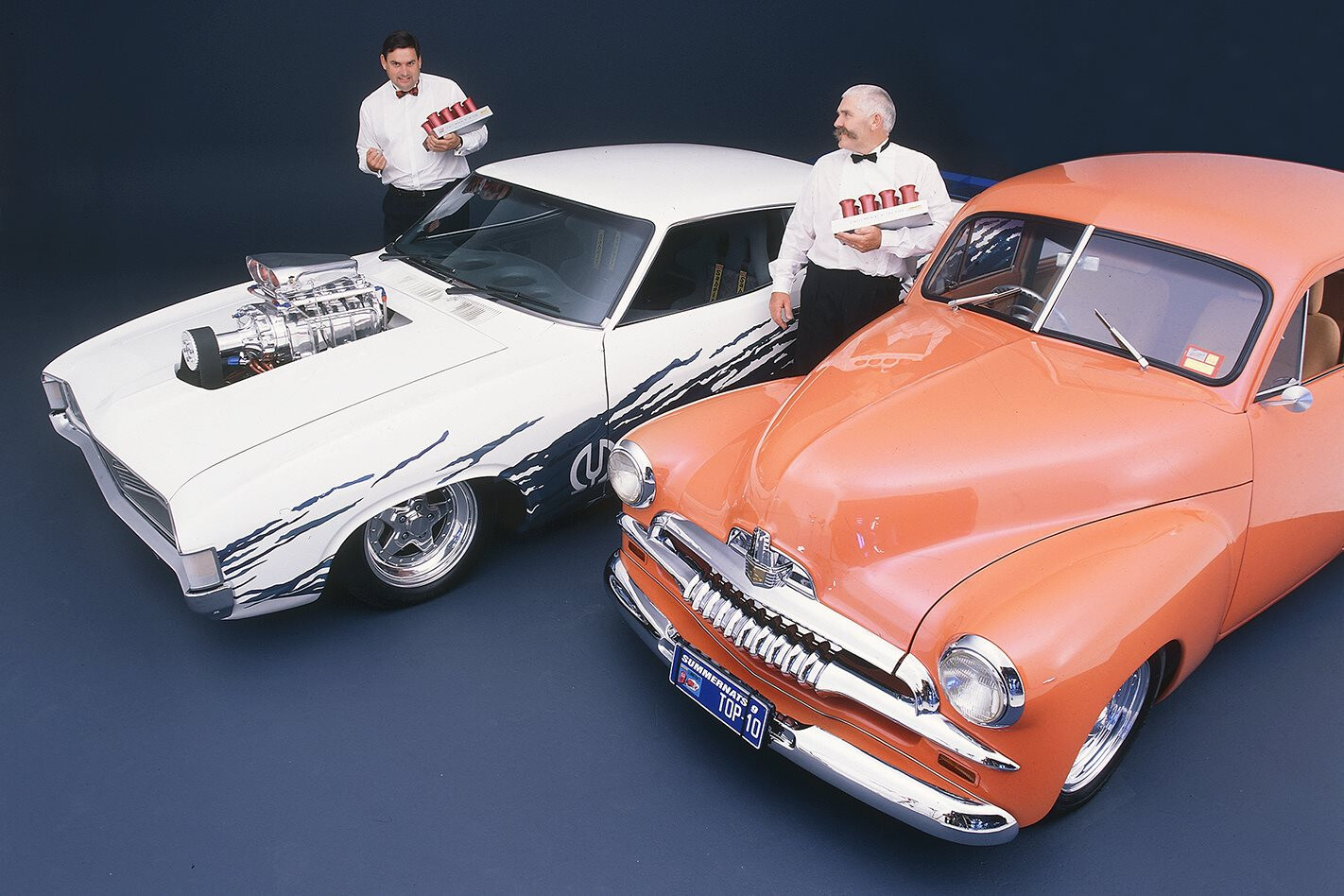
In its debut form, the Astill-prepared bodywork was adorned with computer generated graphics incorporating the Pioneer logo. And, boy, what a reception! Not only did it achieve its primary objective of winning SMOTY (tying with Darryl McBeth in 1995, above), Race Rock also managed to secure the Grand Champion sword at Summernats 10 (below).

After two very successful years on the show circuit came the decision to retire the car and offer it for sale – without success. Then, in September 1999, an unfortunate accident took the life of close friend and team member Leigh “The Kid” Demain. Leigh’s death hit Howard hard and, as a show of respect, Howard and the team decided to get together and rebuild the coupe in memory of Leigh.
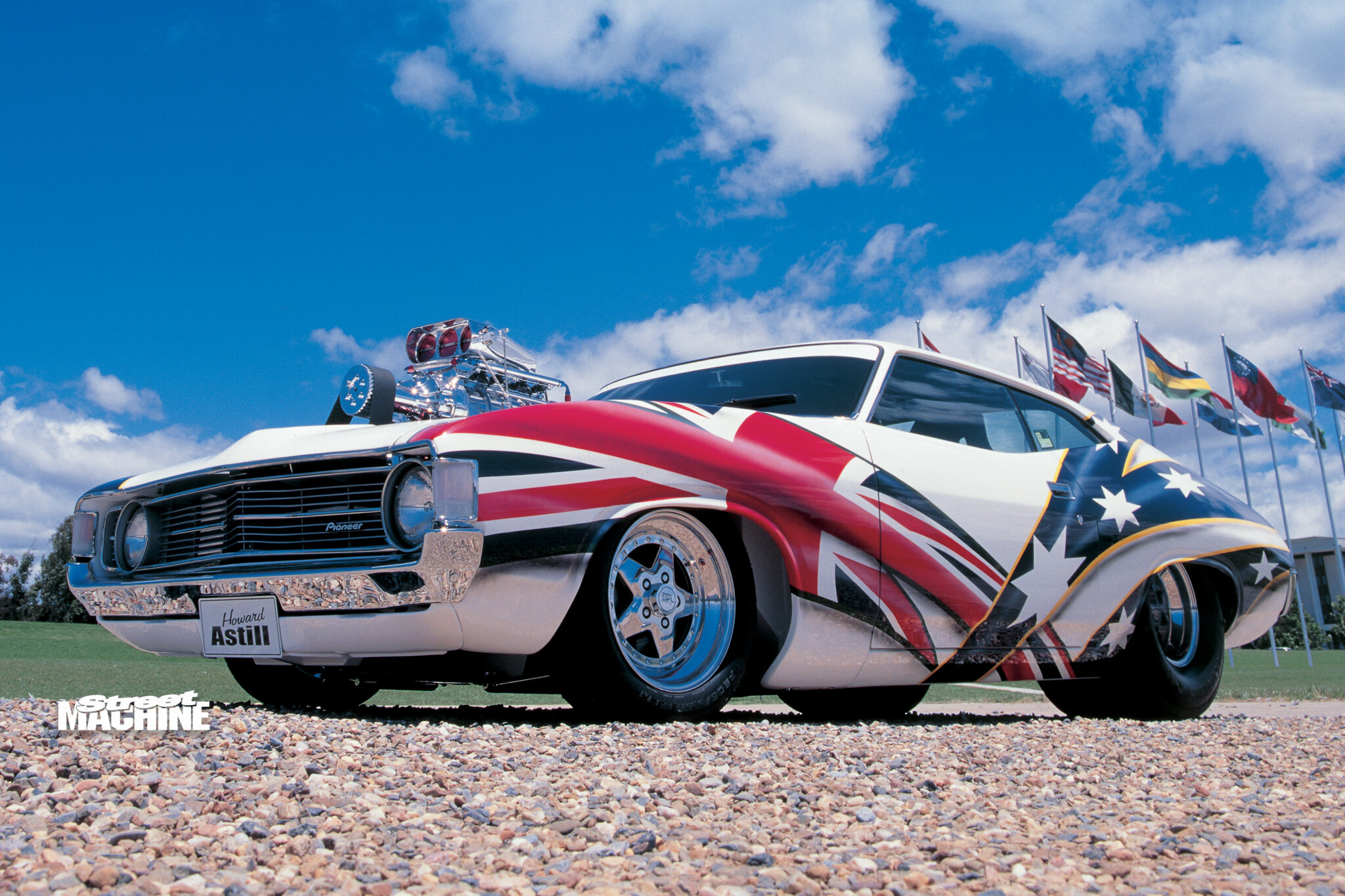
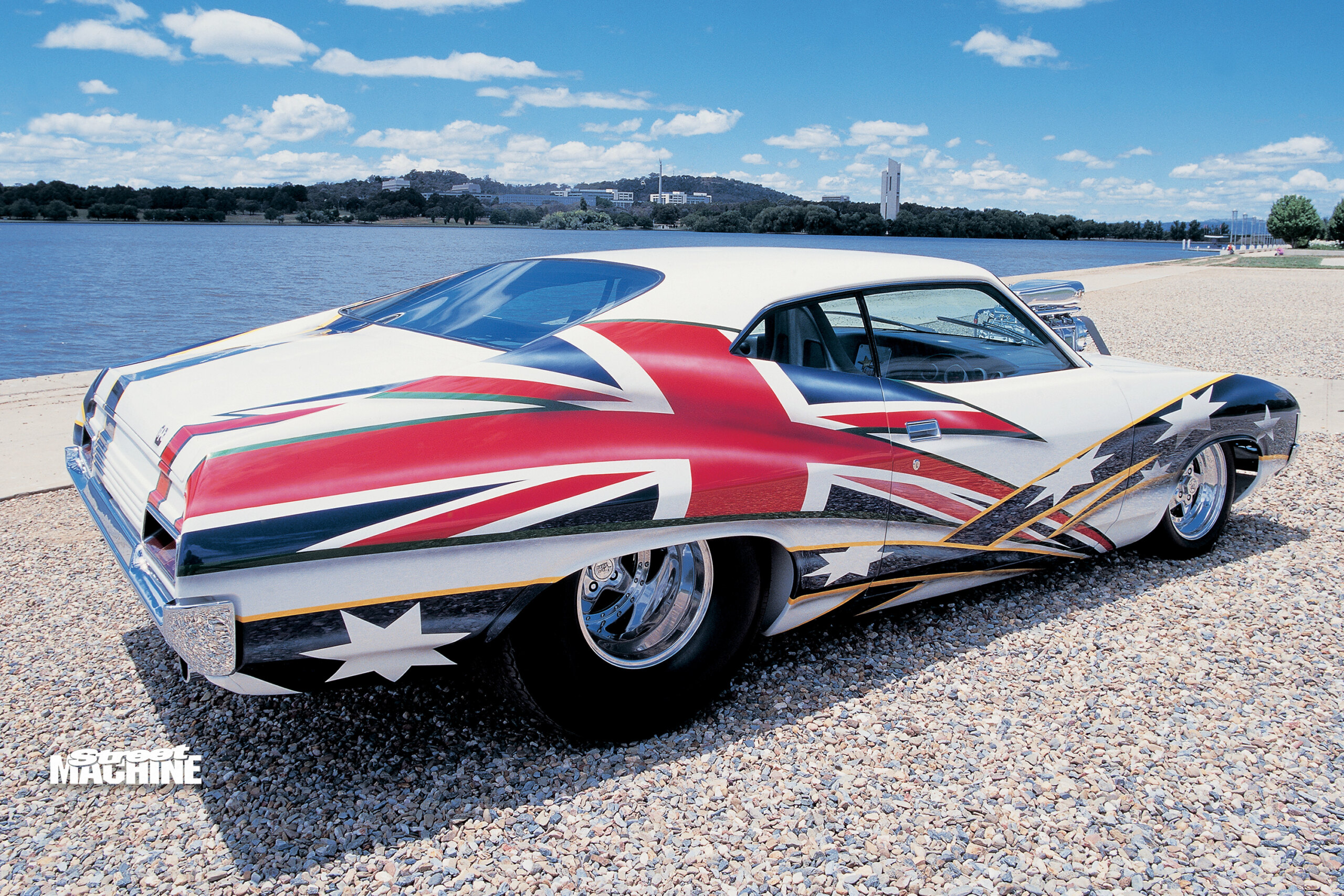
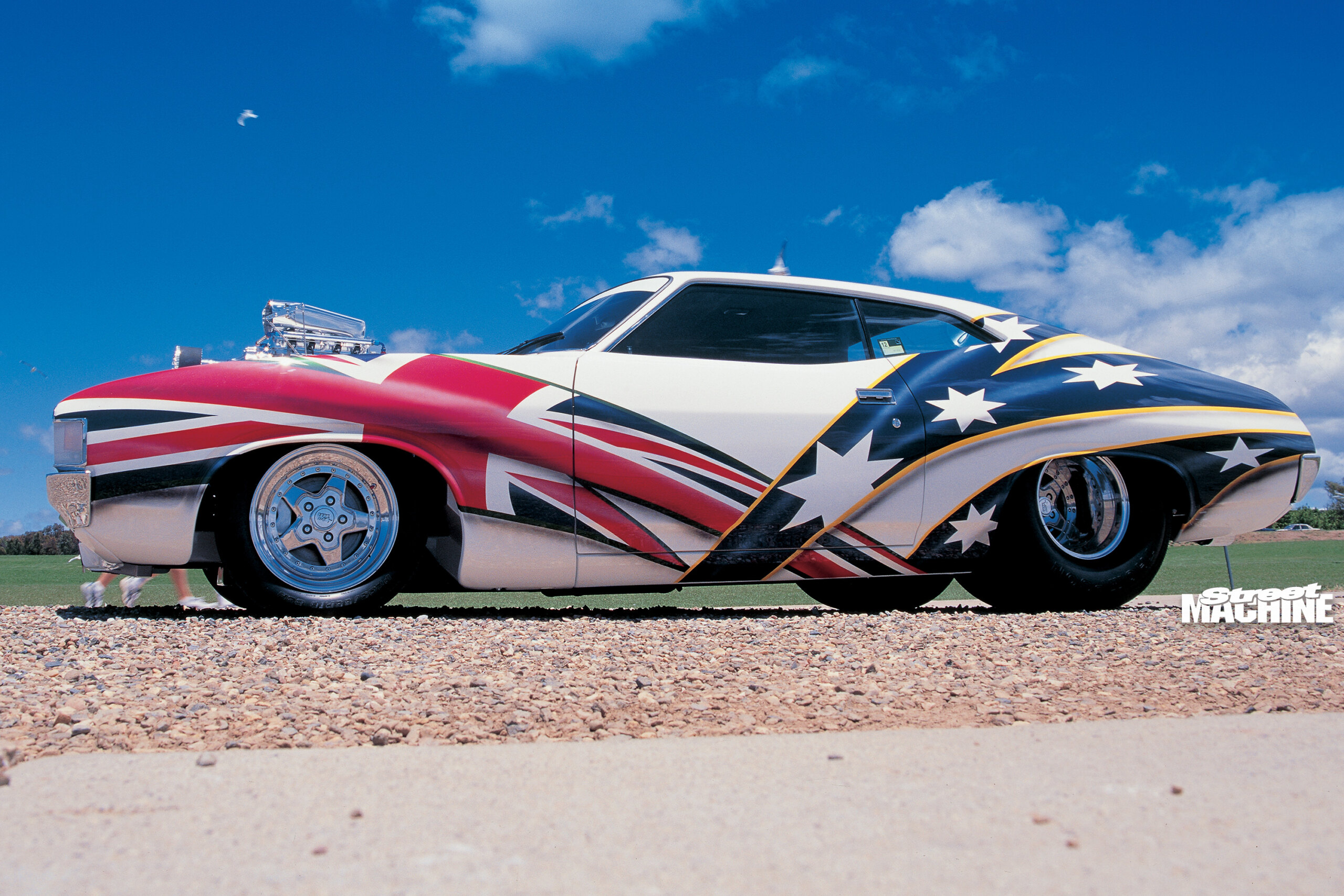
The coupe was stripped to glass, dash and rolling stock and delivered to PPG in Melbourne to be repainted and slapped with the new flag graphics designed by Jeff Haggarty. While many thought ‘Die Hard’ was just a respray, it was in fact a comprehensive rebuild. During its two years on the circuit, it had been upgraded and fiddled with. However, this would be the first time everything on the car was fresh. During re-assembly, maximum effort was put into everything to ensure maximum impact as well as to get the message across that their friend was no longer among them.

Die Hard’s success at Summernats 13 was greater than expected, taking out Top Judged Elite, and Leigh’s story went to press and also featured in the Summernats video.
A pleasing result, as it had given all and sundry a certain amount of closure to some otherwise very traumatic circumstances. After a short siesta, Howard displayed the car at the Melbourne Hot Rod Show with a sign reading, “Best offer over $19,999”. It was sold two weeks later to Chad Murray, closing another chapter for the Astill family.

The coupe will be remembered as one of Australia’s all-time great show cars. It may be almost a decade old, but Howard’s XA is a lesson in street-machine planning, execution, craftsmanship and detail. And it still looks fresh.
THINKING BIG
Howard wanted to win SMOTY. “I had to build a car capable of getting the votes. I had to have something that people would say, ‘Shit! That’s the ultimate!’ Kids always draw cars with big wheels and a big engine out the bonnet. Big is better. So, Race Rock had to have the biggest of everything: biggest tyres, biggest engine. Originally, the concept was for an injected 500 cuber, but this plan changed after one of the Pioneer marketing guys wanted to know why some cars at Summernats had big crowds around them, and others didn’t. I explained the cars with crowds around them were the blown cars. So that’s why we went the blown route.”


HOWARD ASTILL
1973 XA Coupe
| Paint: | PPG White/Aussie flag graphics |
| UP FRONT | |
| Type: | Bob Fisher-built 460 Ford |
| Heads: | 460 ported by Crow Cams |
| Blower: | Bob Fisher 8/71, 10 per cent underdriven |
| Blower manifold: | Custom out of the US |
| Injection: | Enderlee hat with Bosch injectors |
| Engine Management: | MoTeC |
| UNDERNEATH | |
| Gearbox: | Two-speed Powerglide by Race Glides |
| Converter: | Race Glides 1900rpm stall |
| Starter: | Hugo Hi-Tork |
| Diff: | 4.11:1, Detroit locker, nodular iron nine-inch |
| Brakes: | Wilwood rotors & four-spot calipers |
| Master Cylinder: | XB GT four-wheel disc |
| Front Suspension: | Billet aluminium coil-overs, fabricated control arms |
| Rear Suspension: | coil-overs with four-link & Panhard bar |
| ON THE INSIDE | |
| Seats: | Velo |
| Steering wheel: | Momo |
| Door trims: | Hand-made Lou Priori |
| Instruments: | Auto Meter |
| Shifter: | B&M ratchet |
| ROLLING STOCK | |
| Wheels: | 16×7 & 15×10 Dragway Superlites |
| Tyres: | Kelly 205/50VR16, M/T 21.5x33x15 |
Comments