
First published in the February 2008 issue of Street Machine
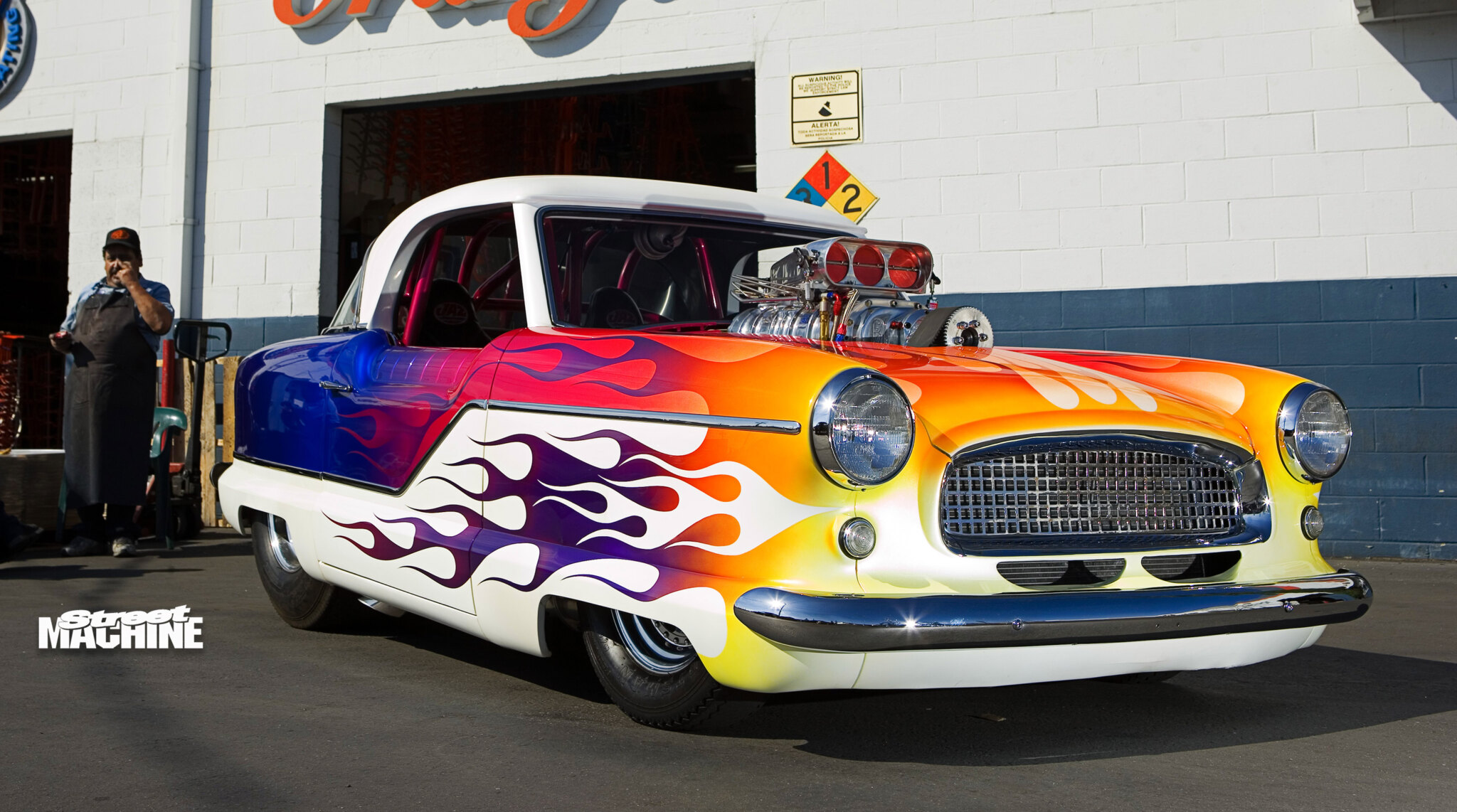
Rocking and spasming, the Metronator pulls out into the traffic. Even at idle, the big-block Chevy does everything it can to pull free of the chassis. Twitching one way then the other, the blower whines its warning. Regular cars line both sides of the street: a Honda, an old Caddy, a minivan. There’s maybe a metre of clearance either side of the Nash and 1500bhp to squeeze through the gap.

They don’t build cars like Bryan Thatcher’s Metropolitan in the States so much these days. It’s all got too safe and self-conscious. Rat rods rule, super muscle cars get the TV time and stock muscle cars scrabble up the big money at auction. Bryan doesn’t care about any of this.
“Ever since I was in high school I was a car guy,” the Californian smiles. “But I always had to have something bigger and faster than everybody else.”
At 149.5 inches long, ‘bigger’ isn’t what springs to mind when it comes to the Nash Metropolitan.

“People do ask why I chose the Metropolitan and I’d like to say it was some kind of great plan but it wasn’t. When I was at school someone had a Nash with a small-block Chevy. I remembered that car when I was visiting a friend one day. He had a Nash sitting in his yard. The car was partially disassembled. I asked how much he wanted for it and he said $50, so I took it.”
Back home, the neighbours got stuck in.
“As soon as the car arrived on my driveway I had guys telling me: ‘You’ll never do anything with it.’ That was all the inspiration I needed. From that moment this car was always going to be wild beyond belief, something that would be noted around the world. That’s why I called it Metronator.”

Years ago Bryan was a drag racer, and a serious one. He ran A-Gas, B/B Altered and Pro Stock. Add an aero-engineering background to the mix and it’s not hard to see where the skill and inspiration came from to build Metronator. But he didn’t make it easy for himself. Key to the car was keeping the bodywork stock, which meant designing a completely new chassis with Funny Car front suspension and a Formula 1-style rear set-up. There was no other way to fit those monster 19-inch rear tyres.
“The car’s built to go fast, no doubt about that,” Bryan says, tapping the roof with the fingers of his right hand as he talks, “but it was also built to be stable on the street. I use it a lot on the road and it performs really well.”

Bryan’s thoughts drift back to the first time he slid into the seat of his just-finished Metro’ — tightening those belts and keying the engine in anger must have been a big moment.
“I was prepared for what the motor would do when I fired it. What I wasn’t prepared for was the car jumping forwards 15 feet when I stuck it in gear. I make sure no-one stands in front of me when I do that now.”

While that maiden run might have been memorable for an unexpected performance, the car has since proven Bryan’s engineering and driving talents time and time again.
“I have to tell you, 0–60mph [0–100km/h] in this car has to be as quick if not quicker than a Pro Stocker. It’s got to be in that 1.0–1.1sec range. When it launches it really sets you back in the seat. The wheels come up and everything translates to the rear tyres but they don’t spin. The design of the chassis really gives it superior performance.”

Back in 1952, when the American car market was mainlining on the bigger is better ethos, the Nash Motor Company turned against the tide and designed the Metropolitan. By building a full-house Pro Street show car in this day and age Bryan has arguably done the same but people love it. Even diehard Metropolitan restorers can’t prevent the corners of their mouths from turning up at the sight of this psycho shoebox.
Back in the present moment, dogs bark and car alarms wail the length of the street. Office workers throw open their windows and men in overalls blunder out of the workshop gloom to see what the noise is.
Metronator, still spasming, pulls onto the stage. Bryan blips the throttle. It’s midday on Monday in Orange County, Los Angeles. Onlookers scan the length of the road for cops while calculating the odds of a serious wipe-out for the tiny Metronator.

It’s not a race, there’s no Gasser Willys to challenge, it’s just for the hell of it. There isn’t even a burnout or a flag man. Bryan just sticks his right foot hard down.
In one smooth movement up come the front wheels as the back drifts a little to the left. Clouds of dust and litter gush into the air as the Nash straightens, squats and goes. The thump and whine of the big Chevy tumbles and rolls off the surrounding buildings for four glorious seconds until the T junction at the southern end of the road halts the proceedings and the Nash is reined in. All around palms slap palms and smiles cut through a morning’s grime. Wild and crazy is what Bryan wanted and judging by this morning’s impromptu audience that is certainly what he’s got.
NASHVILLE SKYLINE
Nash might be an unfamiliar name these days but for years it was one of the most successful American auto makers after the big three, and highly innovative. The company was founded by a Wisconsin bicycle maker, Thomas Jeffery, who started producing a car dubbed the Rambler in 1902.
In 1918, GM president Charles W Nash bought the company, renamed it after himself and took it to new heights, coping with the Great Depression better than most and emerging from WWII to outsell Studebaker, Hudson and Packard.

Nash died in 1948 and the company launched a series of radical new models — the Airflyte in 1949, the Rambler in 1950 and the Pininfarina-designed Golden Airflyte in 1952. The company initially did well but soon found itself struggling to compete with the R&D and marketing muscle of the Big Three. In an effort to survive, Nash swallowed up the Hudson Motor Car Co to form American Motors and by 1957 production of the full-sized Nash had ceased, with AMC putting its hopes in the smaller Rambler and new Metropolitan.
The Metropolitan was designed in the US but built in Britain by Austin. It was launched in 1953, in hardtop and convertible forms, powered first by a 1200cc Austin four and then a 1500cc in 1956. Early cars were dubbed NKI Customs but most were sold as Nash or Hudson Metropolitans until 1957, when Metropolitan became a marque in its own right. Production ceased in 1961 but cars sold until late in 1962, with the finally tally sitting at approximately 95,000 units. AMC itself lived until 1987 when it was taken over by Chrysler.

BRYAN THATCHER
1956 NASH METROPOLITAN
| Colour: | PPG candy/pearl, eight colours |
| GRUNT | |
| Engine: | Chev big-block, 500ci |
| Supercharger: | BDS 8/71 blower |
| Injection: | Enderle injector with Hilborn barrel valve |
| Heads: | Brodix |
| Valve gear: | Comp roller cam and rockers |
| Ignition: | MSD |
| Exhaust: | LaPole custom headers |
| SHIFT | |
| Trans: | Turbo 400, 3500rpm stall converter, Allison modular valve assembly, CSI composite transmission shield |
| Diff: | 4:56 gears |
| INSIDE | |
| Gauges: | Auto Meter |
| Harnesses: | Jaz |
| Shifter: | B&M Pro |
| BENEATH | |
| Brakes: | Nothing! (f), Wilwood discs (r) |
| Steering: | Flaming River rack and pinion |
| Suspension: | Mark Williams Funny Car tubular front axle and spindles, Aldan American coil-over shocks (f), nine-inch Ford diff, modified 41-spline axles, four-link with double mono coil-over shock assembly (r) |
| ROLLING | |
| Rims: | Center Line 15×3 (f), 15×15 (r) |
| Rubber: | M/T Sportsman 26 x 7.50 (f), 33×19.5 (r) |
Comments