
First published in the November 2014 issue of Street Machine
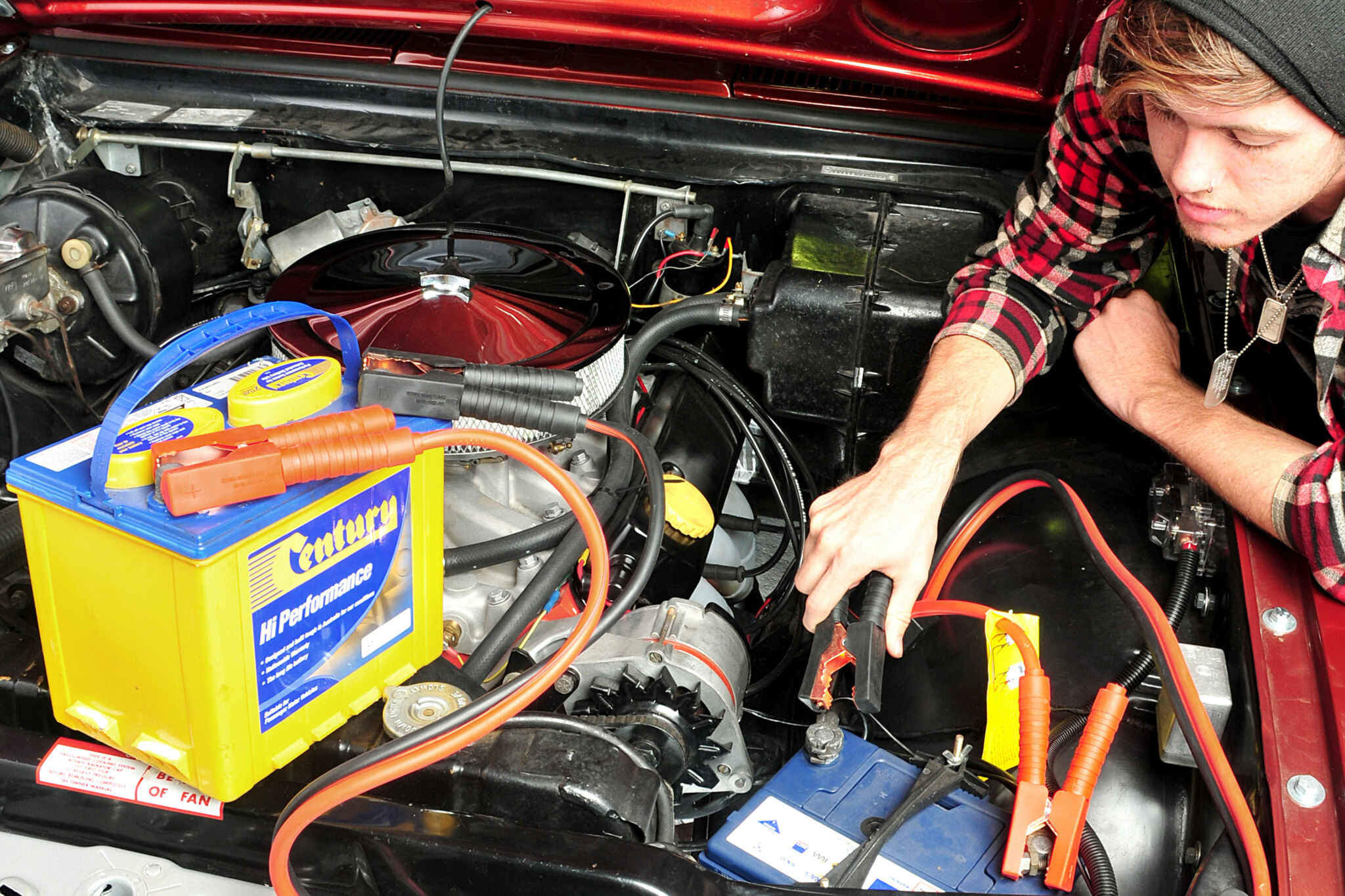
The electrical system of a car is often one of the least-considered aspects of a project, but well worth putting some extra thought into. Your battery has to cope with a lot, including engine bay heat. Excessive heat reduces the performance of a battery and also accelerates internal degradation. Batteries have a limited service life to begin with, so there’s no sense in speeding up the process.
In general, the things you can do to keep your battery in good shape are to keep it clean, avoid over-discharging, avoid overheating and keep the electrolyte topped up. The tops of the plates should never become uncovered. If they do, chemical action/current will be limited to the immersed sections of the plates and may cause overheating. When you are topping up the electrolyte you should use distilled water to avoid mineral contamination of the battery chemistry. The details of lead-acid battery chemistry are complex and difficult to understand. Fortunately, only basic knowledge is needed to keep one in good shape.
BACK AND FORTH
Batteries consist of lead plates immersed in a solution of dilute sulphuric acid. Although both plates are commonly referred to as lead, they’re different. This difference, combined with the action of the acid, causes electricity to flow. As a battery is discharged, both plates are changed into non-conductive lead sulphate, and the sulphuric acid becomes weaker. When the plates are covered in lead sulphate and the acid is at its weakest, no more chemical reactions are possible and the battery is flat. When the battery is recharged, the reversed current forces sulphur back into the acid, re-strengthening it, and the lead plates are returned to their original composition – almost.
The re-conversion of lead sulphate back into lead and sulphuric acid isn’t perfect, and some lead sulphate remains on the plates. Whatever remains there for too long develops a crystalline structure and becomes very difficult, and eventually impossible, to remove. The result is a permanent reduction of battery capacity. This is why a battery shouldn’t be left sitting around after it’s gone flat. If it’s fitted to a car this won’t really happen, because as soon as the engine is running the alternator begins recharging the battery. In fact, the main job of a car battery is simply starting the engine. After that, the alternator itself should meet the electrical needs of a car. It’s only if the current requirements exceed the capacity of the alternator output that the battery contributes current.
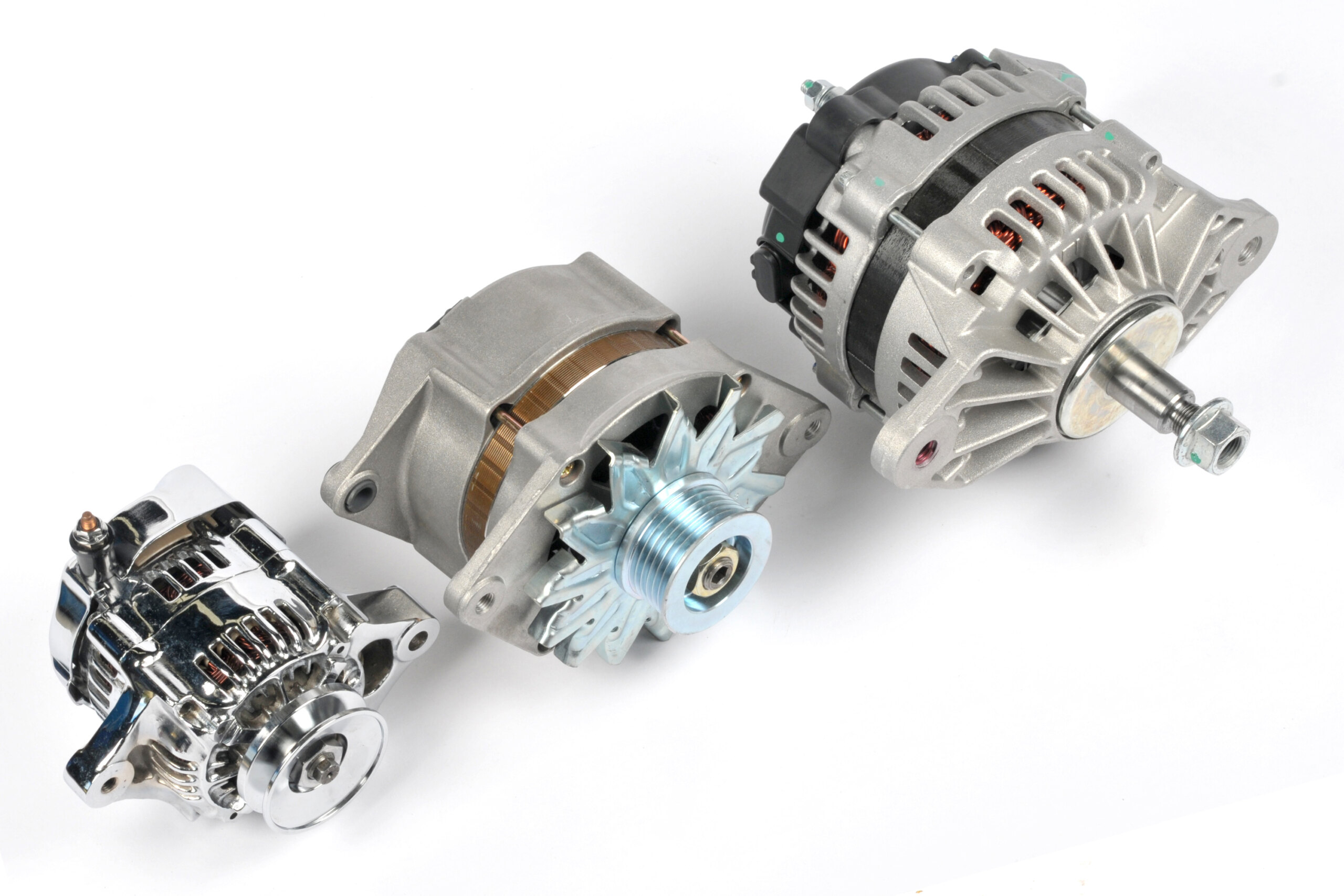
Early cars were fitted with DC generators for their electrical needs, but these were replaced by alternators many decades ago. Some enthusiasts still like generators for the sake of authenticity, but that’s the only reason you’d fit one. CAE Performance Products offers an alternator fitted into a housing that looks like a generator, which is an excellent solution for the rodding fraternity.
THE BETTER ALTERNATIVE
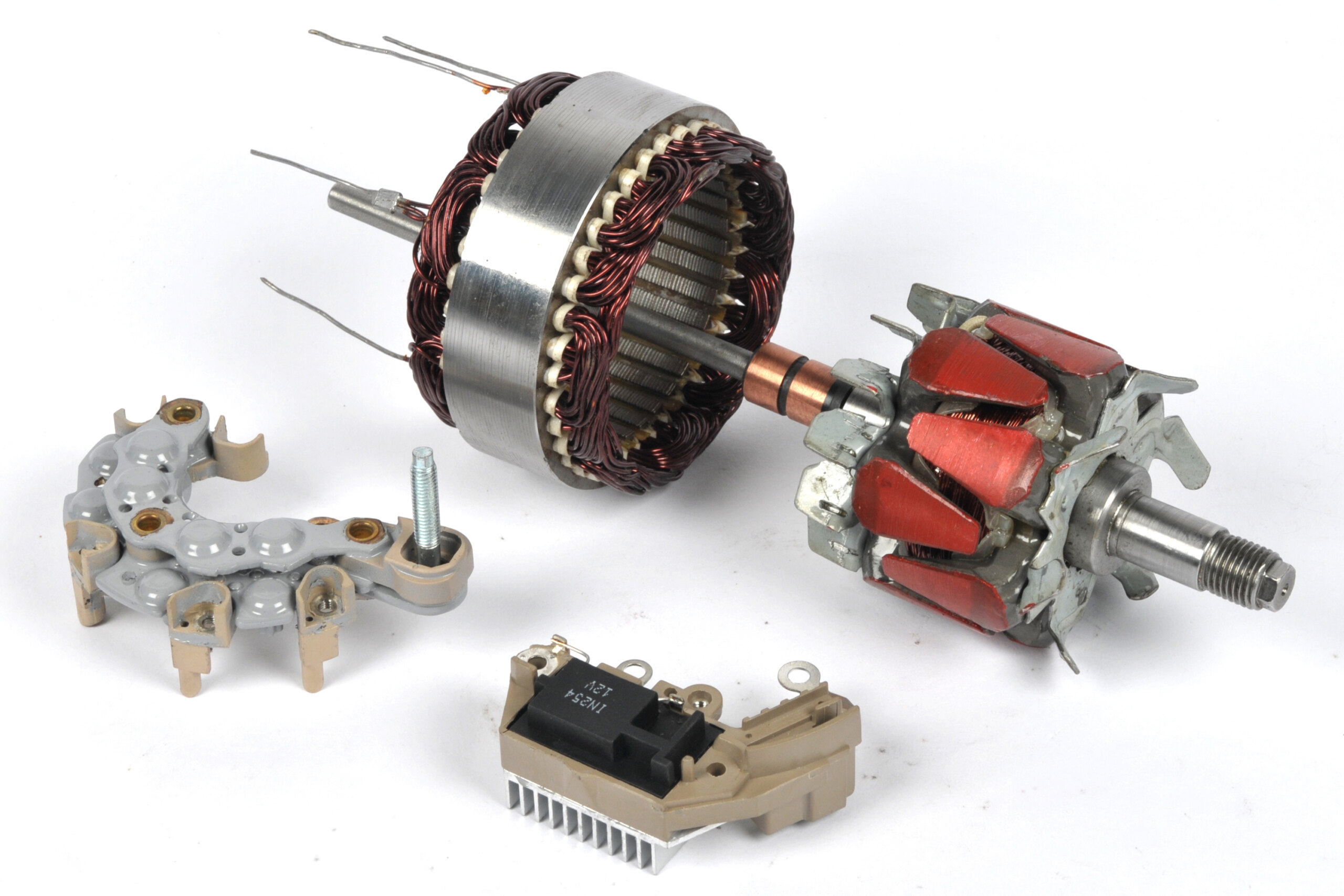
Alternators are more efficient than generators because the current generated passes out of the stator through solid electrical contacts, rather than through sliding contacts as with a generator. In an alternator the only current passing through sliding contacts is that required to create the magnetic fields in the rotor, which is far less than that generated in the stator windings.
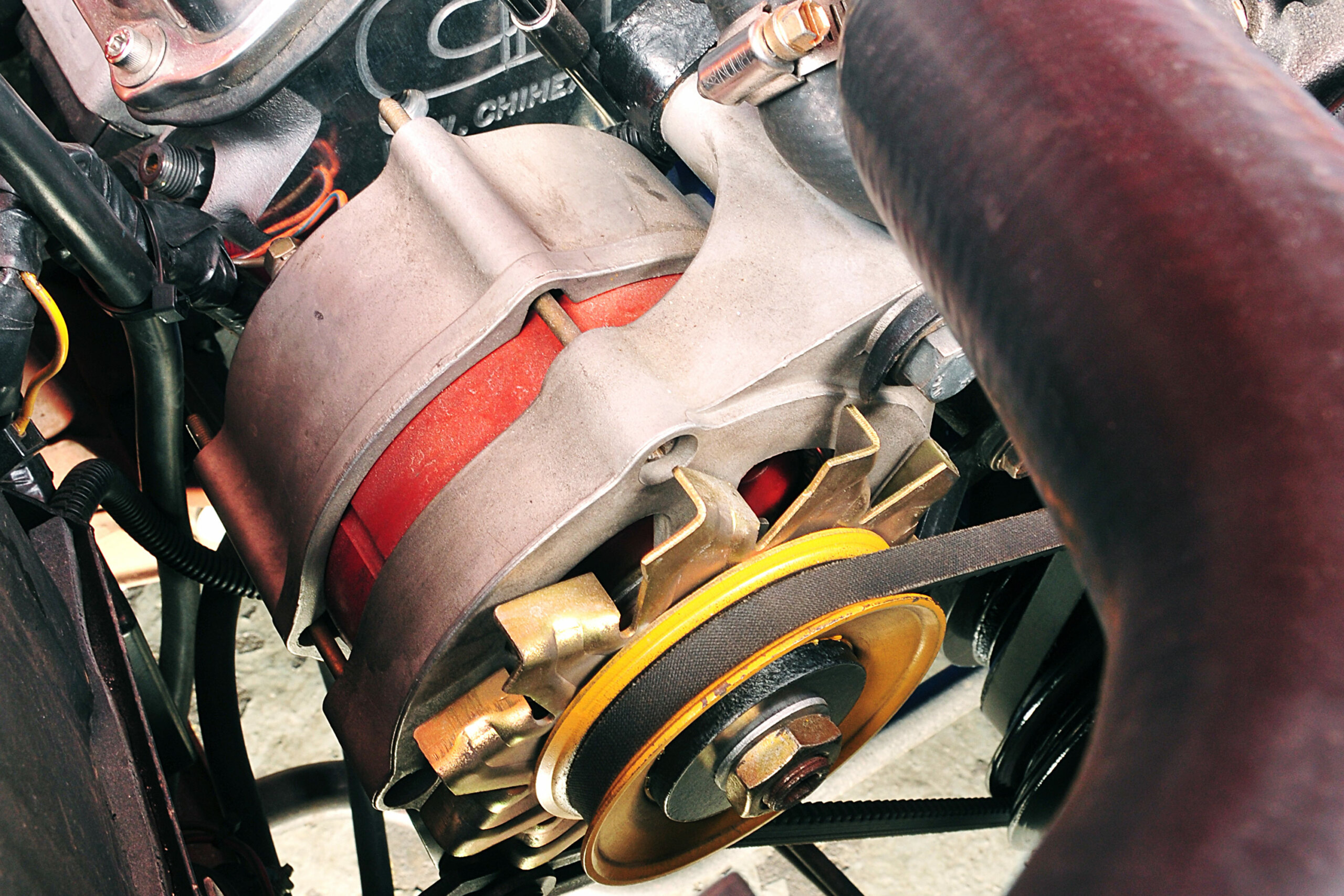
What’s more, the faster wires and magnetic fields slide past each other, the greater the amount of current generated. The interaction between the fields and the windings in an alternator takes place at the outside diameter of the unit. This means that for a given number of degrees of rotation, the relative speed between fields and windings in an alternator is greater, and therefore creates more current at lower speeds.
Manufacturers calculate the electrical requirements of a car and design the electrical system to suit. Of course the cars from yesteryear that form the backbone of street machine projects didn’t have the electrical loads common in today’s builds. Consequently most of them have quite restrictive electrical systems.
Alternators with outputs in the 40 to 60A range were pretty common. If the electrical requirements of a restored car are the same as when it was built, you could simply replace an alternator with one having the same rating as your original. However, choosing the right alternator is important if you have a custom project.
BASIC MATHS
To determine the correct alternator, you have to add up all the electrical loads that could be applied at the one time and get an alternator that can supply the current needed. Headlights might draw around 20A, a Bosch HEI or IC&E ignition will use maybe 6-8A, and a high-performance MSD, Crane or similar might take 16-20A. Any other accessories that are likely to be used simultaneously, like thermo fans, also have to be considered. If you’re into huge sound systems, you’ll absolutely need a higher-rated alternator. Some of these systems can draw between 50A and 100A. Then, there are the needs of the battery.
In addition to the running electrical loads, the battery has to be recharged. If the total draw of the electrical system is, say, 60A, and you have just a 60A alternator, then there’ll be nothing available to recharge the battery after starting. Your alternator must be able to supply more than any total simultaneous loading that’s likely and still be able to recharge the battery. Later-model cars are fitted with much higher-rated alternators and these can be fitted to earlier models. Of course this calls for custom bracketry and wiring, but it’s not overly complex. For example, fitting an internally regulated alternator to an earlier model that had an external regulator calls for a battery sense wire where there wasn’t one before. Auto electricians can obviously do it for you, but there are also kits and ready-made parts available for various models. CAE Performance Products, for instance, carries a considerable range of brackets for fitting high-output alternators to Chevs, Clevelands and Windsors in various positions. Ribbed- and V-belt pulleys are available.
GETTING CLEVER
The latest alternators are linked to engine management systems and they’re becoming quite smart. As you switch on various loads they calculate what the current draw will be and adjust output to compensate. They may even speed up the engine idle to boost voltage. Such alternators will also adjust the charging voltage to a battery so that it’s not hit with full charging current immediately. Instead, the rate will be ramped up gradually. Also, rather than simply reading the battery voltage to determine the charge voltage, the latest systems also consider the state of the electrolyte in the battery.
Increasingly, functions that used to be achieved through direct electrical connection, like starting, are routed through the powertrain management system. With these models the driver presses a start button, and rather than directly connecting the starter motor and activating the ignition and fuel systems, a start request is sent to the PCM. The PCM then turns the motor until it works out where everything is and only then adds fuel and spark and starts the engine. Because it doesn’t add fuel until exactly when it’s needed, emissions are reduced.
This type of system management is going to become increasingly common in the future, and as we retro-fit newer crate motors to our projects we’ll be dealing with it.
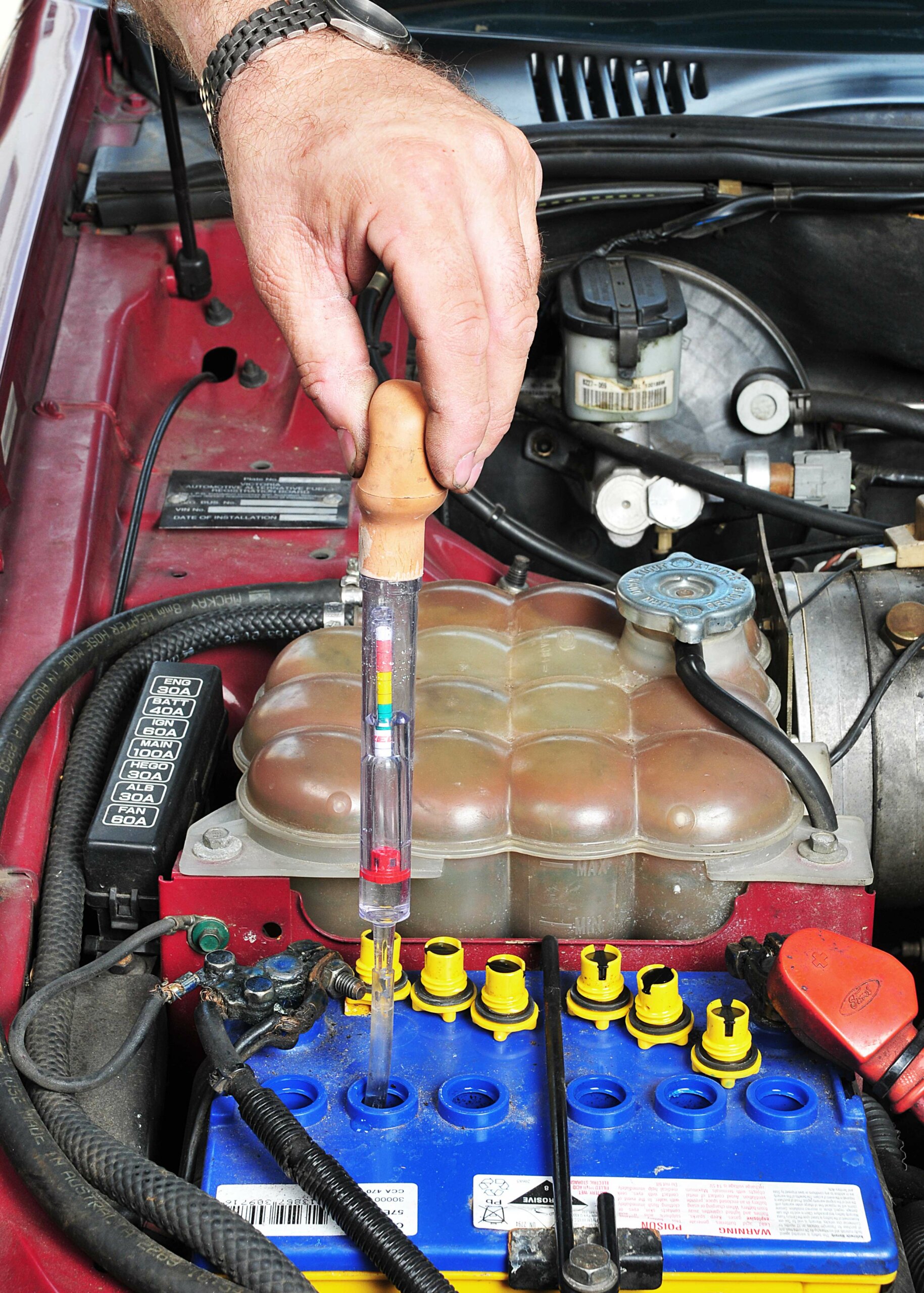
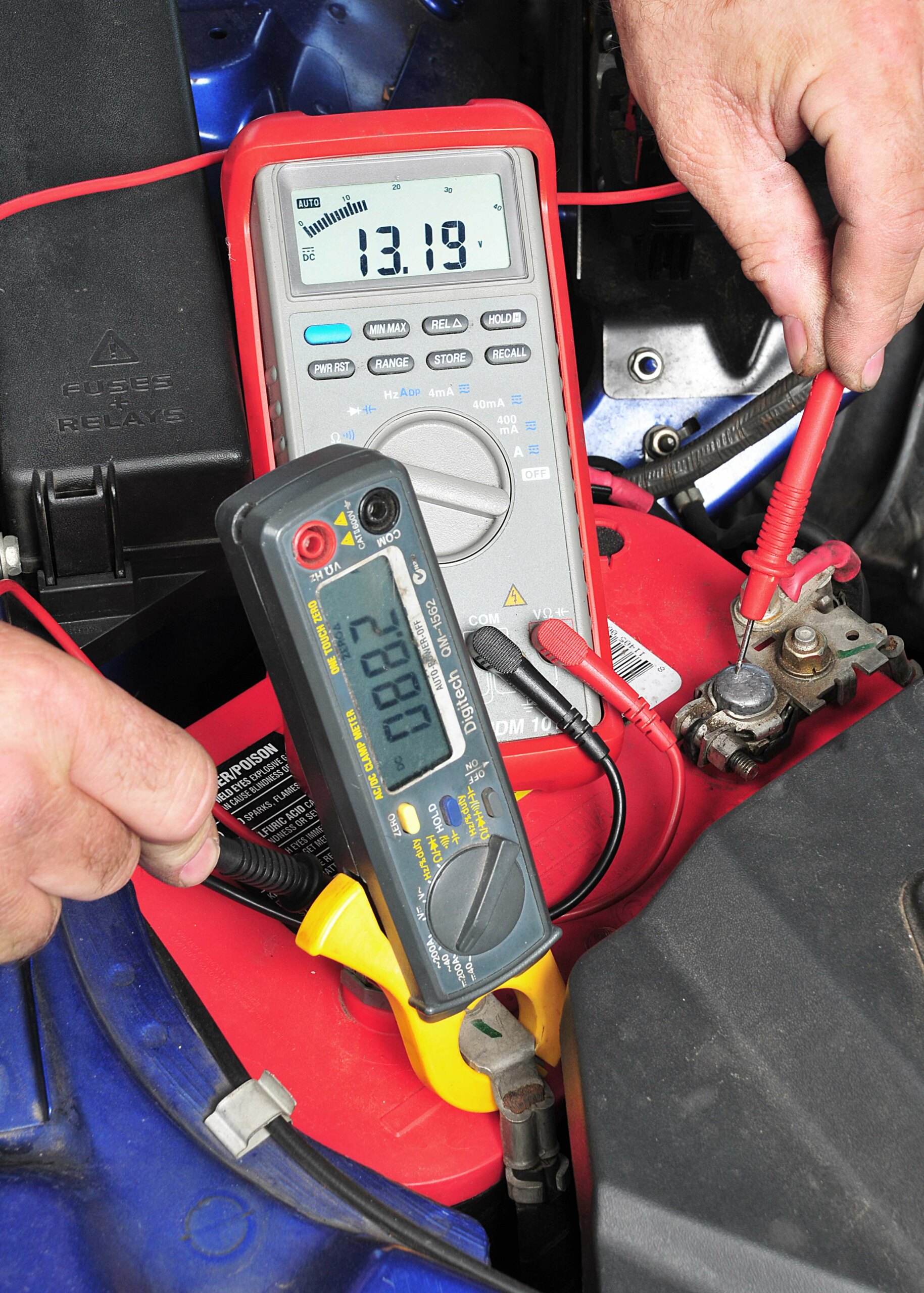
RIGHT: As a general indication 12.7-12.6V indicates full charge, 12.4V is around 75%, 12.2V is 50%, 12.0V indicates 25% and at 11.8 the battery is flat. Also a clamp meter can tell you how much charge a battery is accepting. These methods have limitations but anyone who needs greater precision probably knows how to obtain it already
HARD TO TURN
Large-displacement, performance-oriented engines with higher compression ratios, or big roots blowers perched on top, are harder to start and require strong batteries. Higher-capacity alternators are also needed to keep these systems charged. The main thing to consider in choosing a battery for a high-performance engine installation is its CCA rating. This stands for Cold Cranking Amps, which describes how much current the fully charged battery can supply for 30 seconds. Bigger is obviously better.
Batteries are also defined by their Reserve Capacity. This tells how long the battery will deliver 25A before voltage drops to a pre-specified level, usually 10.5V. It’s designed to be an indication of how long you can continue to drive your car with a failed alternator. A third battery descriptor is the AH, or Amp-hours rating, which indicates how much current a battery can supply and for how long. As a simple example, a 60 AH battery should, according to the numbers, deliver 60A for one hour. Used differently the same battery can deliver 30A for two hours and so on. In practice the figures will be less. The most important rating system for a car is CCA, because cranking the engine during starting is, for the most part, the only thing a car battery does, which is why it’s universally referred to as a starting battery.
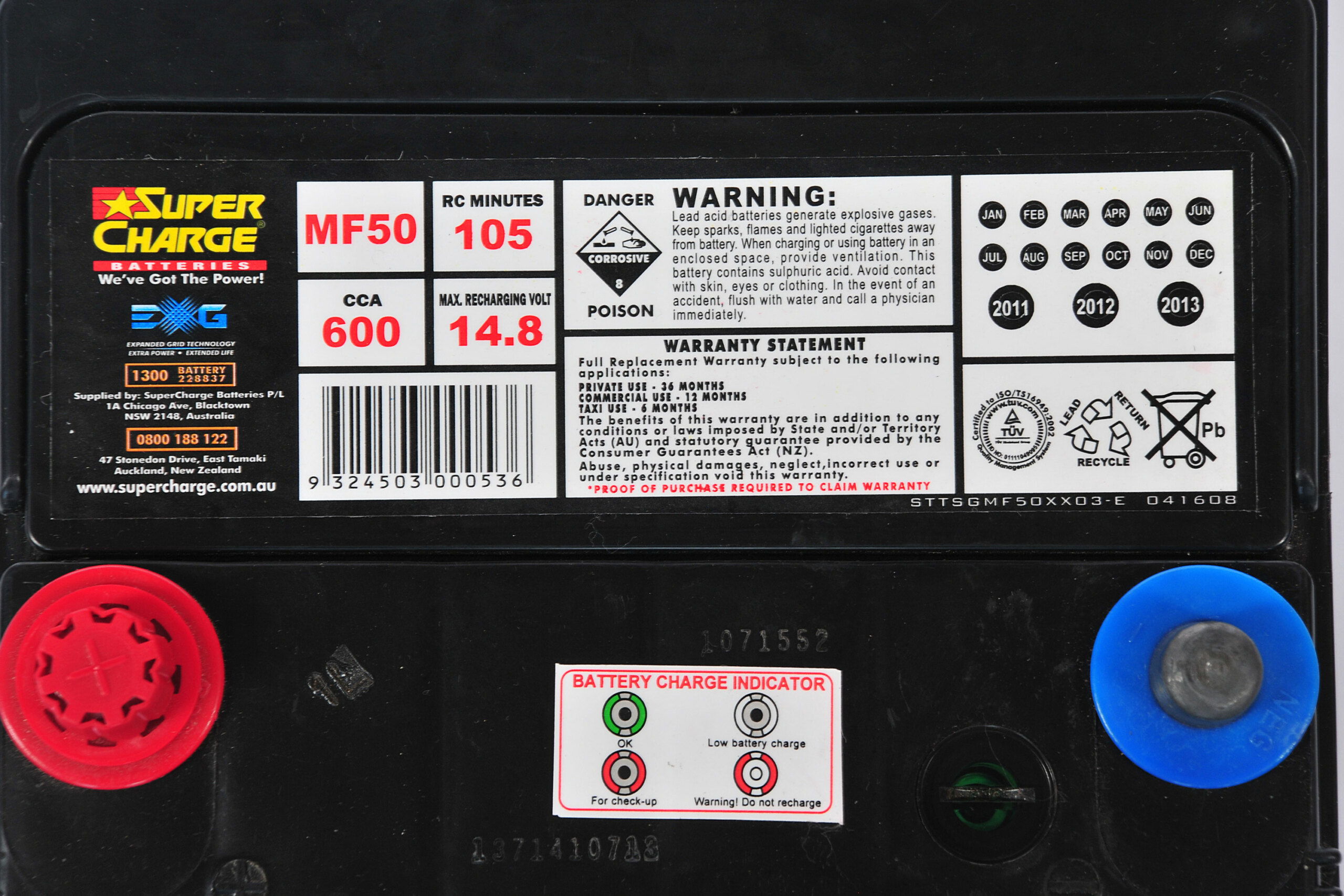
Starting batteries are defined by the fact that they deliver a lot of current in a short time. In order to do this the lead plates must have a large surface area-to-mass ratio. This is achieved with thin plates. Such batteries are not designed to be deeply discharged and will suffer if they are. Deep-cycle batteries, on the other hand, are designed for considerable discharge before recharging. They have thicker plates to allow this. Some newer cars have so many electrical accessories that they’re fitted with two batteries, one for starting and a deep-cycle unit to supply current for things like power-operated boot lids and anything else that operates while the motor/alternator isn’t running. This would be a useful set-up in a street machine with a big stereo system or other high-drain electrical accessories.
NO MAINTENANCE
Sulphuric acid is hazardous, and the battery-manufacturing industry has long sought ways to minimise consumer exposure to it. Sealed batteries, or more formally, VRLA (Valve Regulated Lead Acid) batteries are the result of this. In AGM (Absorbent Glass Mat) versions the electrolyte is held in a very fine glass mat to reduce exposure to acid and eliminate spillage, however these aren’t suited to early charging systems because of gassing.
When a conventional lead-acid battery is almost fully recharged (most of the lead sulphate removed) the charging current begins to split water in the electrolyte into hydrogen and oxygen. Electrolyte loss due to this is why conventional, or flooded, batteries have to be topped up. VLRA batteries operate at higher internal pressures that force oxygen back into the system. In turn, this has other internal effects that reduce hydrogen production and thus reduce electrolyte loss. However, they’re meant to work with newer charging systems that vary the charge applied to the battery according to its internal state. In a custom installation the good thing about AGM and gel cells is that they can be mounted at unusual angles.
If you’re building a project with substantial electrical demands because of either performance or entertainment, or both, you’ll need to look at a higher-capacity electrical system. But even if you’re restoring an older model where demands are likely to be similar to original specifications, attention to the charging system is essential.
IN DETAIL:

1: The lead compound used in battery plates is in paste form. It has no mechanical strength so it’s pushed into grids of cast lead like this. The lead used in the grids would also be too soft if it weren’t alloyed with other metals like antimony.

2: Modern automotive starting batteries use expanded grids. As the grids in some types are stretched open they’re twisted somewhat, which is said to increase contact with the active material when it’s pressed into the plate. Expanded grids are alloyed with calcium.

3: Here’s what real battery plates look like. The brown one on top is a positive, or anode, and is filled with lead oxide. A separator is under it and at the bottom is the negative anode plate that’s filled with porous lead.

4: Here’s what a modern battery looks like inside. Current generation batteries are sealed so it’s a bit difficult to get a proper look inside. The plates are held in pockets that allow electrolyte to pass but keep the plates themselves from touching each other.

5: A lead-acid cell creates about two volts, so 12V batteries have six cells. The more plates in each cell the greater the current available.

6: When you look down a visual indicator window here’s what you’re actually looking at. When the density of the electrolyte drops, so do the balls.

7: It doesn’t happen that often compared with the number of batteries sold, but occasionally the gasses liberated from poor charging procedures explode with spectacular, dangerous, results.

8: Positive plates shed material throughout their life cycle. Here’s what that looks like. Corrosion is kind of built in to batteries.

9: The interior of a six-volt FJ battery being rebuilt by a company called Ariel. The ridges across the bottom of each cell keep the plates separated from any material shed from the plates to avoid short-circuiting.

10: Spiral-wound batteries provide good contact between the plates and electrolyte, excellent capacity and the plates are self-supporting. This one from Exide works as both a starting and deep-cycle unit.

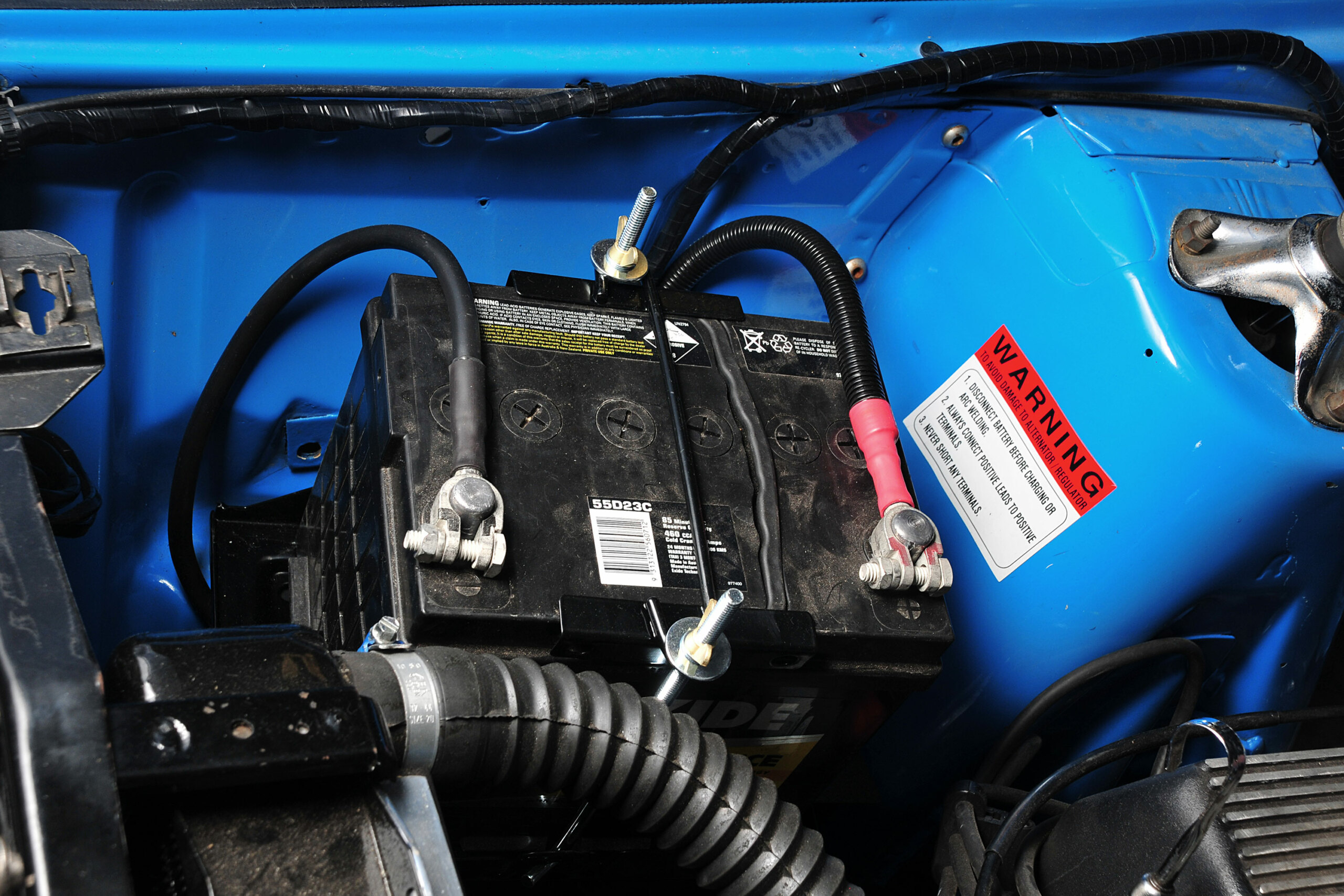
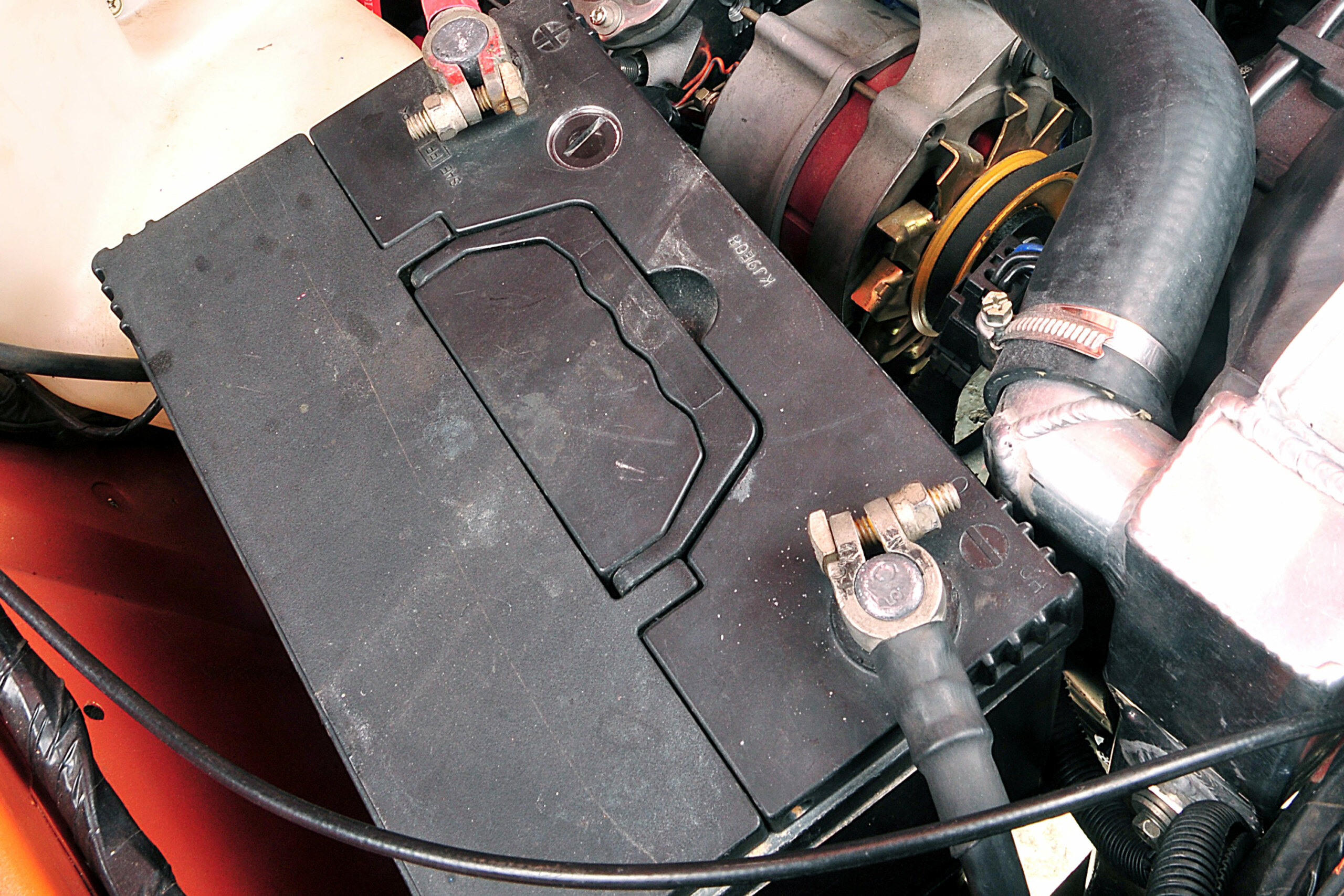
19: Good cables and clamps are essential. They should be clean and fit firmly and tightly, because so many electrical problems can be traced to bad earths. Coating the terminals with a light smear of petroleum jelly is a good idea, although it doesn’t eliminate corrosion entirely. Braided earth straps are good for earthing the engine. More than one is better.
CONTACTS:
Century
centurybatteries.com.au
Retrolooms
retrolooms.com.au
Supercharge
supercharge.com.au
CAE Performance Products
caenterprises.com.au
Mike’s Auto Electrics
mikesautoelectrics.com
Ariel Batteries
arielbatteries.com
Comments