

First published in the January 2006 issue of Street Machine
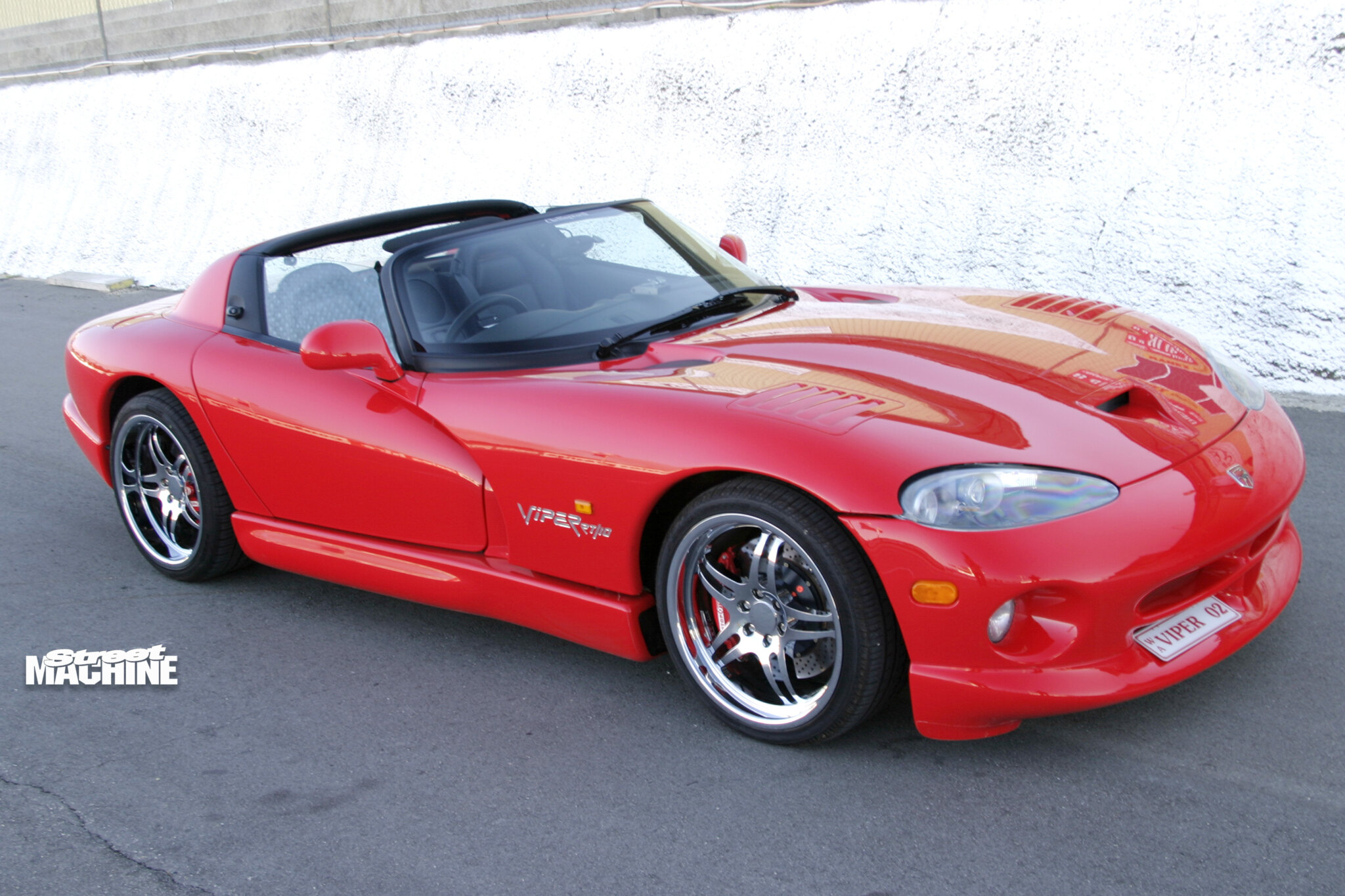
You’ve got to love the Dodge Viper — it’s a sleek looking sports car wrapped around 488 cubic inches of aluminium V10 and with 450hp on tap it has enough grunt to satisfy every urge. Well, almost every urge.
Street Machine readers tend think a little differently to most normal people. It doesn’t matter if we have 500hp under the right foot or if our car runs on methane generated by our own pig farm — we’ll always find a way to make more power.

Many Viper owners agree with this philosophy judging by the aftermarket goodies available. Blowers, turbos and fancy injection systems are all out there.
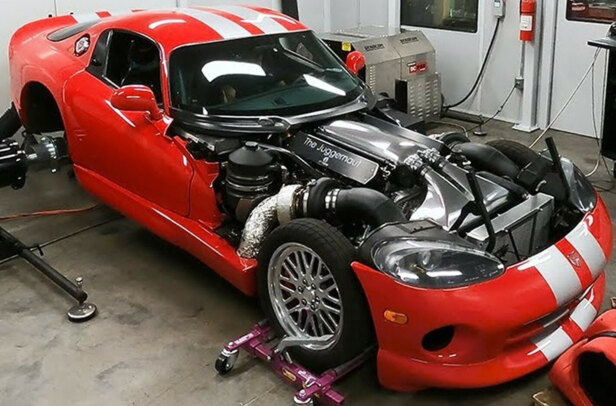
When Mark McKay bought his rare Australian-delivered Viper in 2003 he started checking out some of those goodies straight away and before long it snowballed into the 1000hp beast you see here.


A build-up like this doesn’t happen overnight and it’s not the kind of thing you do in your garage at home so Mark M employed the services of Mark Else to take on this one of a kind build-up. Mark E (Mark’s Workshop, WA) is well known to Street Machine readers — who could forget his twin supercharged SS Holden ute from the February ’05 issue?
With boxes of US-sourced hardware, surely this was just a pretty simple bolt-on job, right? Oh no. Mark E had no intention of just fitting the pieces and waving the Viper out the door if things weren’t right. And as it turned out, many things weren’t right.
If you’ve seen the engine bay on a stock Viper you’d know there’s no room at all under that long, curvy bonnet. This also means that heat is a constant problem and with the boys about to double the output, heat was definitely going to be an issue here. Then there’s the problem of where to fit an intercooler. You don’t take a $250,000 car and hang a $300 intercooler out of the nose.
Engine cooling was tackled first with the fitment of a triple flow four-row unit taking up a fair amount of room up front. This meant that the engine oil cooler had to be relocated elsewhere; the decision was made to fit a monster custom-made oil cooler (with its own thermo fans) under the rear of the car.

Intercooling the intake charge presented another problem because the standard 700hp water-to-air intercooler from PWR wasn’t going to cut it with the engine output pushing 1000hp at the flywheel. So Mark used two 700hp PWR cores running one after the other in the intake path. Coupled with three Davies Craig water pumps, a 15-litre reservoir and a heat exchanger mounted up front, the intake temps are kept pretty much under control.

Moving so much stuff around in the front meant that the original bonnet catch arrangement had to go. Instead of the standard manual release it’s been converted to an electronic set-up that involved some intensive head scratching.

Boosted air is delivered courtesy of the Paxton Novi-2000 centrifugal blower that’s been reverse mounted at the front of the engine. This positions the intake in a forward facing direction. It shoves 11psi worth of high-density air through the custom intercooler and into the standard intake manifold. Combined with a capacity increase to 505ci, the Viper dumps 821hp at the rear wheels on pump gas. That has to be pretty damn close to 1000hp at the flywheel.
Although a built-up short block was delivered from the States, Mark E had to make some changes so it could deliver this kind of power.

“When we first ran it on the dyno, there was black smoke from the exhausts even though it was showing a lean air/fuel ratio of 13:1. The Americans had taken the old school approach of lowering the compression by using dished pistons but in doing that they messed up the combustion chamber shape,” he says.
Basically the new combustion chamber shape was so poor that the Viper couldn’t be tuned effectively. Changes to ignition timing had little or no effect and it was clear things were not right.

Mark has a lot of experience with blown LS1s and he knew that he could run more compression than the US-built short block had been set up for. So he had some custom JE 10:1 compression flat top pistons made which allowed the engine to deliver a cleaner burn. It just goes to show that the Yanks don’t always know best.

So how does it drive?
“I’ve been in a lot of extremely fast street cars but I haven’t been in a street-tyred car that pulls as hard as this one,” says Mark E.
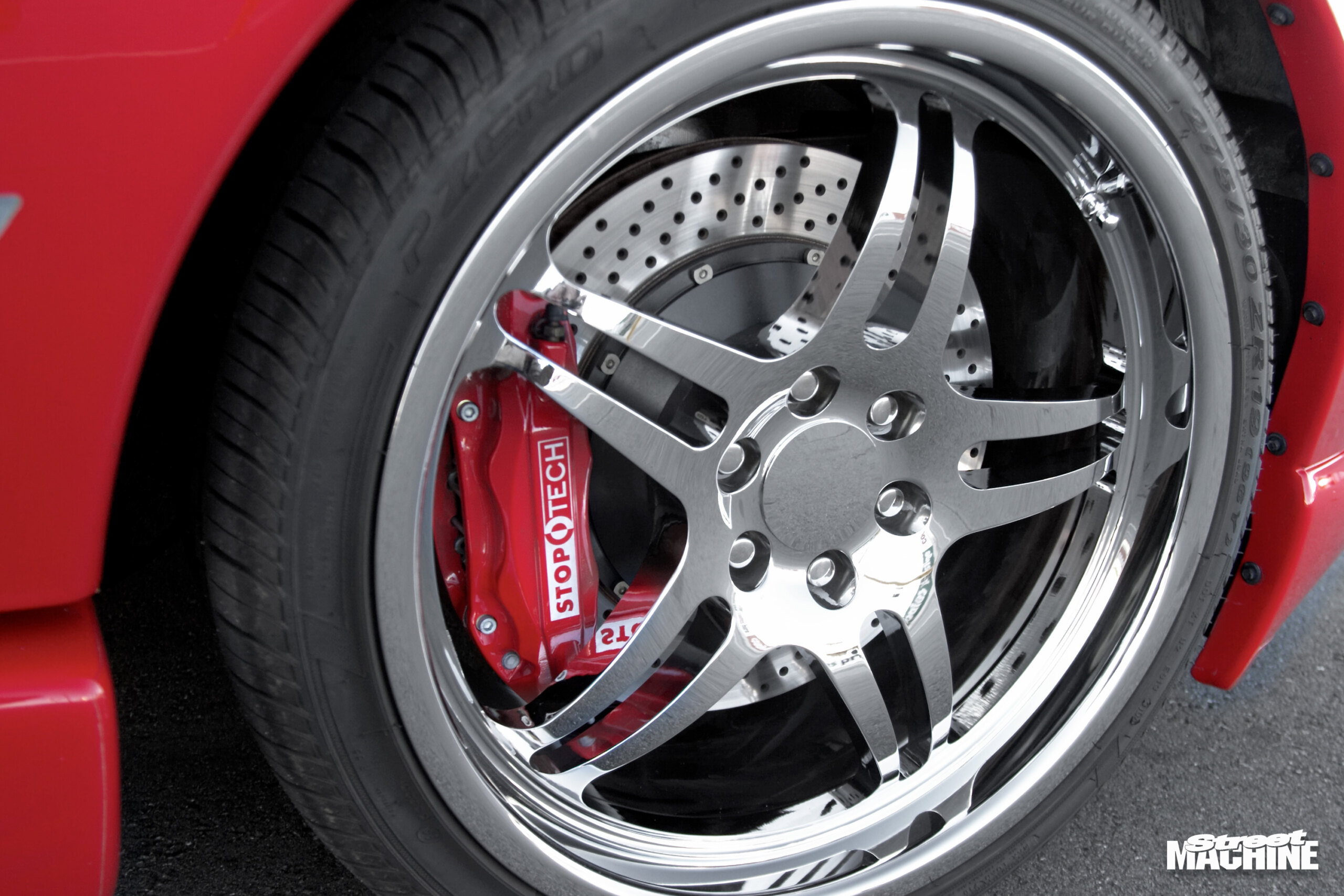
Yeah, it has a stack of horsepower but without decent rubber this car wouldn’t be going anywhere. Check it out — those are Pirelli P-Zero Rosso 355/25 ZR 19s wrapped around 13-inch wide wheels. Have you ever seen so much rubber in a true streetcar?
Up front the treads are wider than most people’s rear tyres, with 275/30 ZR 19 Pirellis mounted on 10-inch wide Complete Custom Wheels.

“When they’re cold you can smoke them into fourth gear,” Mark M says, “but when you get some heat into them they have unbelievable grip and she really takes off when you hit third.”
All that grip has made some driveline mods necessary, such as the 1400hp-capable Unitrax half shafts that transfer the horsepower from the cryogenically treated 4.55:1 ratio diff. In fact the only thing that hasn’t been modified in the driveline is the T-56 six-speed transmission — although it does use a Mopar Performance short shifter and a six-puck brass button clutch.
Funnily enough, the standard Viper brakes aren’t much chop, so a pair of 355mm diameter discs were fitted at the sharp end while 328mm discs work the tail. With four-piston calipers at each corner, it stops as good as it goes.

“I drive it nearly every weekend. It’s awesome, it’s got so much torque,” Mark M says.
“I love taking people for a drive in it. It pushes you so far back in the seat that the seat belts tighten up and when you stop you’re choked by them!”
McKay has plans to take the Viper for track sprints at Barbagallo Raceway and maybe even make some passes down the quarter at Kwinana. That should see some interesting trap speeds.
A SNAKE’S TALE
Unleashed on the world at the 1989 North American International Auto Show, the original Dodge Viper concept car took everyone by surprise. Here was a manufacturer that previously seemed obsessed with punching out bland econo-boxes all based on the same platform.
All of a sudden there was the Viper gleaming on the stand and a groundswell murmur grew into a crescendo — all crying: ‘Build it … Build it … Build it.’

So Dodge came up with a business plan to build the Viper over a low production run that would start in 1992 and finish by 1997.
Funnily enough that original car it released in 1992 was still being built until its replacement arrived in 2003. Dodge’s attempt to ‘out-Corvette the Corvette’ was a raging success and America couldn’t get enough of the Dodge Viper.
The first Vipers pumped out 400hp with their all-aluminium 8.0l (488ci) V10 based on the cast-iron V10 available in the Dodge Ram pick-up. The 1992 model was only available as a red RT/10 roadster. Eventually the colours extended to black (1993), and yellow and green (1994).

Dodge unveiled the hardtop GTS concept in 1993 and it went into production in 1996. By this time the power of the aluminium V10 had climbed to 450hp and you could order a GTS-R 650hp race version with carbon fibre/Kevlar composite shell, for $US325,000.
The RT/10 and GTS were updated in 2003 with a fresh new look and even slipperier shells to replace the aging design. These days the Viper pumps 510hp and 535ft-lb from a redesigned V10 that displaces 8.3l (505ci), and it will dent the wallet to the tune of $85,745US.
And if the Viper isn’t your style, there’s the Viper-powered SRT/10 Dodge pick-up.
Mark McKay
2002 Dodge Viper RT/10
| Colour: | Viper Red |
| GRUNT | |
| Engine: | Viper V10 |
| Blower: | Paxton Novi 2000 (11psi) |
| Intercooler: | Twin PWR water/air intercoolers |
| Manifold: | Standard Viper |
| Injectors: | 65lb/min |
| Heads: | Stage-III Viper 2.04 in, 1.6 ex |
| Rockers: | T&D shaft mount |
| Pistons: | Custom JE forged flat tops, 10:1 compression |
| Crank: | Custom stroker, 505ci |
| Rods: | H-beam Carillo |
| Cam: | Blower race-profile camshaft |
| ECU: | AEM plug and play |
| Fuel: | Twin Bosch 044 pumps |
| Exhaust: | Custom slip-fit stainless headers, 3in high flow cats, twin 3in system using three custom mufflers |
| SHIFT | |
| Gearbox: | T-56 six-speed |
| Flywheel: | Fidenza aluminium flywheel |
| Clutch: | Six-puck brass-button |
| Diff: | 4.55:1, cryogenically treated |
| INSIDE | |
| Steering wheel: | Standard |
| Shifter: | Mopar billet short-throw shifter |
| Seats: | Standard |
| Stereo: | Standard |
| Gauges: | Auto Meter fuel and boost pressure |
| BENEATH | |
| Brakes: | Stoptech 355x32mm rotors and four-spot calipers (f), Stoptech 328x28mm rotors, four-spot calipers (r) |
| Springs: | Standard |
| Shocks: | Standard |
| Bushes: | Standard |
| ROLLING | |
| Rims: | CCW 19×10 (f), 19×13 (r) |
| Rubber: | Pirelli P-Zero Rosso, 275/20 (f), 355/25 (r) |
Comments