

First published in the August 2016 issue of Street Machine
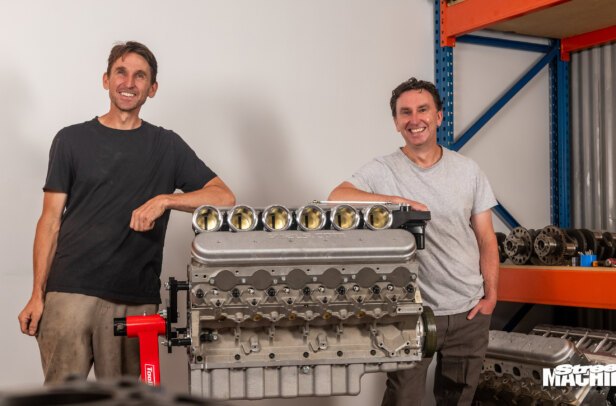
We’ve seen plenty of weird and wonderful engines over the years, but this V12, built using two LS1 donks, might just be the craziest yet. Created by brothers Matt and Shane Corish at V12LS.com, this one-of-a-kind V12 is a pretty cool piece of engineering.

“First, we did it to prove it could be done,” Matt explains. “But then Shane and I started receiving a lot of interest at SEMA when we were talking to suppliers about parts. So now we’re ultimately hoping to offer custom car builders something more exciting to go under their bonnet. High-end builds have come so far in the past few years; this engine will help take these builds to the next level.”
The guys took two standard LS1 V8 engines and cut off half the front cylinder on either side of one block to make the rear part of their V12 block. Then they cut away the rear one-and-a-half cylinders on both sides of a second block to create the front section. The two sections were trimmed in a CNC mill and then expertly welded together by David at Arctech Sales in Dandenong, Victoria. Then the newly created V12 block was completely re-sleeved and line-honed through both the main and cam tunnels by the guys at Dandy Engines.

Shane is handling the engineering side here in Australia, while Matt is sorting the business and marketing end of things, including the V12’s planned debut at SEMA in November.
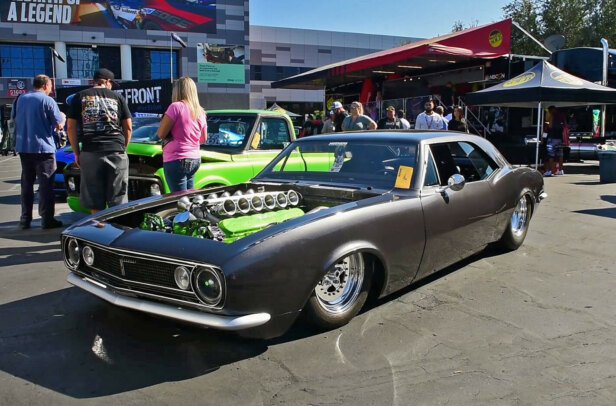
“The plan for the moment is to just dyno-tune this engine and then test its reliability in a car,” Shane says. “We’re going to put it in a ’68 Camaro built by Quality Custom Rides in Pennsylvania and try and have it at SEMA this year, with a view to making the engines commercially available in 2017.”


The V12 shares the same bore size, bore centres, deck height and stroke as your everyday bargain-basement 5.7-litre LS1 V8, but those extra four pots pump the capacity up to around 8.5 litres (519ci for those who like their measurements old-school).

To create those very long cylinder heads, the guys used four 241-type cathedral-port heads and cut a combustion chamber from each before welding each pair together. Shane created the casting patterns for the one-piece cast-alloy rocker covers at home. “Having my little CNC mill at home was useful for a few different reasons,” he says. “For example, the heads had to be cut through the bolt holes, so I milled up some shouldered sleeves for those particular holes to help spread the load.”
Shane couldn’t find a local company to make him a crankshaft, so he sourced a crank from overseas, built to his own specs. “We tried to source as much locally as we could, but no one wanted to touch the job of making the crank here in Australia,” he says. The billet hydraulic-roller camshaft, on the other hand, was machined by Clive Cams in Ferntree Gully. It’s not a massive bumpstick by any measure, with the duration 228/238 at 0.050in and 0.589in lift – basically a good street cam.

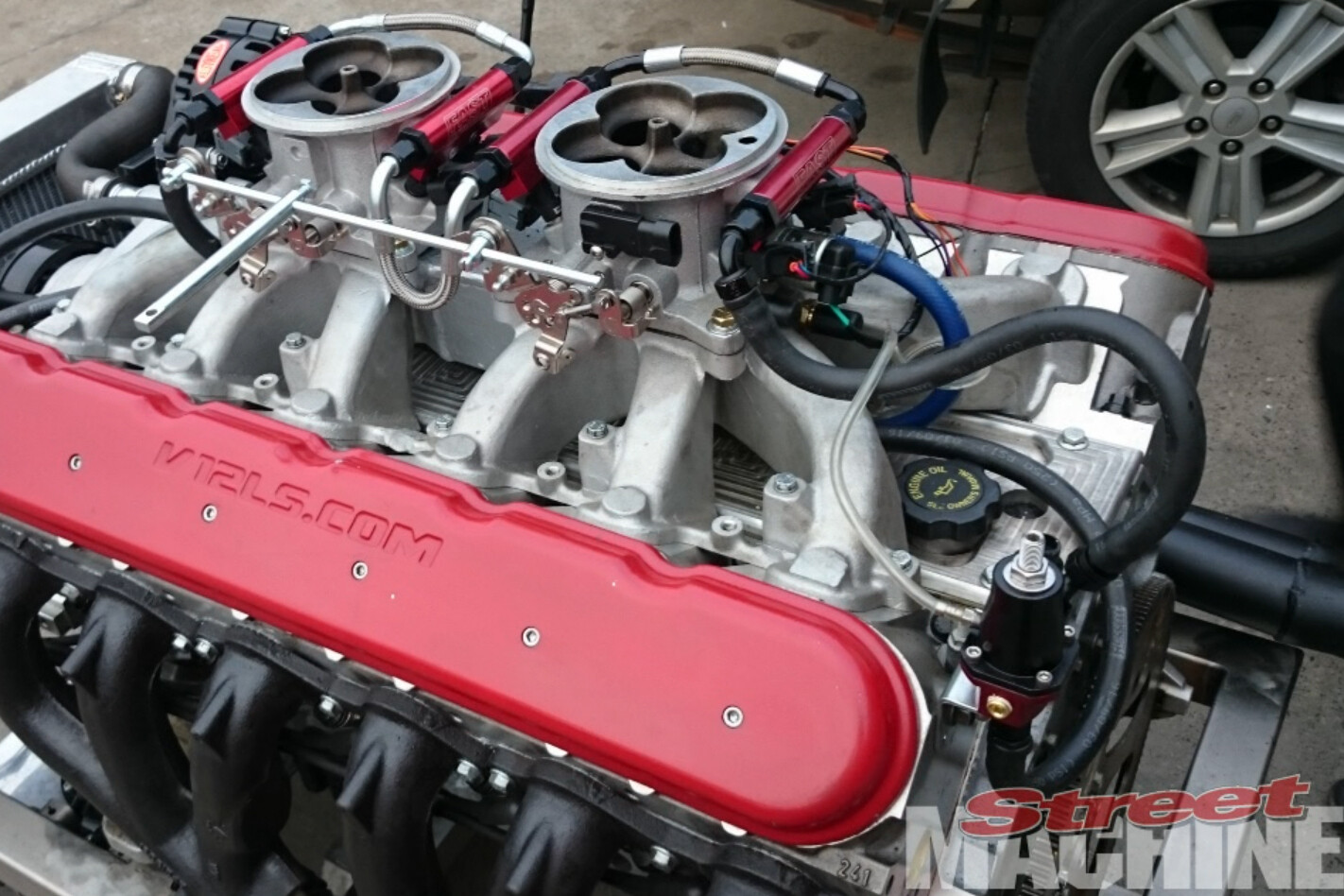
“For the intake, we used a pair of single-plane four-barrel intakes and cut front and rear runners off one each, then welded a large plenum chamber between them.”
Assembly was handled by Shane with a bit of help from his mate Travis Laurien. With 12 slugs and rods, it takes a little longer to put together than your average engine. The guys used standard rods and standard replacement LS1 pistons; essentially this engine has a cam, valve springs and a tad more compression after the block and heads were decked for straightness. Oh, and four extra cylinders.

To control it all, the guys are using a Haltech Elite 2500, which works with the 12 coil-packs and two FAST EFI throttlebodies to handle the fuel and spark. “Using the four-barrel throttlebodies was the simplest way to do it,” Shane says. “Even if we’d just used carbies we would have still needed a computer to control the ignition. The Haltech also allows us to run the V12 in an odd-fire configuration, which we needed to do because of the 90-degree block. It’s the only way we can do it without using offset crank pins like a V6 Commodore.”

‘Odd-fire’ refers to an engine that doesn’t fire at even intervals per revolution. The reason for this is that with 12 cylinders on a common crankshaft and 90 degrees between the cylinder banks, the maths doesn’t work out. Most V12 manufacturers choose to go the easy route and tighten separation between the cylinder banks to 60 degrees and have the cylinders firing every 60 degrees – 720 degrees divided by 12. At 90 degrees of separation between the banks this firing option isn’t possible (without using split crank pins), because there won’t be a piston at top dead centre every 60 degrees; therefore some cylinders fire 30 degrees apart while others fire 60 degrees apart. Plenty of manufacturers have had odd-fire engines over the years, but very few have tooled up for the expense of a 90-degree V12. It can bring up some interesting harmonics, but it also means this V12 has an exhaust note all of its own.
The whole project has been an interesting exercise, from the custom copper head gaskets through to the stresses placed on the starter motor turning 12 big pistons and rods, but the guys are looking to turn this engine into a commercial enterprise and they’ve already started on a second donk.

On the dyno at Dandy Engines the Frankenstein V12 produced 717hp at 6300rpm and 627lb-ft at 5600rpm, with over 600lb-ft available from 4600rpm all the way up to 6200rpm – and that was with cast headers and no head porting. It’s already in a box and headed to America for SEMA.
Shane is keen to make 1000hp naturally aspirated using aftermarket rods and pistons, custom headers and possibly a 12-throttlebody set-up. That’s sure to make people sit up and take notice.
There’s no pricing as yet, but what is the cost of individuality? For the person looking to have the only V12 hot rod in the parking lot, this engine could be just the ticket. Ultimately the guys are hoping to eventually offer three different levels of performance, with this engine being the middle ground. Any way you slice it, there’s no denying this mill’s coolness.
IN DETAIL:

Power:
With over 700hp, and a torque curve that’s as thick, flat and juicy as Grandma’s apple pie, the LS V12 has real potential as a street, strip and show ride. Eventually the guys are looking at the possibility of a billet block, but that’s a long, long way down the track.

Manifolds:
To save time the guys decided to do the first engine with modified cast-iron manifolds in order to get it on the dyno, but they want to do a neat set of headers on one of the future engines.

Fuelling the beast:
To keep things simple, the guys used a pair of FAST EZ-EFI throttlebodies. The intake itself is made from two four-barrel intakes with a pair of runners cut from each and a plenum welded in between.

Heads:
The cathedral-port heads are nothing special. Once they were welded together they were decked for flatness and then given a basic reconditioning job by Dandy Engines. No porting was done at all.

Block:
Here you can see that the cut and shut was done through the third pair of cylinders. After welding, all the block surfaces were machined and the bores re-sleeved by BnB Engines, before Dandy Engines line-honed the block through both the main and cam tunnels to square it all up.

Bores:
Because the bores aren’t directly side by side, the block wasn’t cut straight across. This section makes up the rear half of the block; the cuts were made down the middle of the first two cylinders.

Welded:
Shane says the blocks were cut with a little extra material to spare and then he machined them to the exact size in his mill. Then he had David from Arctech Sales weld the two pieces together.

Rocker covers:
Shane made the pattern to cast up the one-piece rocker covers in his garage, where he has his own CNC mill. After the castings were poured by TP Castings, Shane finished off the covers at home.

ECU:
The guys went with a Haltech Elite 2500 ECU to control the fuel and spark. The ignition was set up to run as a ‘wasted spark’ arrangement because there weren’t enough ignition outputs to run all 12 coils.

Test bench:
Shane built a test stand, complete with its own fuel tank and cooling system, so he could sort the initial start-up and save time on the dyno. The coil-packs were mounted underneath each side and the ECU under the radiator.

Dyno time.
On the dyno at Dandy Engines the V12 made 717hp and 627lb-ft, which is a great start considering the mild cam, cast headers and unported heads. They’re hoping to do a wilder version and make 1000hp naturally aspirated.
Comments