
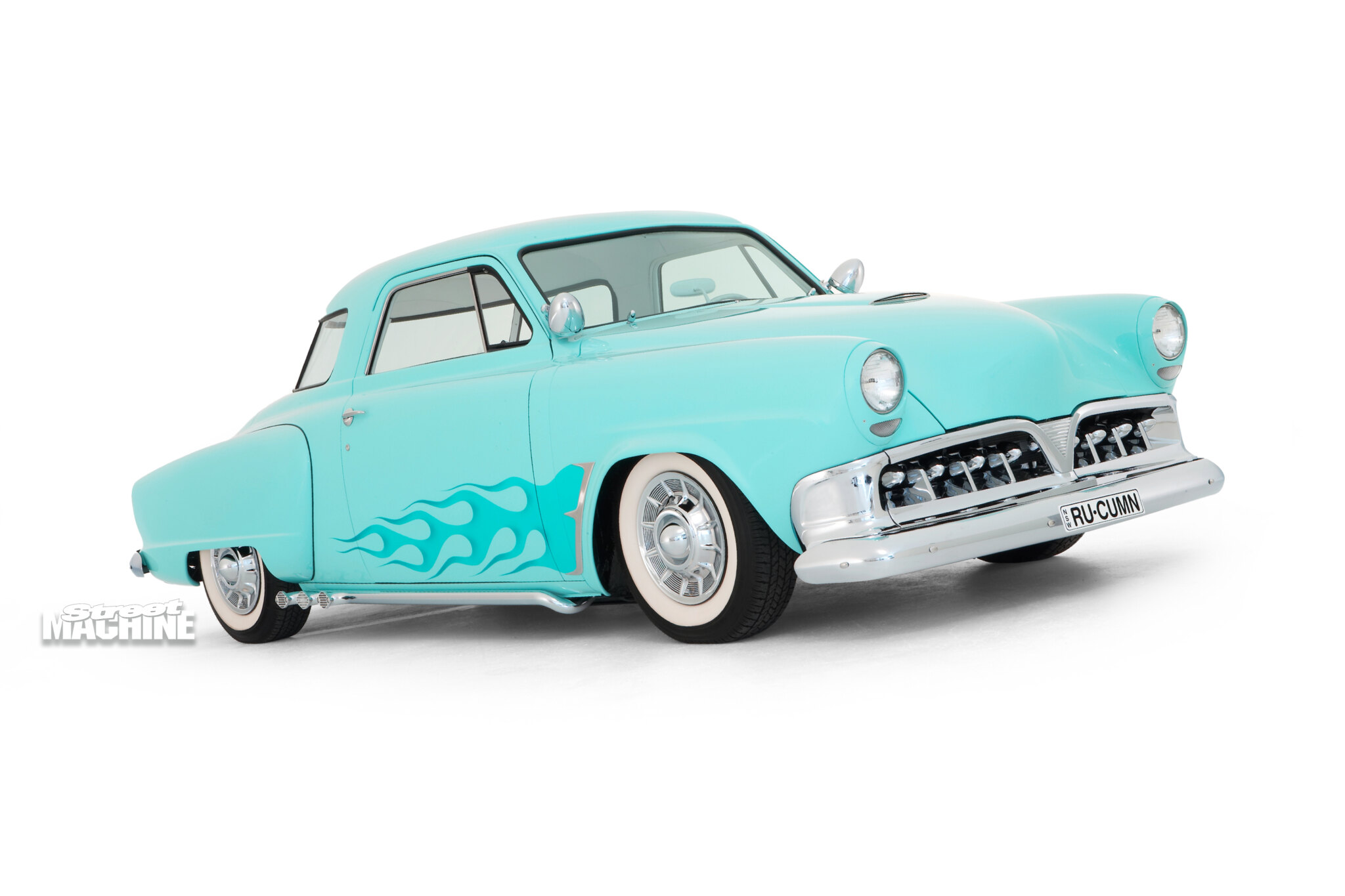
The bonnet is propped up on its chromed stay. Haloed by the bright white walls of the photo studio, Murray Nicholson is pointing out different features of his ‘Kool Change’ Studebaker’s sano engine bay. He’s drifting into the trance that is a characteristic of many dedicated car-crafters, almost religiously savouring the memories of his stunning Stude’s four-year build.
First published in Street Machine’s Hot Rod magazine #3, 2006

It’s a cliche, but despite my delicate condition — it’s Saturday morning and I’m hung-over — the Stude soon has me on my hands and knees, too. The underside is neat! Hallelujah!
“The reason?” counters Murray after my inevitable why-a-Studebaker question, “I like cars that are different,” he says. “These were ugly ducklings in their day. Even though they were the first car after World War II to have modern styling, they had no value for a long time. The ones that survived did so by chance more than anything else.”

Murray spied this semi-restored Canberra-based example — apparently a California car imported sometime during the early 90s — in Unique Cars magazine in 1996. Murray cruised it and showed it, including the last Rickshaw’s Woolstores show in Newcastle in 2001, before taking it off the road to begin the big build.
With the exception of some machining, the upholstery — the white tuck-and-roll marine-grade vinyl is the work of John Viles — and that final layer of paint, all the work was carried out at home, inside Murray’s double garage.

The body stayed on the chassis, but everything else was removed. Murray worked shoulder-to-shoulder with good mate, workmate (Murray is a prestige car body/paint man) and fellow Stude owner Bob Mason for much of the car’s metamorphosis in Murray’s two-car garage. Friday nights were the highlights in the guy’s week, with plenty of pizza and bourbon consumed as they went to work, beginning with the tyres and working up.

Trial and error, rather than experience, was the guideline for many of the vehicle’s modifications, including the suspension. NSW vehicle modification guidelines apparently require a right-hand drive conversion if too much suspension re-engineering is performed. After considering a complete Holden front-end graft to the Stude’s chassis, Murray retained left-steer, but installed a collapsible steering column above the standard steering box. The spindles for the Stude’s coil-sprung front are reversed HQ Holden, carrying Leyland P76 rotors — with a Ford stud pattern and Falcon ‘chaser’ rims — under PBR callipers. The leaf-sprung rear rides over a Sydney Competition Warehouse nine-inch housing; the tall tyres and 3.9 gears promise easy cruising.

With the car’s rarity, you don’t immediately notice the styling tweaks. The bonnet scoop is not something put there in 1949; it’s a Murray original, complete with its finely chiselled stainless trim. There was a pair of ‘crutch-cooler’ air scoops in the front guards; gone. The bonnet, bootlid and fuel filler have been shaved, yet extra shine has been added to the front guards with more Murray-made metal scallops seating the Mike Morris flames. The dummy lakes pipes? Flawlessly handmade by Murray, too. And inside, the Stude dash panel was never as deep as this. It’s been extended to conceal the compact, fully integrated air con unit selected from a bulldozer and mining equipment catalogue, which blows cool cruising air through the original centre-mount speaker grille. Smart thinking!
After fettling the car’s removable panels to give them a sharp fit next to its neighbours, just about the only exterior detail Murray is not happy with is the fit of driver’s door. He reckons it kicks out a bit toward the base of the B pillar. Aw, does it?

Most of the paint — a custom-mixed minty aqua, using Debeers products — was applied by Murray, with one final flow-coat smoothed on by another workmate, Rick McLachlan, in the spray booth at work. With a view to its regular street use, the underside is simply detailed in black.
“I’ve spent as much time as I want to on the body,” says Murray. “The car was too good to hack up much.

I would have liked to give it a roof chop, but you run into problems with the layback of the glass. Plus, I can’t just grab a second turret. You see some street machines or rods and the extra effort in the body is amazing — but it’s not for me, I guess because I work on cars all day. If I wasn’t in the trade, I might have gone a bit further.”
Studebakers aren’t exactly stacked in wrecking yards in Australia, either, but Murray reassembled the car with relative ease. Know where to look, he reckons, and you can get most things, from window rubbers to door latches, without too much drama. “I replaced as much as I could to make it all work better,” he says. “Latches tend to wear after 40 or 50 years. I also had new toughened side glass made; the original laminated stuff had gone milky.”


The Stude’s exterior panels, however, are a different matter, although there are a couple of sources internationally. Luckily, Murray’s Stude was relatively straight and rust free. “I’m not a big fan of rust restoration work,” says Murray. “I prefer to work with fresh, clean metal — making brackets and the like. I love doing one-off stuff.”
And like the exterior, the Stude’s engine bay is studded with that one-off stuff. The air con lines are hand-bent; the alternator and aircon brackets are crafted from alloy. “The usual aftermarket stuff is spindly and cheap,” says Murray. “We made this one by dummying with a piece of Craftwood. Then we cut the alloy and tested the fit. Then I polished it – sanding smooth with emery and machine polishing. Took a while.” Brake lines, speedo cable and trans kick-down cable sheaths, brake fluid reservoirs; all are one-offs crafted from bits and pieces before being polished.

This jewellery is mounted to, and around, a healthy 350 Chev-built from almost all new components by Bob. The car’s consulting engineer specified a max of 350 cubes but even with this limit, 400hp gives this Studebaker plenty of bark. “I chose a Chev because of the availability of parts,” says Murray. “You really can’t beat a small block. It’s easy to get good, reliable power.” The heads are Edelbrock Performer RPM alloys and draw from a Holley 750 and a biggish — Murray can’t recall the specs — cam. The crank and rods are Scat steel with Clevite bearings in four-bolt mains. Most of the assembly fasteners are ARP stainless and Murray has milled, machined and polished them all.
Installing the Chev into the Stude required a late 60s (HK-HG) Holden sump and handbuilt block-hugger-style headers Murray had HPC coated inside and out. As well as the beautifully decorated lines for brakes and air, some of the engine bay hardware — brake booster, aircon bits, windscreen wash bottle — are relocated under the front guards. Murray wanted things clean, but not sterile.

Behind the Chev is a TH700 four-speed auto from Central Coast Automatics with a 2500rpm clutchless converter and some Corvette-spec internals — a little tougher than Holden V8 parts. The Bob-built shifter mechanism is a feat of engineering; all that is visible above the carpet is a manual-style shift lever. An ex-Commodore two-piece tailshaft feeds the twist to the nine-inch.
So what happens now? It’s engineer certified but not yet registered — but with summer beckoning, it will be plated by the time you read this. “I want it to do one more big show,” says Murray. “Probably Rickshaw’s in March 2007 as I don’t want to over-show it.”

Then, the open road and less formal shows beckon. “Wintersun; John’s Picnic, the Bright Rod Run… I want to do those types of runs.” Mate, we can’t blame you!
In the build:

1. With exception of final exterior flow-coat of paint, the car was completely crafted in Murray’s double garage. Build time was four years of Friday nights fuelled with plenty of Jim Beam.

2. Chev V8 uses Chev-to-HK-HG Holden sump for crossmember clearance. Firewall had 57 holes welded up! Remote brake fluid reservoirs are handmade from air-con components; they feed the under-floor master cylinder.

3. Bob Mason, responsible for the engine and assisting Murray with much of the Stude’s assembly, manufactured this compact shifter for the TH700 four-speed auto. Looks just like an old-school manual.

4. Integrated air conditioning was installed using a unit designed for ‘universal’ fitment in tractors/mining vehicles. Car was wired using relays to take the electrical load off the original Studebaker dash switches.

5. Murray added an extra section along the lower edge of the dash to conceal air con and wiring. Steering column has collapsible section added; standard instrument cluster was restored and ‘sweep’ tacho added.

6. Front suspension retains factory architecture highlighted with HQ Holden stub axles swapped side-for-side to suit rear-mount tie rods. Stiffer plastic suspension bushes and disc brakes keep up with 350 Chev grunt.

7. Murray didn’t like standard or aftermarket Chev accessory mounts so he built his own. Gutsy-looking brackets were mocked from craftwood before being duplicated in alloy plate. Air cleaner is Murray-made, too.

8. Making custom air cleaners is a sideline business for Murray.
Murray Nicholson
1952 Studebaker Champion Starlight Coupe
| Paint: | Custom-brewed Debeers aqua |
| POWERPLANT | |
| Engine: | 350 Chev |
| Heads: | Edelbrock Performer RPM alloys |
| Pistons: | TRW forged |
| Conrods: | Scat steel |
| Crank: | Scat steel |
| Carb: | Holley 750 |
| Ignition: | MSD electronic, Blaster coil |
| Exhaust: | HPC-coated fab’d headers, dual system |
| Sump: | Holden/Chev HK-HG |
| Output: | 400hp |
| TRANSMISSION | |
| Gearbox: | TH700 four-speed auto |
| Convertor: | 2500rpm |
| Tailshaft: | Commodore two-piece |
| Diff: | Nine-inch, SCW housing |
| BENEATH | |
| Suspension: | HQ Holden stubs, Pedders dampers, Nolathane bushes |
| Brakes: | HQ Holden front discs, Ford rear drums, VH 44 booster |
| EXTERIOR | |
| Body: | Slimline metal bonnet scoop, shaved bonnet and bootlid, hidden fuel filler, handmade stainless trim on bonnet and front flanks |
| ROLLING STOCK | |
| Wheels: | Ford E-series 15x6in steels with repro Caddy hubcaps |
| Tyres: | 215/75 Coker whitewalls |
SPECIAL tHANKS
My wife Joy, Bob Mason for all the mechanical help, the boys at work, John Viles, Exce Marine.
Comments