
First published in Street Machine’s Australia’s Toughest Fords #3, 2005
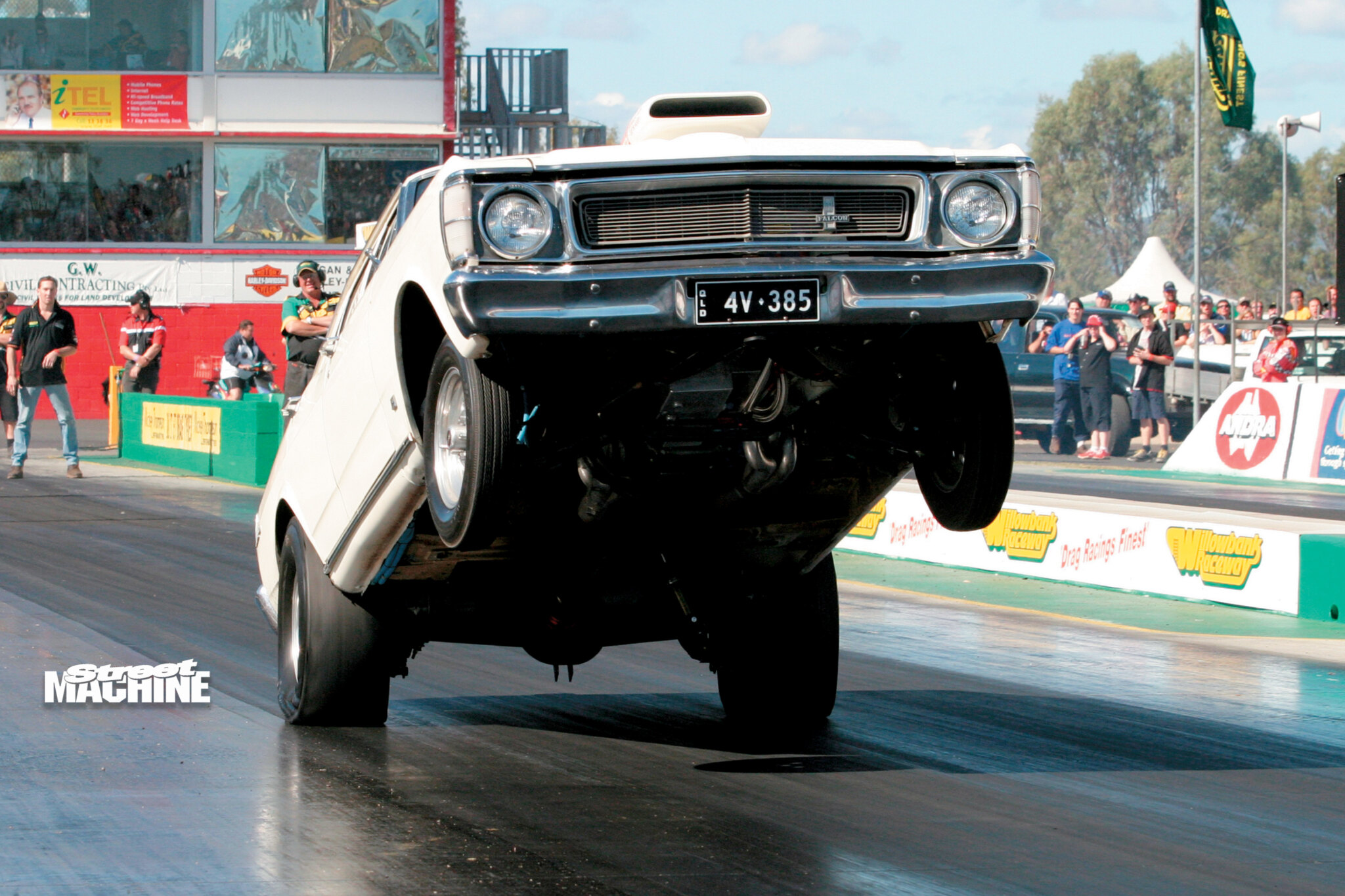
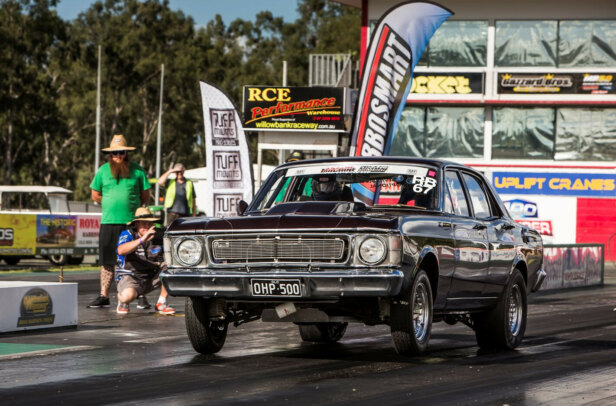
Regardless of whether your motorsport passion is speedway, roundy-roundy or drag racing, there’s always one car that sticks in your mind long after you’ve left the bleachers. For Joe Lipari, it was Scott Karandrews’ wild wheel-standing XW Falcon, whose outrageous antics originally caught Joe’s eye some two and a half years ago at Willowbank Raceway. And when I say say wild, I mean wild. Some so-called tough streeters think they’ve got the right stuff when they get a dozen or so inches of air under the passenger’s side front tyre, but this brute isn’t satisfied unless both fronts are pointing skyward and the rear bar’s scrapin’ bitumen.

Joe’s always had a soft spot for XW/XYs, so he nearly did a back flip when he spotted the ballistic white Falcon in a ‘for sale’ column. He was on the phone lickety split, quickly brokering a change of ownership. Scott was reluctant to let the Falcon go as he and the crew from Hogg Performance had spent two solid years in development – not to mention oodles of cash getting the car to run a best of 9.62 @ 139.5mph. But it had to go, as Scott was stepping up to an ex-Pro Stock EL Falcon that he’s running in the high-tech Sports Compact class.

A less gracious owner might try to reap some glory himself, but not Joe. He firmly attests: “I love the rough edges. Yeah, it’s no glamour show car, but lift that bonnet… what a killer engine! Full credit goes to Scott and Mick [Hogg Performance] for building a tough car and for all their help and advice now and in the future.”
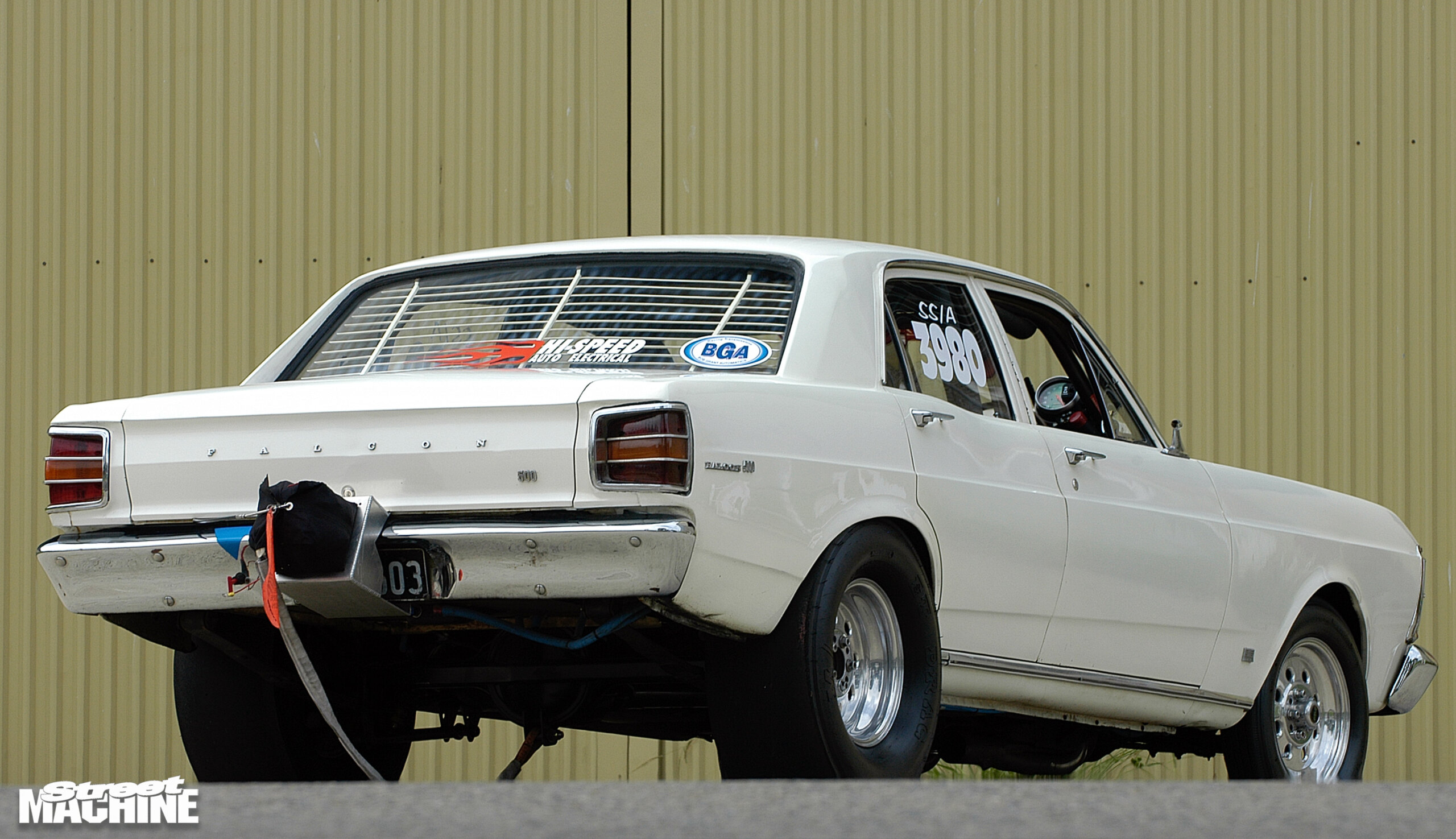
Let’s rewind two years. Scott picked up the six-cylinder XW Falcon with the goal of turning it into Australia’s fastest untubbed XW/XY Falcon; it even runs stock wheel arches. Such a goal takes horsepower, so what exactly was Scott and Mick’s choice for their weapon of mass destruction? Would you believe a factory 351 Cleveland? Well, not exactly, but it’s close!
The engine is a bit like a Pro Stocker, but different. “In Pro Stock form this engine would probably make another 300 horsepower – but less torque,” laments Mick. Pro Stockers weigh 2200lb (997kg), while the hefty Falcon runs closer to 3500lb (1590kg)! This extra flab requires more torque to accelerate it down the quarter. Therefore, engine development was more about maximum torque rather than outright horsepower.

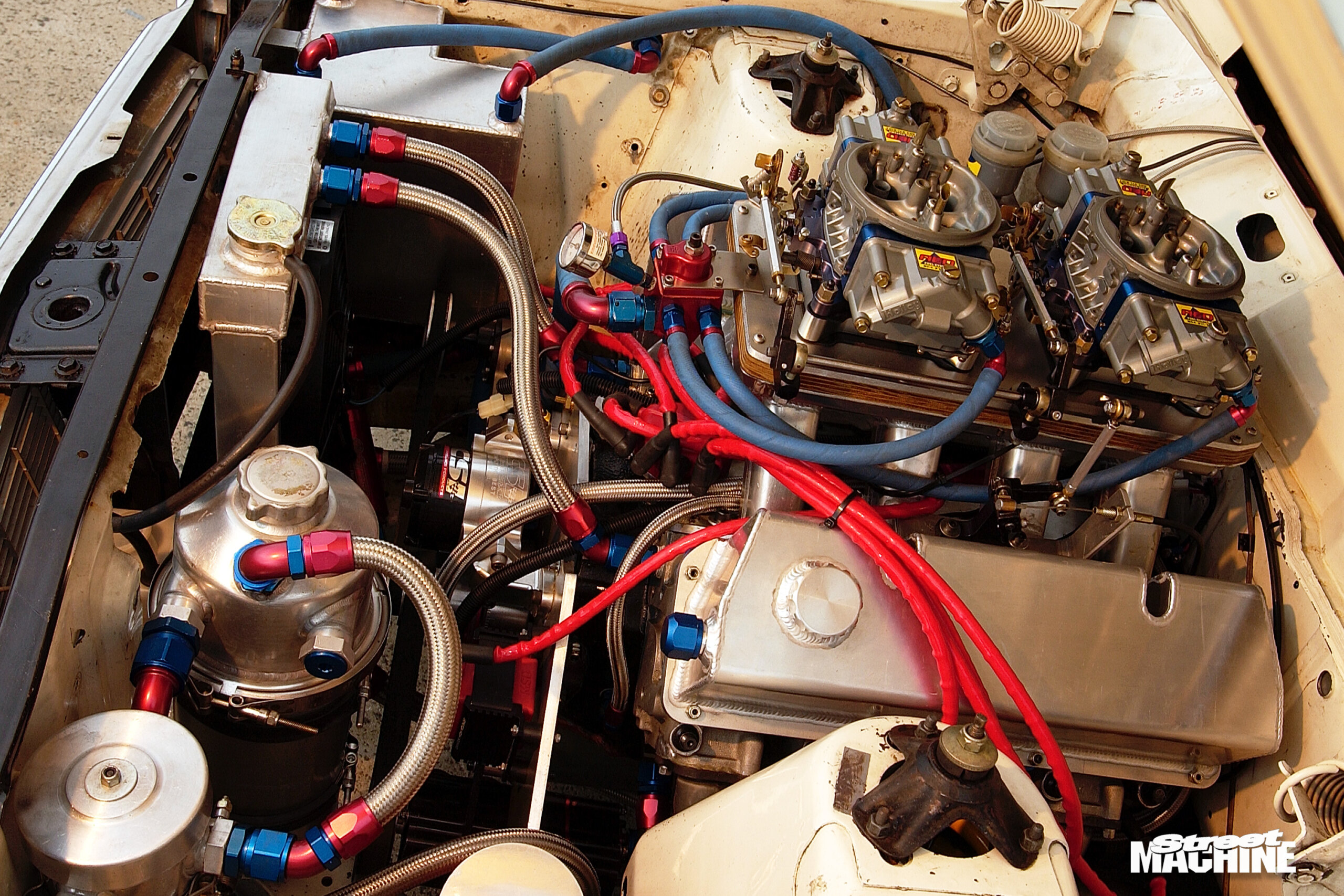
From the bottom up, an Eagle 3.75-inch, 4340 forged crank spins in billet mains caps, while Bill Miller alloy rods hang off Ross flat-top forged pistons. The Aussie block was picked from Hogg’s personal stockpile and has been sonic and core-shift tested. The bores were punched out to 4.020 inches to yield a total capacity of 385 cubes. Mick feels that even when using a grout-filled block, 4.020 is the maximum bore that retains sufficient block strength; switching to a Dart or SVO block was not an option.

Cylinder filling starts out with a pair of Pro Series AED 950cfm alcohol carbs (supplied by AED Australia). Hogg Performance then welded up the sheet metal inlet manifold, which mates them to the Yates C3 alloy heads – which have had a couple of hundred hours invested in them. The engine’s been set up with 16.5:1 comp to run on methanol – even though Mick admits that due to the design of the C3s, it would probably make more power on race gas. But at $1 a gallon for methanol versus $25 a gallon for C16, it’s a no-brainer. Lighting the fire is a MSD Digi-7 programmable; it’s a PC-compatible unit that you can plug into your laptop and program in virtually any set of parameters.

Valvetrain-wise, Hogg had Crane custom grind the monster roller cam, which operates a Rollmaster timing chain and shaft-mounted Jesel rockers. Headers are a stepped design (two-inch into 2¼-inch) by Gonzo Pipes terminated by a pair of Burns-style collectors. Keeping the all-important black, slippery stuff at the necessary pressure is an internally modified oiling system fed by custom oil pan and a Peterson dry sump system.
So, what’s it good for? Scott and Mike had the same question, so they bolted the tough Clevo to the Superflow 9000 dyno at Advanced Engines and it twisted the dials to the tune of 790hp and better than 600ft-lb of torque – not bad out of only 385 cubes.

Not many people run this much grunt through a C4. Therefore, it took Bob Grant Automatics a while to figure out how to engineer enough strength into the factory ’box; it had a nasty habit of chewing out top gear. Fortunately, the four-inch tailshaft and a nine-inch packed with a Strange Engineering, 5.14:1 full-spool centre proved to be less troublesome. Fronting the radically beefed and modified trans is a 6400rpm stall converter (from The Converter Shop), which happily lets the Falcon launch off the transbrake at 6500rpm, before running through the traps at 8200 to 8300rpm. It runs 1.32sec 60-footers, which is excellent for a 3500lb car!

It takes more than pure grunt to get those front wheels way up there, though. No doubt the sticky Mickey Thompson slicks have a lot to do with it. But the real secret lies in the rear suspension. While exact details are apparently a secret of national importance, we did determine that the rate and height of the rear springs have been cleverly manipulated; they are softer than standard and assisted by a custom-made set of Cal-Tracs. AVO coil-overs (without the coils) were selected for their separately adjustable bump and rebound feature. Up front, six-cylinder coils and 90/10 Pedders shocks help with weight transfer.

Just like the all-steel body, factory steel bumper bars and full factory glass, the interior is an all-stock affair except for the Cobra buckets, a few extra gauges/switches, race harness and the obligatory ANDRA-approved roll cage. Now you know why the brute is such a heavyweight.
Since changing hands, gearbox linkage gremlins have held the wheelstands to waist-height launches and ETs to 10.00 @ 138mph.

“The torque and top end tell me this car has some balls,” enthuses Joe. “I can’t wait to get the car back out there and start playing with the tune-up and pulling some of those radical wheelstands the car is famous for. Maybe even get it to pull a 9.1!”
We can’t wait, either. Good luck, mate.

Joe Lipari
1970 XW Falcon
| Colour: | White |
| MAKIN’ IT MOVE | |
| Engine: | 385-cube stroked Cleveland |
| Block: | Factory Clevo (80s-vintage Aussie) |
| Crank: | Eagle 4340 forged |
| Rods: | Bill Miller alloys |
| Heads: | Yates C3 |
| Intake: | Hogg Performance aheetmetal |
| Carbies: | Twin AED 950 alcohol |
| Ignition: | MSD Digi-7 programmable |
| Sump: | Peterson dry sump |
| Exhaust: | Gonzo pipes, stepped headers |
| UNDERNEATH | |
| Gearbox: | Highly modified C4 |
| Converter: | The Converter Shop 6400rpm |
| Tailshaft: | Brisbane Driveline Services four-inch, Strange unis |
| Diff: | Strange centre, 35-spline axles, full floater |
| Ratio: | 5.14:1, full spool |
| Front suspension: | Six-cylinder coils, Pedders 90/10 shocks |
| Rear suspension: | Re-set, re-tempered leaves, Cal-Tracs, AVO shocks |
| Brakes: | four-wheel discs |
| IN THE COMFORT ZONE | |
| Seats: | Cobra |
| Harness: | RCI |
| Shifter: | B&M Reverse Pattern Pro Ratchet |
| Wheel: | Factory plastic |
| Gauges: | Autometer |
| Tunes: | 385-cube, 8200rpm Cleveland |
| ROLLING STOCK | |
| Rims: | Weld Wheels, 15×5 (f), 15×10 (r) |
| Rubber: | 135mm Nankang cheese cutters (f), 29.5/10.5W*/15 Mickey Thompsons (r) * Using the ‘Ws’ gives you a greater rollout diameter |
THANKS
Hogg Performance, Ray Edwards at AED Australia, Bob Grant Automatics, The Converter Shop, Gonzo Pipes, Buzzard and Warren from Superflow Heads, Gerry Medati at Crossroads Towing, Hi-Speed Auto Electrical, My crew – Vinnie, Lee and Ben, and of course my wife Kerrie, who has been so understanding and inspirational.
Comments