

First published in the March 2005 issue of Street Machine
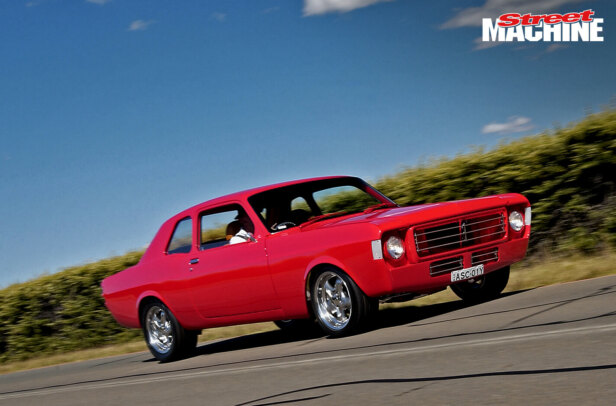
Jeez mate, is this a Mustang?” asked the pimply teenager in the Slipnot T-shirt. Hud Johnson smiles because this is the kind of question customisers just love to hear. He explains that while there are some definite Mustang cues there, the car started life as a XW Falcon sedan. All this occurs while Hud and his dad, Rod, wait in the scrutineering line for Summernats 18.

The front of the car is covered in dead bugs, proof the pair drove their latest creation from Wongarbon, NSW – just about 400km. This is all the more impressive when you drop to have a squiz at the gorgeous, seamless undercarriage — which is good enough to have the car slip straight into the Elite Top 60 and stroll away with the event’s most prestigious awards for custom cars. Not that Hud meant to build an Elite car this time, but as often happens things got out of hand.
“The XW was our daily driver and needed some attention,” he says. “We had a couple of American tudor doors lying around and, you know… Nobody really customises these cars; they get made into GT replicas or get restored, so we thought, why not?”

If that sounds a bit casual that’s probably because the Johnstons have been at the customising game for a fair while. Rod has been a panel beater since 1957, building award-winning customs before Hud was even a twinkle in his eye.
Now that Hud has grown up and come onto the scene they’ve built three notable street machines (see more below), all on a budget — and until recently, all on a dirt floor.

The XW is a definite case of ‘old school meets new cool’. For 50s flavour, check out the rounded corners of the doors, boot and bonnet.
“I wanted to take away some of the harshness of a car full of sharp edges,” says Hud.

Astute observers will also note the entire lower reveal line is no longer there – giving a smooth finish to the sills. This theme carries right around the car with the deletion of the bumpers and the forming of super-smooth front and rear roll pans.
An XY Falcon donated its tail-lights and front park lights for moulding in, so they are now more integral with the overall design. The Mustang-flavoured grille was hand formed; alloy grille bars are built into it and, for balance, it’s the same in the lower grille, as well.

The fronts of the guards were altered to suit the front of the bonnet – all in the name of smoothing out factory lines.
“You work away at the car and every modification has a knock-on effect; you change one part and the aspect of the surrounding parts needs modifying to match,” says Hud. “You use your eye a lot; if it isn’t right it jumps out at you – so there is a fair amount of rehashing involved.”

The two-door conversion is, of course, the most noticeable modifications. There was a big problem here: the Aussie roof was nothing like the American roof the doors were built for, which meant glass was going to be an issue. This was overcome by making new doorframes and fitting flat glass – and the result is very factory. The rain gutters were also deleted. Notice the rounded corners of the rear fixed quarter glass match the rest of the car’s.

It’s the detail that makes this car work so well. Consider the moulded-in windscreens, or the total lack of seams – including underneath! The finish is the same as the topside.
After about two and half years of fabrication and smoothing, the car’s body was bathed by Rod in the Johnston’s signature colour of custom red acrylic.

Inside the car the smoothing operation continues; there’s a lot of extra metalwork in here, as well. Determined to break away from the tradition of interiors being the domain of trimmers, there was a lot of thought put into the likes of the doors, which are now partially filled with sheet steel, and blending in with the nearly nude dash. This is repeated in the back, as well, with similar treatment of the rear quarters blending into the parcel tray.

An alloy sprint car wheel confronts the driver, with a cluster of Vintage Ford Motorsports gauges arranged in a hand-made alloy fascia. The only farmed-out work on the entire car was the upholstery; local trimmer Tony Espert covered the EL Falcon front buckets (which slide on hand-crafted alloy seat adjusters), the rear seat, hoodlining and what’s left of the door cards in Rustic vinyl.

Custom alloy parts are absolutely everywhere in this car; there is very little aftermarket billet used. A few Lokar items, such as the shifter, handbrake, throttle and pedal covers, are about the only concessions to the aftermarket.
The driveline and mechanicals never escaped the detailers either; every possible area and component was meticulously filed smooth of castings, or filled in and flushed up prior to painting in straight bright silver acrylic. “It’s all hung on there pretty good so far with no problems,” adds Hud.

Helping to clean up the appearance of the underside, the handbrake and fuel lines were hidden. Most of the bolts used are polished stainless, as was the custom-made alloy fuel tank.

One deviation from the norm is the use of the warm XF 250 six-pot and four-speed single-rail box. “It helps keep the cost down and is also something else that sets the car apart,” states Hud.

The rocker cover was modified, for a 50s GMC look, and the alloy sump was hand made. “There’s just not much decent dress-up stuff for Ford sixes, so we had to make our own.”

Adapted EA Falcon disc brakes at the rear and XF disc brakes at the front have the job of pulling the lot to a stop. The calipers are polished and the rotors are detailed DBA drilled and slotted items.

Rolling stock consists of a set of sensible 17-inch ROH rims shod with Falken tyres all ’round. The lot now sits two inches lower to terra firma thanks to Pedders lowered springs up front and reset stock leaf springs at the back.
IN DETAIL:

- Custom grille, modified guards and bonnet plus XY parkers
- Bumpers gone, roll pans front and rear
- Moulded-in windscreen
- Reveal line in door deleted
- Two door conversion, using US model tudor doors; note rounded door corners, smoothed gutters
- Fixed rear windows
- XY tail-lights moulded in
SOME WE PREPARED EARLIER

1. Hud’s XL featured twice in Street Machine: once as an orange four-door mild custom (June ’93), then as a custom tudor with two-tone paint and graphics (Sept ’94). The car won plenty of trophies in both forms and ran 10s at the Orange eighth-mile.

2. The Johnstons don’t mind rods either. This one was a ’40 Ford pick-up and is the current parts chaser. The driveline is alloy from radiator to diff, with a Toyota 3.4-litre Hemi V8, Supra five-speed and Currie nine-inch at the back.

3. This red ’62 F100 featured in SM April-May 1996, sporting a four-inch chop top, bumper deletion and a heap of other custom touches. This car made the Top 20 at Summernats 9 and 10.

Hud Johnston
1969 XW Falcon custom
| Colour: | Custom red acrylic |
| Motorvation: | |
| Engine: | Ford XF 4.1-litre six |
| Induction: | Holley 500 two-barrel, Ultraflow manifold |
| Cam: | Crow 30/70 |
| Head: | EFI XF – three-angle valve job |
| Exhaust: | Lukey headers and muffler, 2.5-inch stainless system |
| Power Swapping: | |
| Gearbox: | XD single-rail four-speed |
| Clutch: | Heavy-duty, plus heavy-duty pressure plate |
| Bell housing: | Polished alloy adapted four-speed |
| Stomp ’n’ Steer | |
| Suspension: | Pedders shocks, Nolathane bushes, 2in lowered front coils, 2in lowered rear leaves |
| Brakes: | XF calipers (f), EA calipers (r), drilled and slotted DBA rotors all ’round |
| Rolling Stock | |
| Wheels: | ROH alloy 17×8.5-inch all ’round |
| Tyres: | Falken 235/45 (f), rear 255/50 |
Comments