
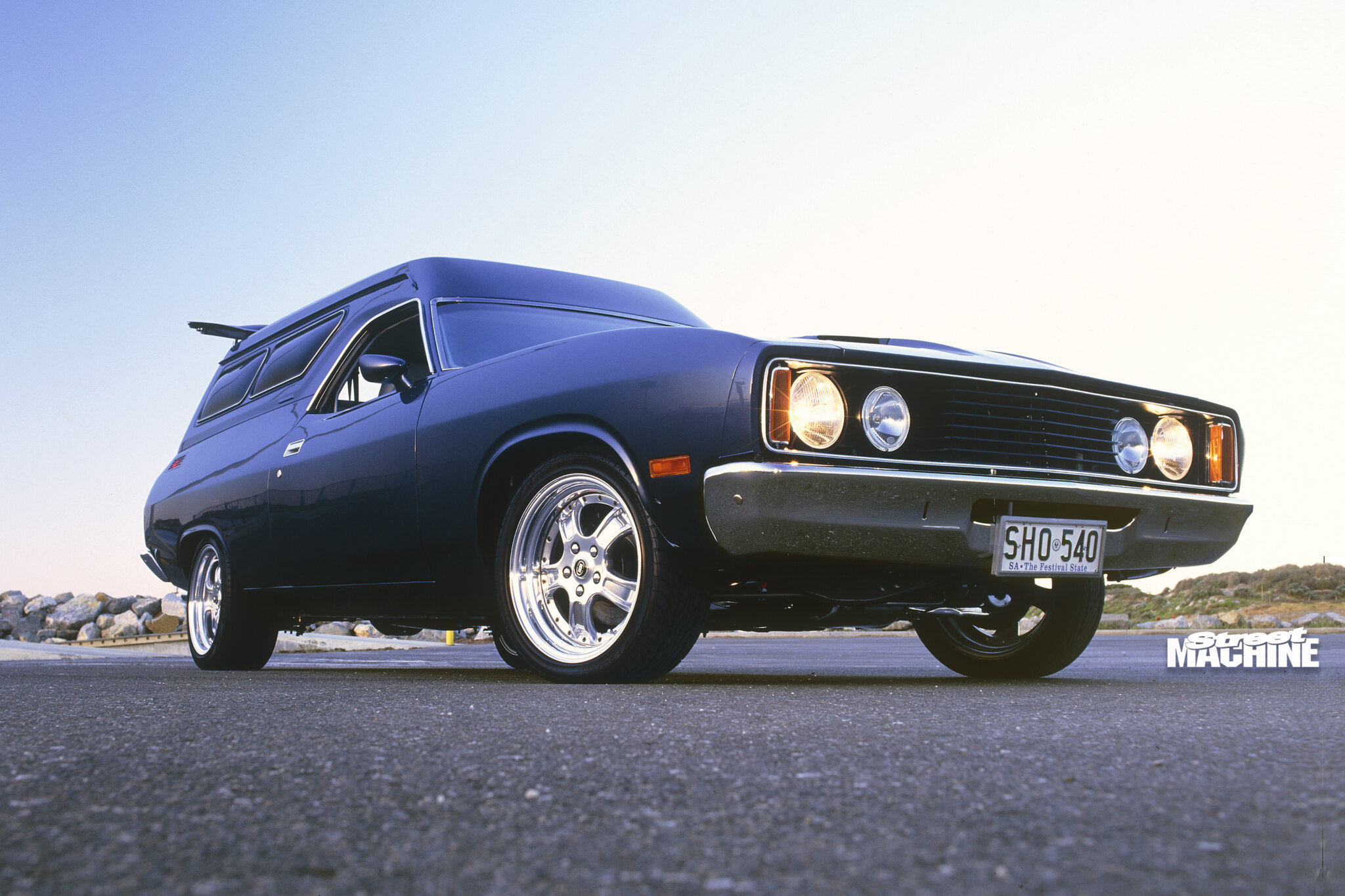
First published in Street Machine’s Australia’s Toughest Fords #3, 2005
Haydn Rowley’s van is without doubt the best of its type in Australia. Big statement, huh? Who are we to argue, though, with the trophy-snatching achievements of Haydn’s 1977 Ford XC panelvan. A quinella of Van Nationals championships and a cabinet full of silverware are proof of the skill and dedication that have driven Haydn and his wife Lisa over a drawn-out 18-year build period.

Lisa tells us that it all started with a boyhood dream. “When I first met Haydn we were at school, and I noticed something different about him straight away. He was the only guy in the class that had a pencil case covered with drawings of vans.” Living on a diet of van magazines throughout his formative years, and having a Street Machine collection that covers every single published edition (good man), Haydn’s thirst for vanning was finally quenched when, at the age of 18, he set off, cash in hand, to buy a white XB.
Imagine, then, Lisa’s surprise when Haydn fronted up to her folks’ house in a hot orange Sundowner, complete with an artistic steam train transfer on the windscreen. Lisa was in love, if not her folks, who saw every parent’s fear parked in the driveway. They had nothing to worry about, though, with both Lisa and Haydn recounting their early married days in the van as being some of their most memorable. Then after three years the fun stopped and the rebuild started.

Haydn knew he was on to a winner when close inspection showed his Sundowner had never been used as a tradesman’s vehicle. No crudely drilled holes, smashed panels, or anything in the way of rust, pointed to the XC being a perfect base for some serious customisation. Nothing was rushed into, though, as years of absorbing van culture had given Haydn a multitude of ideas to incorporate into his own unique ride.
“I had a difficult choice: opt for the current look of the day, or go full retro van style”
“I reckon we looked at over 50 different colour patches before deciding on what I like to call the special mix blue. Fifteen years ago, when we painted the XC, the colour choice was nothing like it is now, so you could say it’s a little conservative in modern terms. Eventually I would like to give it an update, but, hey, it still looks okay, doesn’t it?” Looking past the paint job, the panelwork is gunbarrel straight, with nary a ripple in its metal finished surface.

With the bodywork being a painstaking process of hand crafting the panels, Haydn got to work in the shed, and assembled himself a tough, yet still totally streetable, Cleveland. “I wanted something I could drive every day, and wasn’t particularly interested in dyno numbers or quarter-mile times,” he says. Still, it’s tough enough, with the lope at idle from the competition-grind TQ20 camshaft hinting at what’s in store when the throttle is stomped.
“Even though I’m an auto transmission tech by trade, I didn’t go nuts on the ’box specification. The thought of a big stall and, say, four eleven gears just didn’t cut it for me. Instead, we built up a nice low-stall C4 with a stage two-style shift kit, kept the stock heavy-duty converter, and fitted a nice-inch limited slip diff to the rear. Not over the top, but it will never bust. That’s what I like.”

The coolest aspect of this van, though, is without a doubt the interior. “We got the trim done in the early 90s, and I had a difficult choice: opt for the current look of the day, or go full retro van style. I didn’t want something that would date, so Claude [from Claude’s Trim Shop] and I agreed on building the definitive era interior.”

Acres of grey leather and velour dominate the interior landscape, while rectangular Dakota Digital gauges peek through the facia. “The Recaros were a birthday present from Lisa,” says Haydn. Gotta love that girl.
The rear of the van – often referred to by vanners as “the workshop” – features twin swivel seats in matching trim which allow the lucky occupants an unmolested view of Haydn’s pride and joy: a proper late 70s black and white telly.

“When you could buy a Sundowner new, colour televisions were few and far between, so I went with what you could get then. When you watched shows like Chopper Squad and The Young Doctors in colour they lost a lot of impact, so yeah, it’s going to stay.”
Haydn and Lisa both agree that their days of showing the van are now behind them. Rather than spend their weekends polishing and detailing the undercarriage, they now want to get out and do some serious driving.

“I built this thing to drive, and really I haven’t done enough of it. We’ve got some serious weekends away planned, following the van scene around the country, and instead of taking the Sundowner and a support vehicle, we are going to fit a towbar, and use it properly. After all, life’s short, and I don’t want to become a ‘Rocker from the Locker’.”
No fear of that, guys.

ACTION VANS
It wasn’t only Ford that got in on the van craze with its Sundowner series (Falcon, Escort and Transit). That other pair of adversaries that make up the Aussie big three, Chrysler and Holden, also had something to say when it came to being young at heart, wild and free.
Chrysler had the least known but probably most effective tool to counter the Sundowner. It came in the shape of a 1977 CL Valiant ‘Drifter’, and generally packed a 318 cubic inch V8 under the bonnet (sixes were optional). Chrysler also gave purchasers the option of customising their new van straight off the showroom as a ‘roll your own’, in reference to the roll-your-own cigarettes which were popular in the late 70s. However, buyer enthusiasm wasn’t as great as initially expected, and the big Chrysler quickly Drifted off the showroom floor, and into oblivion.
Holden’s Sandman needs no introduction, having singularly dominated the production ‘custom’ van scene of the era, and still threatening to make a comeback today.
The first Sandman appeared in 1971, wrapped in an HQ body, and was finally phased out in 1979 when the HZ platform was retired. Many more Sandman utes than panelvans were built, with the rarest being a special-order 350 cubic inch HQ version. Apparently with contacts, money and enough time, anything was possible in 1971. Those were the days.
Haydn and Lisa Rowley
1977 XC Falcon Sundowner Panelvan
| ENGINE | |
| Type: | 351ci Cleveland 2V open chamber heads |
| Camshaft: | TQ20 competition grind |
| Pistons: | Cast ACL |
| Rods: | stock balanced |
| Exhaust: | Genie extractors, stainless mufflers/pipes |
| TRANSMISSION | |
| Gearbox: | Ford C4, stage two shift kit |
| Converter: | stock heavy duty |
| Diff: | disc-brake nine-inch LSD |
| SUSPENSION | |
| Springs: | Pedders, 1.5 inches lower front/rear |
| Shocks: | Monroe |
| Bushes: | Nolathane throughout |
| ROLLING | |
| Rims: | ROH Milano, 17×7 front, 17×9 rear |
| Tyres: | Dunlop Le Mans, 235/40 front, 265/40 rear |
| BODY | |
| Paint: | Spies Hecker special mix blue |
| Mods: | LTD rear quarter indicators |
| INTERIOR | |
| Seats: | Recaro front, custom rear |
| Wheel: | Momo |
| Mods: | Custom grey leather/velour trim |
| Gauges: | Dakota Digital |
| Shifter: | B&M |
| Other: | Black and white rear-mounted television |
THANKS
Claude and Maria Carofano from Claude’s Trim Shop, Danny Anderson, Peter Eames, Heath Street Crash, A Class Metal Finishers, My local Ford dealer.
Comments