
First published in Street Machine’s Australia’s Toughest Fords #2, 2004
Three hot rods made up the Top 10 at Summernats 17. Mark Course’s stunning ’32 Coupe even won Grand Champion at Summernats 16. Hot rods doing well at Summernats is nothing new, you might think. Not so. It wasn’t that long ago that a hot rod in the Top 10 was the exception rather than the rule.

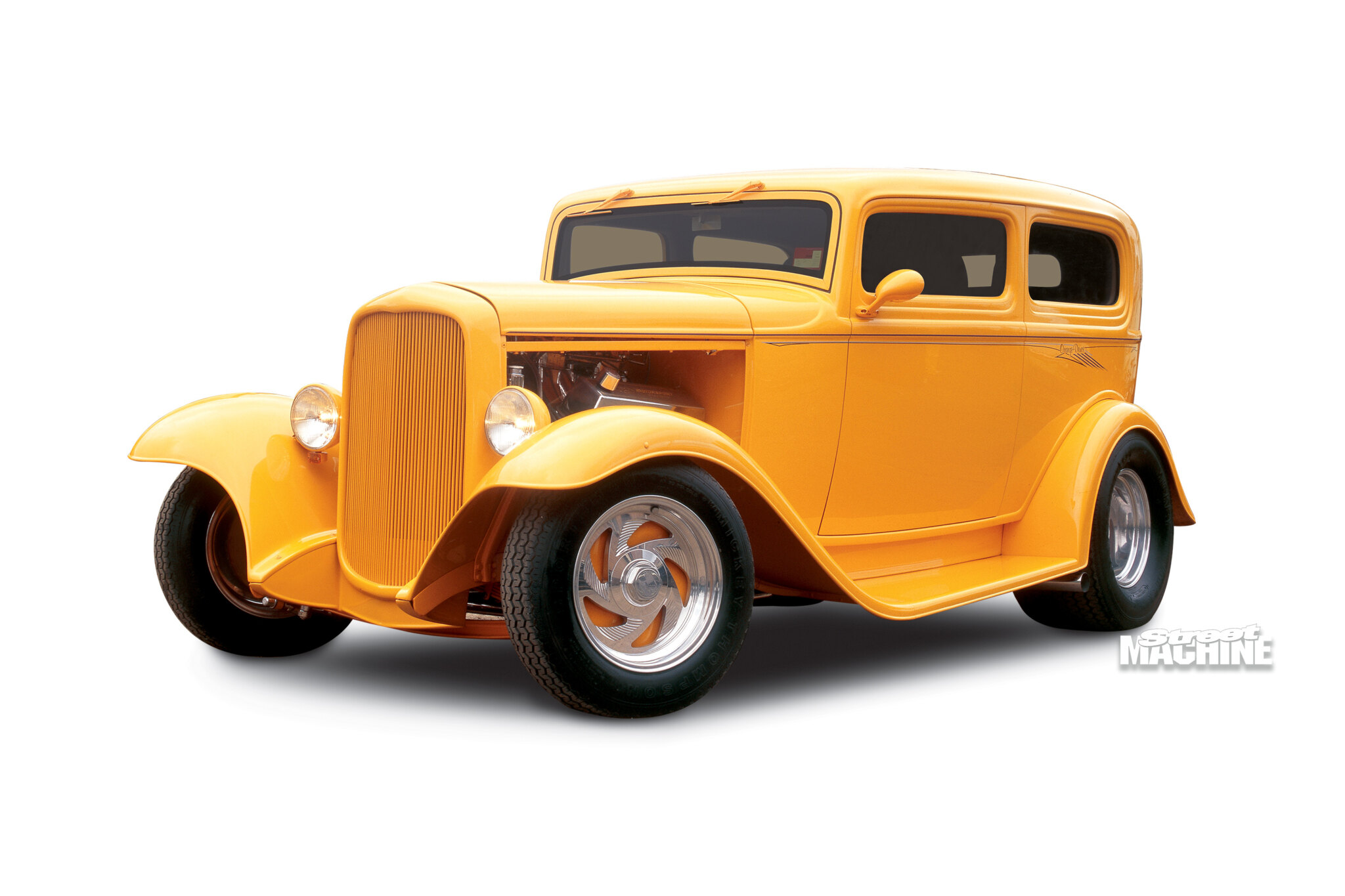
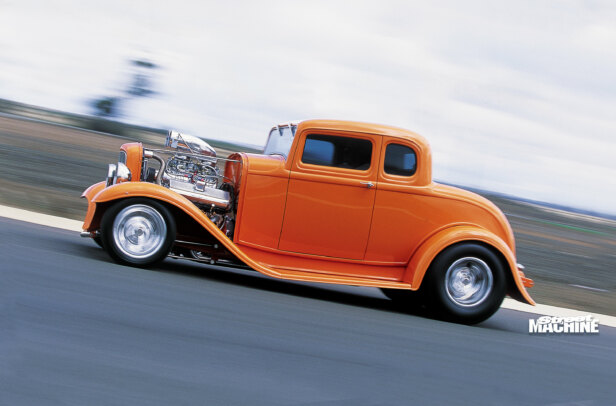
One of the early rods to buck convention good and hard was John Portelli’s ’32 Tudor. This bitchin’ hot rod, dubbed Orange Deuce, originally barged its way into the Top 10 at Summernats 9 back in 1996. The devil’s in the details, as they say – and detail, along with a penchant for superb build quality, runs like blood in the veins of the entire Portelli family (brothers John, Tony, Peter and Steve are all mad hot rodders). So when Orange Deuce returned to Summernats in 2004, few people were surprised when the eight-year-old rod snagged itself an invite into the coveted Meguiar’s Top 60 hall.
Probably the biggest change with the car since its 1996 debut is the name on the rego papers – John recently relinquishing ownership to brother Tony. The killer detail is still there, and so is the outstanding quality of the paint, undercarriage and interior. At a glance, Orange Deuce might come across as just another early Ford, built to the familiar rodding recipe. But if you take the time to look this car over, you’ll quickly appreciate the depth of its detail.

Like all true hot rods, this ’32 is based on a ye olde original chassis. It still uses period front suspension, too, with an I-beam axle and transverse leaf spring. But otherwise Mr Henry Ford would hardly recognise it. To improve the chassis’ torsional rigidity, the original C-section rails were boxed and then tied firmly together with custom-fabricated crossmembers. To get that all-important low stance, the front spring was reset and shackled to a Magnum dropped axle to lower the lot by a healthy four inches.
Out back, Henry’s original underpinnings didn’t quite fit the picture. The original ’32 torque tube driveline and transverse leaf rear were replaced by a narrowed Ford nine-inch carrying 3.40:1 gears. This modern axle set-up is located by a four-link trailing arm set-up complete with Panhard rod and coil-over shocks.

Out back, stopping duties are now handled by Ford drums, but the front is a little eclectic, with Ford vented rotors being squeezed by Holden calipers – all operated via a Datsun 180B master cylinder and Lokar pedal assembly. The steering box was also borrowed from a 180B, topped with a Billet Specialties column and a shiny, soft-rimmed Budnik billet wheel. Billet Specialties also supplied those trick 15×6 and 15×10-inch wheels. The ’32 uses 7.5x26x15 rubber for steering, while the tubbed rear swallows meaty 15.5x29x15 Mickey Thompsons.
All in all, it’s a very tidy chassis package. But you also need raw grunt to make it a bona fide hot rod – an area where this Tudor certainly doesn’t wimp out. No pissy small-block here; that’s 460 cubes of Ford big-block power stuffed under the hood. Making sure it rumbles ’n’ rolls like the best of them, the big-block was filled with a Crower cam, Pro Seal lifters, TRW 10.5:1 forged pistons, Manley conrods, Sealed Power rings and Michigan 77 bearings. On the intake side, a Weiand tunnel ram has been port-matched to a set of nicely massaged heads and carries a pair of 600 Holleys. Hot outpourings are evacuated by block-hugging extractors leading into a dual two-inch stainless system.

Feeding the prodigious torque rearward is a beefed-up C6 tranny combined with a 2500rpm, high-stall converter, with selections courtesy of a B&M shifter. Covering this mechanical marvelry is a fabricated stainless steel floor and transmission hump that seamlessly integrates with the New Zealand-sourced Osborne fibre-glass body. At the time, no one in Australia was offering anything similar, and the Osborne body came with some nice touches, including a neat three-inch top chop, no swages on the cowl, re-radiused windscreen corners, no cowl, vent or rain gutters, shortened rear guards and a hidden fuel tank (it originally sat out the back).

Finishing things off is a pair of traditional-style King Bee headlamps and a pair of late-model Vitaloni Californian side mirrors – which blend in nicely with the early ’30s body. All these fiddly, time-consuming jobs were completed before the body was lifted for final smoothing – both on top and underneath – prior to being sprayed in a brilliant orange DuPont 2-pak.

In keeping with its show car heritage, there’s not a clip, screw, hard line or wire in sight. It just goes to show that quite often it’s the details you don’t see that can make all the difference between a good job and a show-winning one. The fact that the car managed to make the Top 60 eight years after its debut is testament to the quality of the workmanship. Ironically, it was probably brother Steve’s ’34 Tudor Tourer (see more below) that edged the ’32 out of the Top 20. Still, Orange Deuce proves that if you build it right the first time, it will always be a classy car, no matter how much time passes.
All in the family
Easily one of the standout rods at Summernats 2004 was Steve Portelli’s HOK Magic Blue ’34 Tudor Tourer. Steve hadn’t even finished setting up the display and the crowds were swilling around the stunning rod.

The judges were in agreement with the mood of the crowd, the ’34 marching off with Top Open Hot Rod, Outstanding Engineered Hot Rod, Showcar Superstars Finalist and a possie in the Top 10. This breathtaking beauty features a fully detailed 454 Chev, suicide doors, twin-A-arm front end, flush-fitting glass, electric hood, Halibrand-style wheels, fold-down ragtop and a Romoar blue leather interior with suede inserts.
While it looks super-sweet in photos, this is one car that needs to be seen in the flesh to be truly appreciated.
Tony Portelli
1932 Ford Tudor
| Colour: | DuPont Orange |
| MAKIN’ IT MOVE | |
| Type: | 460 big-block |
| Cam: | Crower hydraulic |
| Manifold: | Weiand tunnel ram |
| Carbs: | Twin 600 Holleys |
| Extractors: | Custom block-hugger in polished stainless |
| Air cleaner: | Billet Specialties |
| UNDERNEATH | |
| Gearbox: | C6 |
| Converter: | 2500rpm |
| Diff: | Nine-inch, 3.40:1 gears |
| Springs: | Transverse leaf (f), coil-overs (r) |
| SUSPENSION: | Factory-style four-bar (f), fabricated four-bar with Panhard rod (r) |
| Brakes: | Falcon discs, Holden calipers (f), Ford drums (r) |
| IN THE PLEASURE DOME | |
| Body: | Osborne fibreglass |
| Seats: | Tweed-covered Commodore |
| Wheel: | Budnik billet |
| Column: | Billet Specialties |
| Gauges: | Auto Meter |
| Shifter: | B&M |
| Tunes: | 460-cube big-block |
| Pedals: | Lokar billet |
| ROLLING STOCK | |
| Rims: | Billet Specialties, 15×6 (f), 15×10 (r) |
| Rubber: | Mickey Thompson, 7.5x26x15 (f), 15.5x29x15 (r) |
Comments