
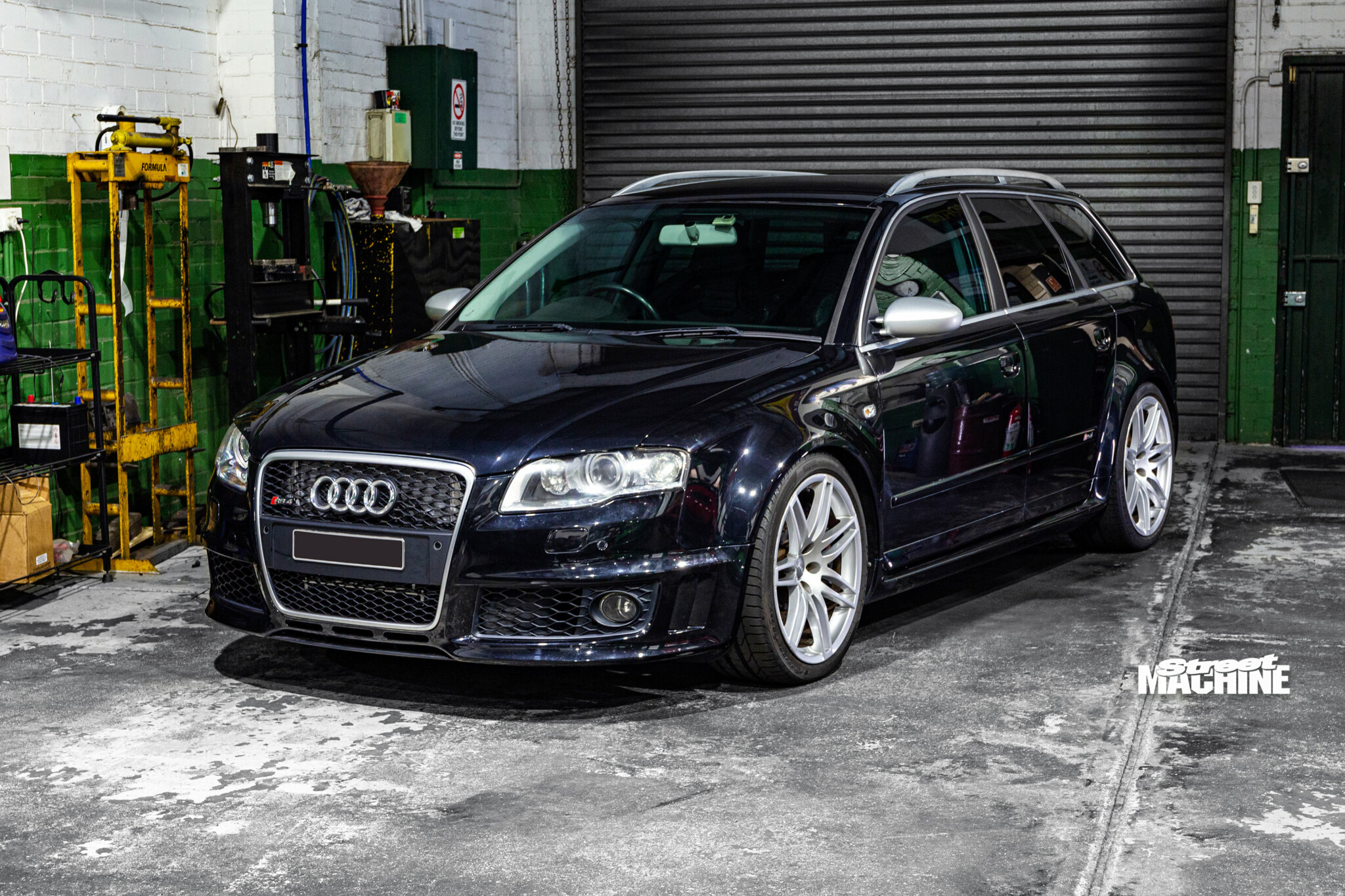
After purchasing it while working in the UK, Dr Dylan Wynne took his V8-powered, all-wheel drive Audi RS4 wagon on a driving tour of Wales, before importing it home to Australia, where he decided to boost its already staunch factory performance to V8 Supercar level and beyond!
First published in the June 2025 issue of Street Machine

“I was fortunate enough to be working for a few years in the UK,” Dylan recalls. “The UK was the cheapest place to buy this car, so I set off with my dad and we spent 10 days hunting for what we wanted in northern England.
“You really need to drive it to understand; it’s an incredible touring wagon, corners on rails, and the sound of the V8 from start-up to 9000rpm is intoxicating,” he enthuses. “I managed to stay long enough in the UK to allow me to export it back to Australia without paying the crazy taxes on the car.”

Dylan’s car is from the last RS4 generation to be offered in V8/manual form only (subsequent gens would switch to V8/auto and then V6/auto only). And what a V8 it is! In factory trim, the aspirated, 4.2-litre quad-cam mill belts out 340hp at 7000rpm, with owners encouraged to take them to a lofty 9000rpm! But as impressive as that is, the newly built, supercharged 4.2-litre that now powers Dylan’s RS4 is good for 633hp at all four wheels on pump unleaded!
“At the time of purchase, the car’s performance was cutting-edge, but 13 years on, I wanted to turn it back into an ultimate driving machine,” Dylan explains. “So, I went and had a chat to Tyson Munro at Autotech Engineering in Sydney and told him I wanted to build something with a bit more punch. I had an open mind about it, but it had to be supercharged, had to drive on pump fuel, and I needed to be able to drive the car anywhere.”

Neither Dylan nor Tyson anticipated the complexities of rebuilding an engine for a European car in Australia, with the bulk of the parts having to be sourced from either Europe or the United States. “It’s not the sort of car we do every day,” Tyson admits. “But we do build and tune, and that’s what the job was. We were pretty excited about further developing what was already an awesome car, built to a very high standard of engineering.”

It wasn’t long before the boys had the engine apart to be rebuilt from the ground up. Audi had done an incredible job to make the 4.2-litre V8 so powerful yet so compact – once all the bolt-ons are removed, the block is only 464mm long and 228mm high! “The inside of these engines is remarkable,” Tyson says. “It’s like opening a Swiss watch, with everything run off chains and shafts; the engineering is next-level.”
Everything from the quad cams to the oil pump, dual mechanical fuel pumps and even air con is run by a chain or shaft drive. In the case of the a/c compressor, it’s shaft-driven off the alternator.

With the factory compression ratio at a hefty 12.5:1, Tyson and the team ordered a new set of custom dished JE pistons and full-custom Saenz I-beam conrods out of the USA, with ARP 2000-Series rod bolts. The stock crank was retained, but as these engines were hand-built, each one has differently graded big-end and main bearing sizings, so once clearances were measured, the team had to order bearings through Audi.
Apart from a port clean-up, the four-valve-per-cylinder heads were left stock and sealed with factory-style, steel-shim head gaskets.

The TTS Performance Rotrex supercharger is a lot like a ProCharger in design, and has been fitted in the valley of the engine. The outlet points upwards, blows through the intercooler bricks and into the billet intake manifold, which is fitted with direct-port injection. The injectors are fed by custom-built dual mechanical pumps, mounted on the rocker covers and cam driven.
In preparation for the increase in power, a full Milltek stainless exhaust system was sourced from the UK, comprising four-into-two-into-one headers with 44mm primaries, followed by dual high-flow catalytic converters running into a dual three-inch system to the rear.

The factory six-speed manual is predicted to get the job done, although the flywheel has been switched to a billet item and the clutch and pressure plate beefed up.
Tuning these engines is no picnic, either. For a start, Audi chose to set the motor up on dual Bosch ECUs – one for each cylinder bank. It sounds crazy, and it certainly poses a challenge for tuners, but it’s said that one ECU could not handle the performance complexities and processing speed required.

So, while these Audi V8s are amazing feats of engineering, Tyson says it was a complicated project to work on, with over 100 hours in labour spent just reassembling the mill. “Dealing with suppliers in the UK was a nightmare,” he says. “The blower kit was promised in eight weeks, but that became six months; there were multiple midnight calls to try and coordinate parts, and there was always an excuse. Thankfully, the blower kit fitted as it should, and apart from some problems with the direct-injection pumps sealing, all the parts were as they were supposed to be.”

In the end, though, the Autotech crew got the job done and then some. Boasting a hefty 633 horses at all four wheels during the run-in period on 98-octane, Dylan’s RS4 is now a land-based rocket ship destined for a lot of twisty backroads in outback NSW and beyond.


“I’ve given Tyson free rein on the car, and the next phase will be to bring the suspension up to a similar standard,” the good doctor says. “With the current set-up, we do have some understeer issues that we intend to get to the bottom of, but as a package, I absolutely love it. I will never sell it and will hand it down to my children.”
Comments