
First published in the January 2008 issue of Street Machine
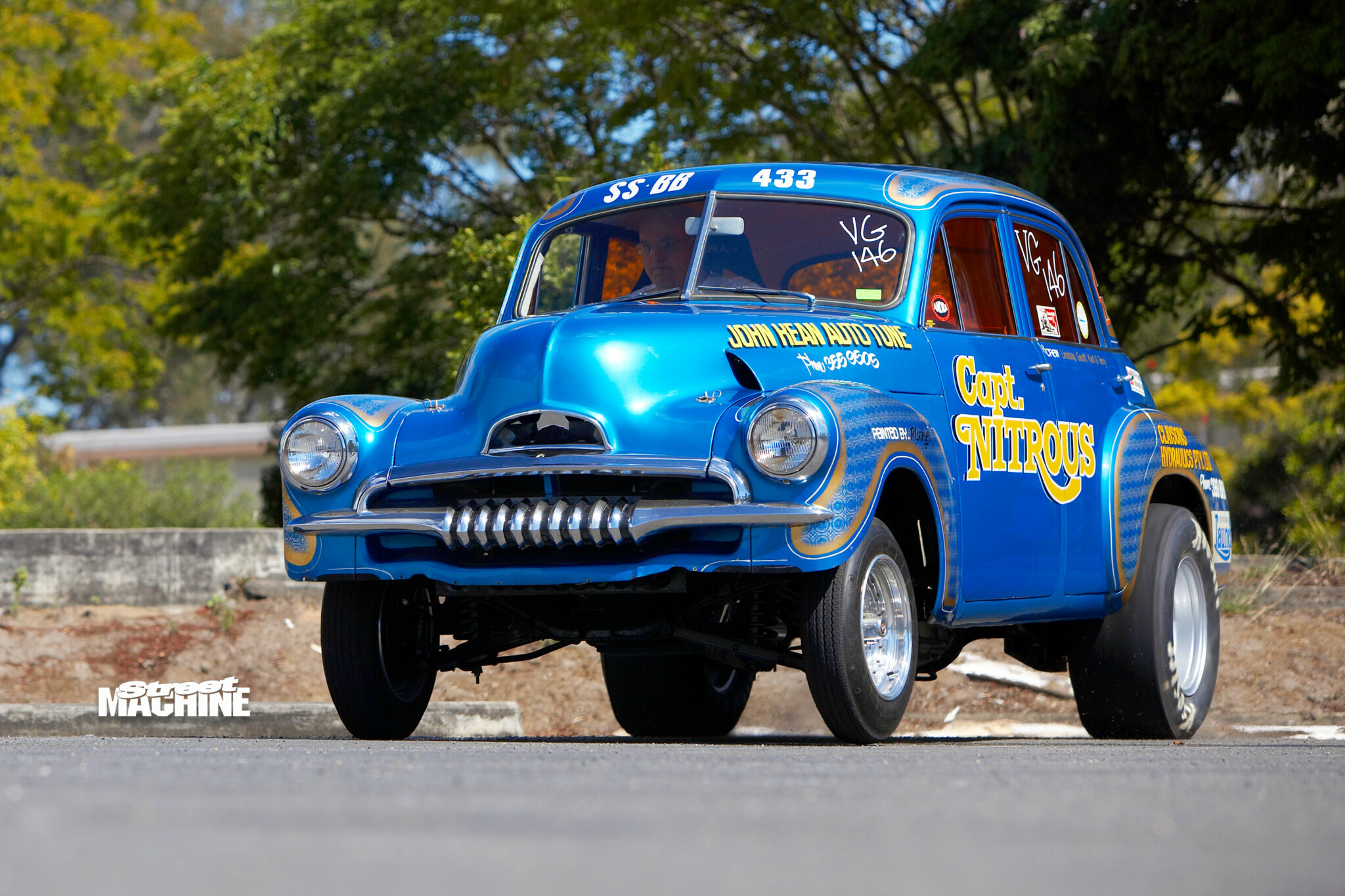
In the early 1980s drag racing enthusiast Bob Hamilton used to drive to work each morning past a blue and silver FJ called Mr Terrific. He knew the car from the drag scene and had a soft spot for classic Holdens. One day he decided he wanted it, so he approached the owner, Rob Sloan, who’d launched its racing career in 1969. Rob had been drafted into the army soon after that and when he finished his national service he married. In 1977 the FJ was retired.

Despite that, Rob refused to sell but Bob persisted, promising to retain the spirit of its creation, and eventually got his way.
Bob bought Mr Terrific minus its motor and gearbox, planning to use the nitrous motor from his street FJ, but Rob soon offered the missing parts and Bob was happy to take them.

“His sideplate reflected the technology in the late 60s but we gave it a go. I swapped the Torana gearbox for an Opel four-speed, and fitted a 100hp nitrous kit to the triple Strombergs.”
The car ran low 14s but the low ratio Opel ’box caused the front wheels to bounce in first and second and he was in top by half track.

Bob also changed ‘Mr Terrific’ to ‘Captain Nitrous’ so subtly that nobody noticed for a while. Otherwise the body remained as it came, in silver lace-detailed Monza Blue, but it’s not the original shell. The first was lost in the early 70s when it blew an oil line, coated the tyres and went sideways into a pole while testing on a quiet street.
“The damage wasn’t too bad but in those days there were heaps of FJ bodies around so it was tossed away for a new shell,” Bob says.
The interior still has its red carpet, black deerhide buckets and buttoned panels on the door trims; Bob was more concerned with mechanical improvements.


The double-diaphragm Holden clutch had plenty of lock-up but it made his leg shake from the pedal effort on the start-line, so he replaced it with a paddle-clutch, using four sintered copper pads.
The 15-inch Globes and small slicks were replaced by steel rims with 29x10x15 Firestone slicks. The Strombergs were swapped for a set of triple 1½in SUs.
“I told (drag racing legend) Ron Richards I wanted to run 12s because everyone said a grey couldn’t do it. He said we’d never do it with our cylinder head, that we’d need 300hp, and while we could punch it in with gas, we couldn’t get it out.

“In 1983 I bought several grey heads for Ron to cut up so we could examine core shifts and see where we could go with it. Ron Harrop and Ron Richards had this idea to use smaller valves closer together and more perpendicular, to mimic a Hemi flow pattern.
“We did about $3500 of work on that head. We blanked the valve guides and redrilled them at the angle we wanted. A sideplate head is full of water jackets and has a dumbbell shaped combustion chamber; we had to put in copper wire O-rings and they ended up looking like a map of Tasmania as they swerved around obstacles. They had to be cut by hand on a pantograph — it took four weekends. We switched from head bolts to studs, and went to 7/16in wheel nuts combined with a copper head gasket to get the sealing needed.”

Bob retained Rob’s home-made roller rockers and the Mallory coil, but the distributor was rebuilt to standard specs (with vacuum advance removed) and locked at about 15 degrees because he didn’t need much advance with the nitrous.
They sorted through a lot of blocks before they found one they could bore to 3¼in. Most would only go to 33⁄16in before breaking through a cylinder wall due to core shifts. They weighed blocks, knowing extra weight meant extra material. The donk finished up at 155 cubes.

“We went through enough cranks to provide letterbox stands for the entire street,” Bob says. “They broke on the journal between five and six when you backed off at the finish. We finished with a standard-weight steel flywheel bolted to a crack-tested standard crank with six V8 bolts and plenty of Loctite.
“We tried every form of harmonic balancer, even a Massey Ferguson tractor piece, before settling for a standard unit with new rubber and a bolt into the end of the crank to unload the keyway. I only went through three blocks but a lot of cranks.”
International truck pushrods were used as they were lighter and larger diameter; Chev grey and white dual springs kept it together at 7000rpm. The Wade cam was driven by a Bosch fibre cam gear — replaced at every rebuild.

In 1984 Bob switched to methanol and tuner John Kean came over with a quarter-inch drill to bore out the SU main jets.
“It sounded totally different, and after recalibrating the nitrous for alcohol, times dropped to 13.2,” Bob says.
The sidey now made 250hp and broke four Opel ’boxes, so Bob went to an Australian four-speed with a standard H-pattern shift.
By the late 80s he’d run 13.007 after lots of tuning but he couldn’t crack that 12. He tried an electronic sequencer for the nitrous, giving the car 50hp off the line, 100hp in third and 150 ponies in top, easing in the power. The car was still wheelstanding but the times tumbled to a tantalisingly close best of 13.001.
In January 1989, at Willowbank, Bob decided enough was enough. He gave the old girl the full 150hp from go to whoa.

“The car exploded off the line. I had to fight it all the way. I thought that if it hadn’t run it, it never would. When I got to the pits the guys were going wild. It’d run 12.98. Apart from a day at Lakeside’s eighth mile in 1994, I haven’t raced it since. It cost me $12,000 to run a 12 but it was worth it.”
Parked behind Bob’s work for the next 18 years, the FJ got the occasional nudge from the forklifts.
“I was going to repaint it and give it to one of my sons as a daily driver but this deputation of racers and pit crew told me that while I might own the car, I was just its caretaker and had no right to change its character. I decided they were right so it sat there until nostalgia racing came along. I had such a ball I decided to drag the FJ out again.”
He parked the grey motor and went to a new gas-assisted 199ci Holden six combo, disguised to look like a sideplate and using some trick pieces developed by Ron Richards in the mid-80s.

It’s taken a bit of effort by Karl Zerner and John Koolbanis to put the new-old engine together and make it work and they’re looking for 400hp. But if it runs a 12, Hamilton reckons it’ll be by accident.
“These days it’s all about having fun and putting on a show. If that’s what we do, Captain Nitrous will be back in the spotlight where it belongs.”
GASSED UP
Nitrous has played a big part in Bob’s life. As a chemist he’d begun mucking about with the gas in 1968, when few understood it for vehicular use.
“Some people claim I just pulled an American unit apart and copied it,” Bob says, “but I worked this all out myself long before the Yankee kits were around.”

He started Precision Nitrous and handled the giggle gas needs of a number of record-holding racers as well as the GM diesel-powered Bandag Bullet in the 1980s. He even developed a unique combo of carbon dioxide and nitrous that produces more power with less nitrous!
His chemical skills were also applied to the development of Launch Traction Compound, to save having to ‘rev the ring out’ of the FJ before each run.
These days Hamilton’s business ventures have expanded much further and fund seven nostalgia racers/street cruisers, including a Hemi-powered ’57 DeSoto Fireflyte two-door, several early XY Fords with more than 650hp each, and some quality German iron. He still has his original two-tone blue FJ streeter, featured in SM, Dec 2004, complete with a 400hp six-pot from a BMW M3!
BOB HAMILTON
1955 FJ SEDAN
| Colour: | Monza Blue, silver lace/gold borders |
| ENGINE | |
| Type: | 199ci Holden six |
| Carbs: | Triple 2in SUs |
| Head: | Ron Richards |
| Camshaft: | 260 @ 0.050, roller |
| Pistons: | JE forged |
| Crank: | Standard |
| Fuel pump: | Holley Black |
| Exhaust: | Custom |
| Ignition: | Standard dizzy, Bosch coil |
| Nitrous: | Owner built |
| TRANSMISSION | |
| Gearbox: | Holden four-speed |
| Clutch: | Button clutch |
| Diff: | Nine-inch, Moser axles |
| SUSPENSION & BRAKES | |
| Springs: | Standard |
| Steering: | Standard |
| Brakes: | Standard (f), Ford drums (r) |
| INTERIOR | |
| Tiller: | Wood rim |
| Trim: | Cobra bucket |
| Instruments: | Oil & fuel pressure |
| Shifter: | H-pattern |
| WHEELS & TYRES | |
| Wheels: | Alloy 14in (f), steel 15in (r) |
| Tyres: | 5.20 x14 (f), Hoosier 29×10 (r) |
THANKS
My wife, Terri, for sharing my passion for fast cars, and tolerating the time and money it takes. My long-serving pit crew Lindsay Wilson, Geoff Park, newcomer Karl Zerner, plus motoring brains trust John Kean, Ron Richards and Steve Jeffs. And Rob ‘Mr Terrific’ Sloan for letting me share in the honour of caretaking a piece of drag racing history.
Comments