
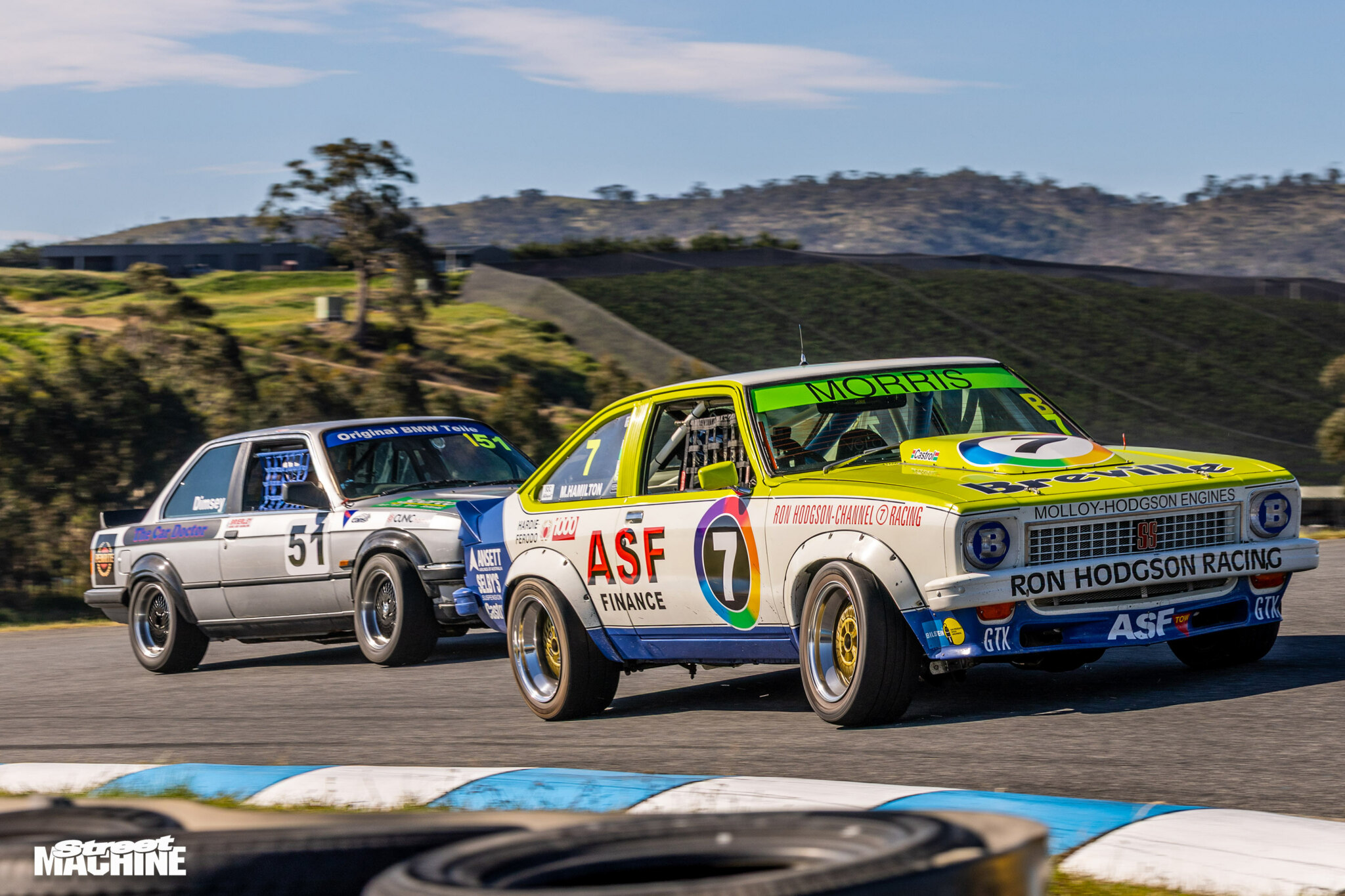
The recent Baskerville Historics meeting felt like a trip back in time. For a fleeting moment, it could have been 1960 rather than 2025. Picture the scene: a sea of spectators on the hill looking down on a 25-car field of FX and FJ Holdens, along with a couple of those new-fangled FC and FE models. The cars are lined up proudly on the grid, ready to tackle Tassie’s Baskerville circuit. But as the flag drops and they blast off, this fantasy is shattered by the sound of a couple of roaring V8s. Imposters! These two dream-killing V8-powered humpies tear away from the pack and up through Turn One, but any indignation is short-lived, as the rest of the field flies by, delivering the soothing sounds of traditional six-cylinder grey motors, with the odd rogue red motor upgrade.
First published in the March 2026 issue of Street Machine

A record 210 entries came to party at Baskerville 2025, 70 of those coming from the mainland. Add to that the 5000-odd spectators keen to check out the action, and you’ve got an above-average weekend by any standard.

Baskerville Raceway holds a special place in Touring Car legend John Bowe’s heart. He first went there with his dad when he was a boy sometime in the early 60s, and his first time racing there was in an Elfin Formula Vee in the early 70s. He reckons he was so nervous that he felt sick!

John was running the Frank Arronis-owned Elfin 600D (pictured above) at Baskerville ’25, originally raced by Elfin Sports Cars founder Garrie Cooper. Garrie was a huge help in John’s racing career – running cars for him, building engines, and supporting him through the formative years – so he was honoured that Frank asked him to drive the 600D.
Another notable Tasmanian-born entrant who was raised around local motorsport was Todd Willing, who is now Head of Design at Ford in Dearborn, Michigan. Todd made the trek back to Baskerville to link up with his brother, Steven, and pay homage to their late father, Brent, a lifelong racer who worked as an official at Baskerville events in the 70s. Todd showed he’s no slouch behind the wheel of his 1977 March 772, as he clocked the fastest lap of the weekend and won all four of his races, while Steven piloted a 1978 March 793.


Other stand-outs included Tony Ross’s pace-setting FX (pictured above). It’s running a mid-mounted 350 Chev, with the driver’s seat situated near where the back seat would be, squeezed beside an enormous engine cover. Every panel except the roof is removable. Fully souped-up for racing duties, it’s little wonder this FX silhouette was streets ahead of the rest.


Among the more traditional early Holdens, many had the Phil Irving-developed Repco Hi-Power crossflow heads, with a variety of carburettor combinations, and most were still running three-speed transmissions.

There were more open-wheelers at Baskerville than ever. Group O racers from 1966-69 featured multiple examples of Elfins, Brabhams and Lotuses. The oldest car was the 1948 George Reed Special ‘Monoskate’, with a fully open cockpit, a bicycle chain-operated clutch linkage, and a gearstick bent between the driver’s legs. Running a flathead V8, the car sounded amazing as driver Graeme Raper cut laps at speeds that left you wondering how.

Tasmania is the birthplace of HQ Holden racing, so it was fitting that they should be on the program. The small field of Queys put on a solid display of close racing, with very little paint exchanged. Phil Ashlin pipped Andrew Toth in all four races, but the gap in each race was rarely more than a second.

Not all events on the program were races. There were also ‘spirited demonstrations’ featuring some legendary machinery, including a one-of-two NZ-built Begg FM2 Formula 5000 (pictured above); a freshly restored, multi-time Australian championship-winning 1987 Toyota Supra; and a Ralt RT4 that Formula One ace Nelson Piquet drove to second place in the 1981 Australian Grand Prix.

Some competitors were experiencing Baskerville for the first time, including many out-of-towners like Luke Warwick from Victoria. Driving his McLaren M1A (pictured above), Luke said he couldn’t believe how good the track was, and that he’d be there every weekend if he could.
Mike Ellis, of race organisers the Baskerville Foundation, reckoned the Baskerville Historics was bucking a national trend of lower participation in historic racing events. One of the keys to that success is the welcoming atmosphere the Foundation provides, which permeates down to all attendees. The pits are full of families. No garage is off limits. Drivers encourage kids to sit in their race cars and have Mum or Dad take pics for their Insta feeds. It’s just a good, wholesome time at the race track.

The Baskerville Foundation is aiming to raise the bar every year. Mike Ellis would love to see some of the period clothing seen at the Goodwood Revival make an appearance in coming years, and he has explored the prospect of a Tiger Moth landing on the back straight. One upgrade already announced for the 2026 Historics is the addition of Group A and C Heritage Touring Cars. Fittingly, Baskerville was the location of the very last Group C-era race, in November 1984.
For an event intended to celebrate the past, Baskerville has a bright future indeed.

Baskerville Back Story
Opened in 1958, Baskerville Raceway is our oldest continuously operating racing circuit. Located 25 minutes from Hobart, it’s set within a natural amphitheatre, allowing spectators to park on the hillside and view the entire track. John Bowe describes it as “Australia’s hidden gem”.
The land was originally leased to the Hobart Sporting Car Club (HSCC) by local motoring tragic Calvin Morrisby for basically pocket change – a shilling a year. Calvin passed away in the early 80s, and the HSCC ultimately took control.
Early meetings were mostly local affairs, but by the late 70s, the track was hosting national championship rounds, and even a Formula 5000 race. By the 2000s, the track needed love, and the Baskerville Foundation – launched in 2013 – delivered. Thanks to more than two million dollars raised, the circuit scored a resurface in 2017, plus major drainage, tower, electrical, and pit upgrades. Today, Baskerville looks better than ever.
HIGHLIGHTS:

1: Tony Ross’s FX Holden is one of the coolest vintage Sports Sedans around. A celebrated street machiner whose white FC Holden (SM, Aug ’22) won Top Street Machine at the first Street Machine Nationals in 1975, Tony bought the FX from builder Dave Ferrall in 1977 and raced it until 1993. It then sat for two decades before it was sold to Simon Pfitzner, who restored it and now allows Tony to race it at various events.


2: Ben Creed showed off the superb resto job he did on Kerry Baily’s old ’87 Supra, which won three Australian Sports Sedan titles with Kerry at the wheel. Ben, who bought the car in 2020, rebuilt it with a Chevy SB2.2 NASCAR engine, Holinger six-speed sequential ’box, and independent 9in rear. While Baskerville was the rejuvenated Supra’s first outing, its lap times were not far off the record set by Kerry in the 90s.


3: Among the incredible vintage machinery at Baskerville was the first Formula 5000 ever built in New Zealand, the 1969 Begg FM2. Chassis #001 of two, it was built by George Begg, who had worked in the UK with fellow Kiwis Bruce McLaren and Fred McClean. Current owner Lachlan Thomas purchased it three years ago and engaged David Crabtree to get it back into tip-top shape.


4: Luke Warwick’s 1964 McLaren M1A is an international superstar. Chassis #013 of 24, it was delivered to South Africa, where driver Bob Olthoff raced it to wins in the 1966 and ’67 Sports Car Championships, and set a national land speed record of 295km/h. In the early 80s, the car was shipped back to the UK, where it was restored. Luke’s dad, Max, brought it Down Under in ’84. Running a 289ci Ford with period-correct downdraught Webers, the car’s power-to-weight is off the charts – a 600kg package with 420hp underfoot!

2: Derek Quin’s 1955 Ford Customline didn’t turn a wheel in anger all weekend, but it still drew large crowds. First campaigned by Ray Allford, it was bought by Derek’s dad, Neville, in 1966. He raced it until 1973, when he blew it up and sold it. Derek rediscovered the car 40 years later and spent five years restoring it with a 292ci Y-block and triple Stromberg 97s. Neville got the chance to run it around Symmons last year, but he sadly passed away before Baskerville


3: Mark Goldsmith’s 1966 Elfin 400 runs a 289ci Ford Cobra engine that’s been massaged to 5.0L and accessorised with a Shelby Cobra manifold and four Weber 48 IDAs. Mark first fell in love with the 400 as a 14-year-old volunteer flag marshal at Mallala. Many years later, he tracked the car down and had it taken back to South Australia for a full resto


4: At 83 years young, Graeme Springer reckons his 1954 FJ is a lot faster than him! Packing a blown Holden 202 with a five-speed Tremec gearbox and four-link rear with Torsen diff, Graeme runs it in regularity events, but the car is built to Sports Sedan specs and goes a fair bit quicker in his son’s hands. It was in the build for a few years, and judging by the smile on Graeme’s face, it was well worth the toil

1: Before becoming a tin-top titan, John Bowe cut his teeth in open-wheelers, and most of these were Elfin Sports Cars out of South Australia. Baskerville saw JB reconnecting with these roots in an Elfin 600D. The car was originally raced by Elfin founder Garrie Cooper in both Australia and South-East Asia in 1970. Rocking a 2.5L, 295hp Repco Brabham V8, it still cut very quick laps in JB’s hands


1: Peter Fitzpatrick bought this 1963 Le Chalutier ‘homemade’ racer as a wreck and faithfully restored it over many years. The driveline consists of a 292ci Ford Y-block connected to a Citroën DS 19 four-speed transaxle, which caught us by surprise. As did the sweet sound of the unmufflered long-tube headers going up the hill at full noise with Peter’s son, Alan, at the wheel


2: Built by John McCormack and raced by Bruce Gowans, this 1977 Toyota Celica finished third in the 1978 Australian Sports Sedan Championship. Bruce sold it in 1981, and it bounced around between various owners before he tracked it down again in 2007 and began a nine-year restoration. Powered by a 5.0L Repco V8 coupled to a Hewland five-speed and LSD, it was piloted at Baskerville by Bruce’s son Adam in the spirited demonstration events


3: This ’76 Gemini was built as a potential replacement for Peter Brock’s HDT ‘Beast’ Torana, but that plan never came to fruition. Current owner John Douglas kept tabs on the Gem’s whereabouts, and when it came on the market nine years ago, he nabbed it. While originally designed to have a V8 fitted, it currently runs a 13B rotary turbo coupled to a Holinger H6S, and is still lightning quick. John doubled up for the weekend, racing his FJ as well.

Comments