
First published in Street Machine’s Australia’s Toughest Fords #2, 2004
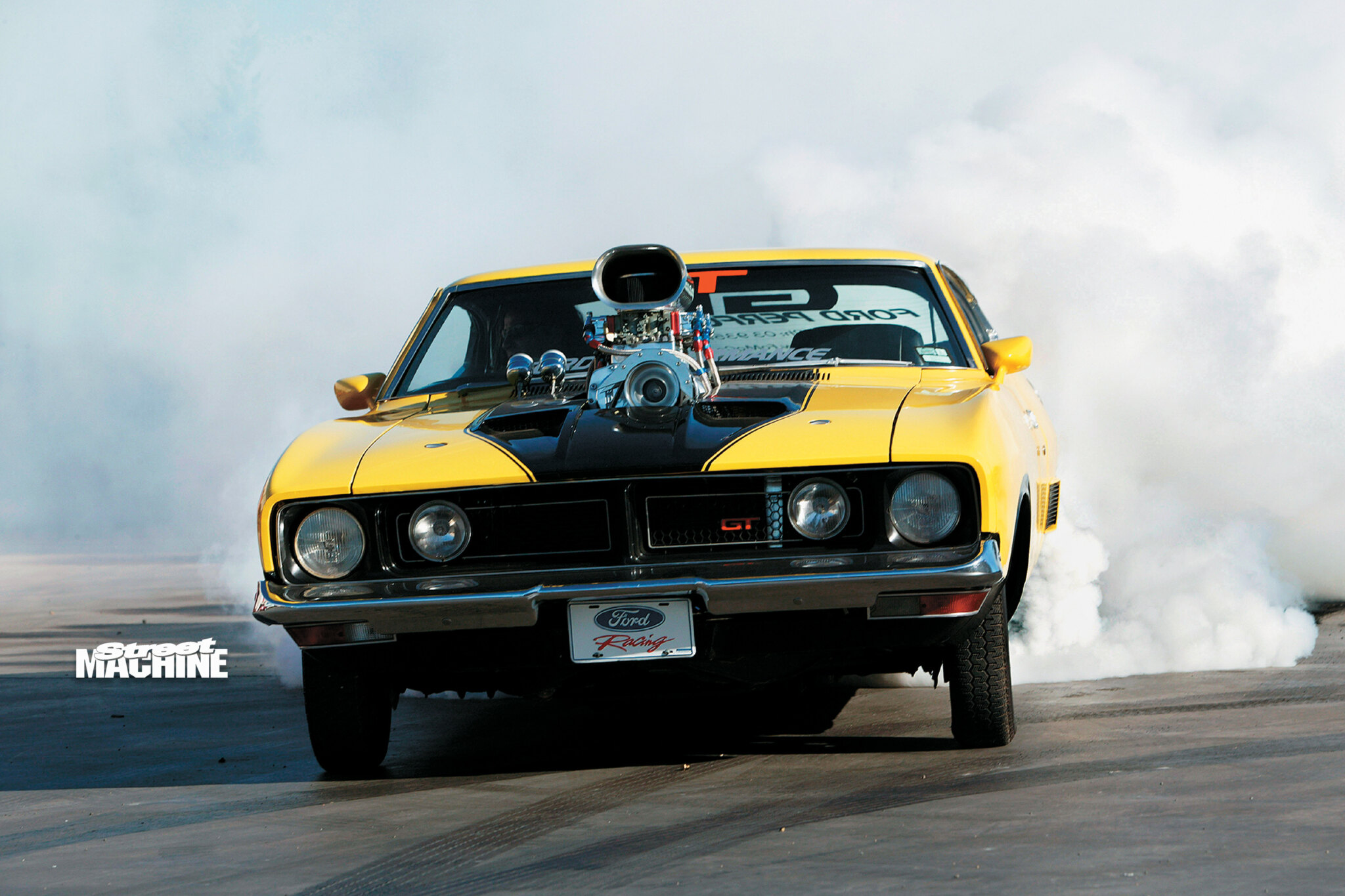
Some fellas get too bloody precious about things. Yeah, sure, this is a genuine XB GT coupe, and yes, there’s a fair dinkum monster of a mill towering through the bonnet and 12 inches of rubber under the rear haunches, but who said you can’t do that to a GT? Is that any reason to go apoplectic? It was all the excuse one bloke needed when he knotted his knickers and abused the hell out of Danny Musso at a show.

Danny loves his Ford and wasn’t going to take any crap about it. He stood his ground and gave it all back to the guy. So what if there’s a 700hp blown engine in there? So what if there’s an XY GT diff under the back to provide adequate elbow room for the fat meats? So what if the front wheels are skinnier than Paris Hilton on a diet? All of it can be undone. The original, matching-numbers engine can go back in. There are no tubs. The paint’s the proper Blaze Yellow – with satin black accents – just like it was when it left the factory.

Nothing has been molested. But the fun factor’s been given a swift kick up the bum and a dose of avgas to really wake things up. In short, Danny’s done a killer resto, with a respectful nod towards originality and a cheeky wink at street machining’s excessive side. And he loves it!

“It’ll peel the tyres off, right through second, third, fourth, so that’s good,” Danny says with a smile. “You leave black marks all the way down the road. That’s what makes it fun. That’s all I’ve been doing with it.”
The engine is one of those gems that’s been put together from the best of two already tough donks. The coupe came with a NASCAR-type Clevo on which someone had spent a lot of money, and Danny already had a blown Cleveland that Gary Myers built for his old LTD.

“I had all the good gear,” says Danny. “I ended up making the one good engine out of the two, and I’ve got a lot of NASCAR parts and Yates heads sitting there for another Cleveland.”
The list of good gear is impressive, but getting it all to come together – and stay together – was an even more impressive effort on the part of Sandy ‘Doggy’ Graham.

“We had to get the oiling system right,” says Sandy. “We had to drill the block out, and the oil galleries had to be tapped and have restrictors put in, but then the restrictors had to be drilled out to certain sizes, too.” He got the info from a machine shop in America, which he reckons knows how to get Clevelands working.
“I think that’s half the reason it’s held together,” he adds. “It’s got one of those bottom-end girdles which helps hold it together, too. That was a prick to fit because it didn’t clear any of the Eagle rods or anything. Nothing cleared. It took ages. There was a bit of messing around involved there.”

Eventually he got it finished, fitted with top and bottom Sterling girdles and a full set of ARP studs. The 4MAB crank is nitrided and carries Eagle H-beam rods topped with Ross Racing forged pistons with a huge 10:1 compression ratio – in a blown motor! The blower’s pushing in 12 pounds of boost, so we’re talking total compression of 18.2:1.
“I don’t know how the heads hold onto it, but they do,” Sandy says. “Danny gives it a hiding. It seems to hold on, but I don’t know how.”

“It should be on methanol, really,” admits Danny, “or NASCAR fuel, but that costs about $700 or $800 a drum. So far I haven’t had any drama. I make sure the fuel’s all right.” Avgas with octane booster might sound extreme, but it does the job nicely.
Clevite H-series bearings help reliability, as do the Mellings HV oil pump and a beaut cooling system that starts with the biggest Aussie Desert Coolers aluminium radiator that Norm Hardinge makes. It’s backed up by a Meziere billet water pump, twin thermos and Dash 20 Earls fittings and hoses, so nothing will ever let go.

The tower of power starts with a pair of 850 HP Holleys with Barry Grant four-port regulator, eight speed-flow fittings and two Mallory pumps to handle a thirst for fuel that’d keep a Middle Eastern oil well busy full time. All this sits on a BDS blower from the States. For a manifold, the guys modified a Weiand tunnel ram, while the 4V heads have bigger than stock (2.250 inches) Manley Severe Duty stainless valves. The screw-in studs, guide plates and Yella Terra billet rockers add strength and reliability. The solid Crane cam is the same one Myers fitted to the first blown engine, and Danny says it’s similar to Gary’s own. Inlet duration and lift are 292 degrees and 0.542 inches respectively, and exhaust 298 degrees and 0.552 inches – nothing radical, but beaut for a blower.

“It makes good horsepower down low,” says Danny. “I’ll spin it up to, say, 7500rpm and it’ll hold that all day, but the thing makes horsepower down low, too, because of the blown side of it. You stand on it and away it goes.

“The main thing that slows it down is the exhaust – trying to keep it quiet enough and still making power. That’s the hardest thing with it. It makes a big difference when you dump the pipes.” Drop the pair of Flowmaster mufflers and the engine’s blowing through a virtual wind tunnel: two-inch Pacemaker primaries, four-inch four-into-one collectors and three-inch pipes.

“The top-loader gearbox is a fine-spline, long-extension-housing Phase III piece – the best you can get,” says Danny. “I replaced the factory shifter with a Renegade sequential type to improve things, but it’s still not the easiest thing to flat-change. With the Centre Force clutch you’ve gotta use your leg to push it in, so it’s a pretty hard thing to use.”

He’s building a trans-braked Powerglide instead, a much better option for when he hits the track with the XB. “Because the motor makes nearly 750ft/lb of torque, I’ve got no need for a three-speed gearbox. It’s got enough power to pull through a Powerglide, and two gears are easier than three. That seems to be the way to go with drag racing.”

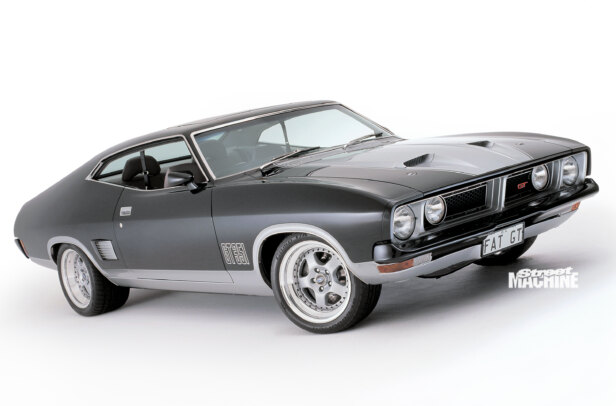
If the angry GT purist mentioned earlier had seen the car before Danny got hold of it, he’d probably have given Danny a handshake instead of an ear-bashing.
“It looked like a real shitbox,” says Danny. “The bloke I bought it off had a hell of a lot of money but not a care in the world. He spent probably 28 grand on the engine and the car was sitting under a tree, covered in shit with the windows open. He just couldn’t give a shit. It’s lucky that it came to me or it’d probably still be sittin’ there now.”

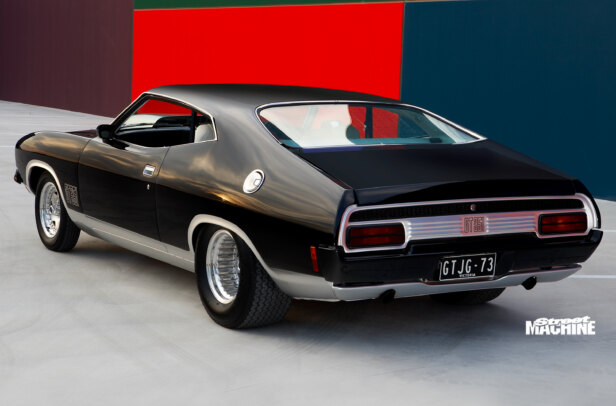
Classic Panels repaired a heap of metal – like the boot corners and behind the rear screen. “That corner for the boot must be a hard thing to make, but it was a perfect fit,” says Danny, who then tarted up the stock interior and had the GT painted in its factory colours despite not being much of a fan of yellow.
One day the coupe will probably go back to fully original, but next up comes some drag racing. Heathcote’s just an hour down the road from Danny’s place.

“The power it’s got and the way it pulls, it’s easily going to be a 10-second car,” he says. “I reckon you’d end up getting a high nine out of it in the end. It’s really got some stick. You can be doing 80-90 kays, and you stand on it and it wants to turn itself around. It’s good fun.”
Just don’t ask Danny how much fun is enough or you might be shocked. “I’ve got a carbon-fibre injector hat,” he says, “and I’ll run it on alcohol then and get even more out of it.”
Struth, what’ll the purists say then?

Crank the monkey
Cleveland engines have a weakness when it comes to superchargers: the crankshaft pulley sits way out front, well ahead of any bearings. This makes the leverage and stresses generated by the blower drive quite extreme. People break cranks all the time because of this. The crank snout needs bracing or support of some kind – something to stop them fatiguing. Danny’s engine uses a harmonic balancer instead of the more common crank hub, and so far it’s proved to be a good choice.

“A lot of people use a crank hub, which I don’t like,” says Danny. “I know a couple of mates who’ve broken the front off the crank. Actually, I know about three or four of them. I just run a GT Boss balancer and its pulley onto it, and I’ve never had a problem.
“With a crank hub type set-up, they have a counterweight instead of a harmonic balancer, and it pushes the counterweight out further than the balancer normally sits. I think that set-up on the front of the crank must overload the crank and eventually it fatigues. But I think a Boss balancer eliminates it totally.
“Down the track, if I switch to methanol, I’ll put a crank support on it.”

DANNY MUSSO
1974 XB GT
| Colour: | Spartan Blaze Yellow with black accents |
| TOWERING INFERNO | |
| Engine: | 351 Cleveland |
| Blower: | BDS Stage II billet-rotor 6/71 |
| Carbs: | 2 x 850 HP Holleys |
| Manifold: | Modified Weiand |
| GEAR GRINDER | |
| Gearbox: | Phase III bullnose top loader |
| Clutch: | 11-inch Centre Force |
| Driveshaft: | Custom chrome-moly |
| Diff: | XY GT, 4.11:1, mini spool |
| ROCK ’N’ ROLLERS | |
| Suspension: | Mainly Pedders; factory tramp rods (r) |
| Brakes: | DBA discs, PBR alloy calipers (f), XY GT drums (r), PBR master cylinder |
| PRIME POSITION | |
| Seats, trim: | Stock |
| Shifter: | Renegade |
| Gauges: | Auto Meter |
| ROLLIN’ STOCK | |
| Wheels: | Weld Draglite, 15×3.5 (f), 15×10 (r) |
| Tyres: | Michelin 165/65/15 (f), BF Goodrich 295/50/15 (r) |
THANKS
Sandy ‘Doggy’ Graham; Steve Pronga for paint and panel; GT Ford Performance; Jack and Scott Nind at Intercontinental Spares.
Comments